
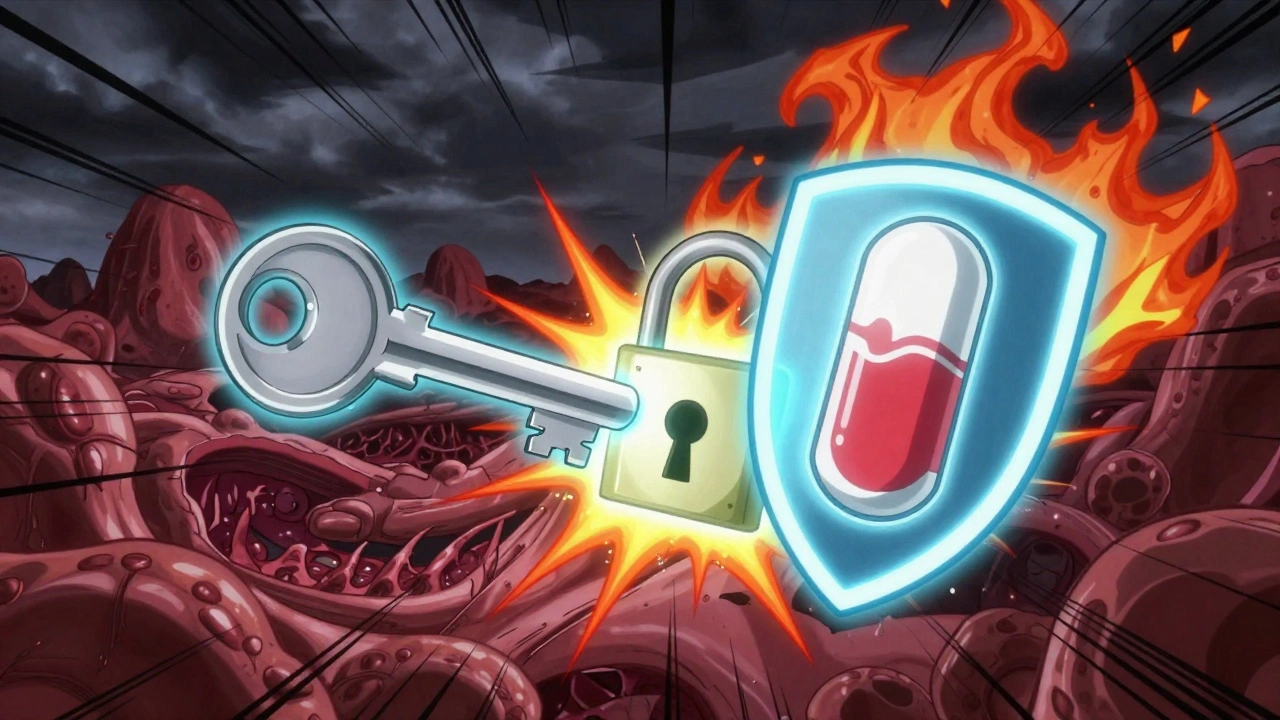
When you take two drugs at the same time, they don’t just sit in your body doing their own thing. Sometimes, they talk to each other-sometimes helpfully, sometimes dangerously. This isn’t about one drug changing how the other is absorbed or broken down. That’s pharmacokinetics. This is about what happens at the receptor level, where the drugs actually do their work. This is pharmacodynamic interaction: when one drug changes how another drug works, even if their concentrations stay exactly the same.
How Drugs Talk at the Receptor Level
Every drug has a target-usually a receptor on a cell. Think of it like a lock and key. The drug (the key) turns the receptor (the lock) to trigger a response. When two drugs go after the same lock, things get complicated.Take albuterol and propranolol. Albuterol opens up airways by activating beta-2 receptors in the lungs. Propranolol blocks those same receptors to slow the heart. If you take both, propranolol can completely block albuterol’s effect. No matter how much albuterol you take, if propranolol is present in enough quantity, your asthma inhaler won’t work. This isn’t because propranolol lowers albuterol’s concentration. It’s because it’s standing in the way at the receptor. This is competitive antagonism.
It’s not always direct competition. Sometimes, drugs work on different receptors but end up canceling each other out. NSAIDs like ibuprofen reduce inflammation by blocking prostaglandins. But prostaglandins also help keep blood flowing to the kidneys. When you take ibuprofen with an ACE inhibitor like lisinopril, you’re not just reducing pain-you’re also cutting kidney blood flow by up to 25%. The ACE inhibitor tries to lower blood pressure by relaxing blood vessels. Ibuprofen fights that by making the kidneys hold onto salt and water. The result? Blood pressure doesn’t drop like it should. This is physiological antagonism.
When Drugs Team Up
Not all pharmacodynamic interactions are bad. Some are designed to be powerful. Trimethoprim and sulfamethoxazole (Bactrim) work together to shut down bacterial folic acid production at two different steps. Alone, each drug needs a high dose. Together, they’re more effective at lower doses-reducing the needed amount by 75% in lab studies. This is synergy.Another example? Naltrexone and antidepressants. Low-dose naltrexone, originally used for opioid addiction, has been found in small trials to boost the effect of antidepressants in people who didn’t respond to either alone. In one 12-week study, 68% of patients with treatment-resistant depression improved when the two were combined, compared to 42% on antidepressants alone. This isn’t just additive-it’s multiplicative.

The Most Dangerous Combinations
Some drug pairs are ticking time bombs. The most feared? Serotonin syndrome.SSRIs like sertraline and SNRIs like venlafaxine increase serotonin in the brain. MAOIs like phenelzine stop serotonin from breaking down. Put them together, and serotonin floods the system. Symptoms: high fever, rapid heart rate, confusion, muscle rigidity. A 2021 meta-analysis found this combination increases serotonin syndrome risk by 24 times. It’s not rare-hospital pharmacists report near-fatal cases almost every year.
Then there’s opioids and naloxone. Naloxone reverses opioid overdoses by kicking opioids off their receptors. But if someone is physically dependent on opioids and gets naloxone accidentally-say, during surgery-their body goes into full withdrawal within minutes: vomiting, shaking, panic. It’s not a side effect. It’s a direct pharmacodynamic battle.
Anticoagulants and antiplatelets are another big one. Warfarin thins blood by blocking clotting factors. Aspirin stops platelets from clumping. Together, they can cause bleeding that won’t stop. A 2022 survey of 1,247 doctors found 38% had seen this combination cause serious bleeding in patients.
Why These Interactions Are Hard to Catch
Pharmacokinetic interactions are easier to predict. If a drug blocks liver enzymes, you can measure the blood level of the other drug and adjust the dose. But pharmacodynamic interactions? They don’t show up in blood tests.You can’t measure “how much serotonin is too much” in real time. You can’t check a lab value to see if propranolol is blocking albuterol’s effect. You have to know the mechanism. That’s why 22% of dangerous pharmacodynamic interactions are missed by electronic alerts. The software sees two drugs and says “possible interaction,” but doesn’t know if it’s a harmless additive effect or a life-threatening antagonism.
And it gets worse with age. The average person over 65 takes 4.8 prescription drugs. That’s a lot of potential conversations between drugs. A 2019 NIH study found that 83% of life-threatening pharmacodynamic interactions involved at least one drug with a therapeutic index below 3.0. That means the difference between a helpful dose and a toxic one is tiny. A little extra effect? Could kill you.
How to Stay Safe
There’s no app that catches every interaction. But there are steps you can take:- Know your narrow therapeutic index drugs. These include warfarin, digoxin, lithium, and some seizure meds. Even small changes in effect can be dangerous.
- Ask about receptor targets. If your doctor prescribes a beta-blocker and you’re on an asthma inhaler, ask: “Is this going to block my inhaler?”
- Use trusted databases. The University of Liverpool’s HIV Drug Interactions database is used weekly by infectious disease specialists. It’s not just for HIV-it’s one of the most accurate public resources available.
- Get a pharmacist review. A 2021 review in BMJ Quality & Safety showed pharmacist-led medication reviews cut adverse events from pharmacodynamic interactions by 58% in older adults. That’s not a small number.
Doctors aren’t expected to memorize all 1,842 known pharmacodynamic interactions. But they should know the big ones: serotonin syndrome, opioid withdrawal, NSAID-ACE inhibitor clashes, and anticoagulant combinations. The CICM Primary exams require candidates to name at least five examples of each type-because getting this wrong can kill.
What’s Changing
The FDA now requires pharmacodynamic interaction studies for all new CNS drugs. The European Medicines Agency says 34% of new drug applications include these tests-up from 19% in 2015. Researchers are building machine learning models that predict serotonin syndrome risk with 89% accuracy, using data from hundreds of patient regimens.The NHS is piloting a system that flags dangerous combinations in real time as doctors write prescriptions. It’s not perfect yet. But it’s a step toward moving from reaction to prevention.
For now, the best tool you have is awareness. If you’re on multiple meds, especially for chronic conditions, ask your pharmacist: “Are any of these drugs working against each other-or making each other too strong?”
It’s not about avoiding all combinations. It’s about knowing which ones are safe, which are risky, and which could be life-saving when used right.
What’s the difference between pharmacodynamic and pharmacokinetic drug interactions?
Pharmacokinetic interactions change how your body absorbs, breaks down, or gets rid of a drug-like when grapefruit juice blocks liver enzymes and makes a statin build up in your blood. Pharmacodynamic interactions happen at the target site-like when one drug blocks another from binding to a receptor. The drug levels stay the same, but the effect changes.
Can pharmacodynamic interactions be helpful?
Yes. Some drug combinations are designed to work together. Trimethoprim and sulfamethoxazole block bacterial folic acid production at two different steps, making them more effective together than alone. Low-dose naltrexone combined with antidepressants has helped patients with treatment-resistant depression when neither drug worked alone.
Which drug combinations are most dangerous?
The most dangerous include SSRIs or SNRIs with MAOIs (risk of serotonin syndrome), opioids with naloxone (can trigger withdrawal), and anticoagulants like warfarin with antiplatelets like aspirin (high bleeding risk). NSAIDs like ibuprofen can also cancel out the blood pressure-lowering effect of ACE inhibitors.
Why are pharmacodynamic interactions harder to detect than pharmacokinetic ones?
Blood tests show drug concentrations, but they don’t show how drugs are interacting at receptors. You can’t measure serotonin levels in real time to predict serotonin syndrome. That’s why clinical decision tools often miss these interactions-they rely on algorithms that don’t fully understand biological pathways.
How can I protect myself from harmful drug interactions?
Always tell your doctor and pharmacist about every medication you take, including over-the-counter drugs and supplements. Ask if any of your drugs work against each other or make each other too strong. If you’re on multiple meds-especially if you’re over 65-request a pharmacist-led medication review. It’s one of the most effective ways to catch dangerous combinations.

Aileen Ferris
December 11 2025so like... albuterol and propranolol? lol wtf why would anyone even prescribe both?? my cousin took both and ended up in the er. they said 'it's fine' and then she couldn't breathe. like. wtf.
Nikki Smellie
December 11 2025This is precisely why the pharmaceutical-industrial complex wants you confused. The FDA, the AMA, the WHO-they all profit from polypharmacy. They don’t want you to know that 78% of these 'interactions' are avoidable if you just stopped taking synthetic drugs altogether. Natural remedies don’t have 'receptor-level conflicts'-because they don’t interfere with your body’s innate wisdom. I’ve cured my hypertension with turmeric and sunlight. Ask your pharmacist if they’ve ever read Hippocrates.
David Palmer
December 13 2025bro i had this happen with my anxiety med and my ibuprofen. i thought i was just getting sicker but turns out my bp was just skyrocketing because the ibuprofen was fighting my ace inhibitor. i didn't even know that was a thing. now i just take tylenol and pray.
Doris Lee
December 13 2025This is such an important topic! So many people don’t realize how powerful these interactions can be. Just knowing the basics-like how NSAIDs and blood pressure meds can clash-can literally save your life. You’re doing great work breaking this down in plain language. Keep going!
Michaux Hyatt
December 14 2025One thing people overlook is that synergy isn't just about drugs-it's also about timing. Taking Bactrim with food can reduce GI upset without affecting synergy. And for serotonin syndrome? It's not just SSRIs + MAOIs. Even St. John’s Wort + an SSRI can trigger it. Always check with a pharmacist before adding any supplement.
Raj Rsvpraj
December 16 2025In India, we have been managing polypharmacy since the 1970s-without your fancy FDA algorithms. We use Ayurvedic principles to balance drug effects, and our mortality rates from interactions are lower than yours. Your ‘narrow therapeutic index’ is a Western obsession. We don’t need machines to tell us what our ancestors knew: moderation, timing, and respect for the body. Your system is broken.
Neelam Kumari
December 16 2025Oh wow. So you’re telling me that people actually take two drugs that cancel each other out? And they wonder why they’re not getting better? I mean… I’m not surprised. Most doctors can’t even spell ‘pharmacodynamic’ correctly. But hey, at least the pharmaceutical reps get their bonuses.
Stephanie Maillet
December 18 2025It’s fascinating how we’ve built entire medical systems around measuring quantities-blood levels, enzyme activity, half-lives-while ignoring the qualitative, almost poetic dance of molecules at the receptor level. What if drugs aren’t just keys and locks… but conversations? Some are whispers, some are screams. And some? They’re arguments no one asked for. Maybe we need more philosophers in pharmacology, not just engineers.
Michelle Edwards
December 19 2025You’re right to emphasize pharmacist reviews-they’re underused but so powerful. My grandma’s meds were reviewed last year and they cut 3 drugs she didn’t even need. She’s sleeping better, her balance improved, and she didn’t need a single hospital visit since. Don’t underestimate the quiet heroes in white coats.