
Every year, thousands of patients in the U.S. are harmed or die because of mistakes made when medications are dispensed. These aren’t random accidents. They’re system failures-and they’re preventable. The patient safety goals set by The Joint Commission aren’t just paperwork. They’re the bare minimum that every pharmacy and hospital must do to stop avoidable harm. If you work in a pharmacy, you’ve probably seen the pressure: rushed shifts, unclear labels, automated cabinets that let staff bypass safety checks. But behind every error is a person who could’ve been saved.
What Are the National Patient Safety Goals (NPSGs)?
The National Patient Safety Goals (NPSGs) are annual standards created by The Joint Commission, the main organization that accredits U.S. hospitals and healthcare systems. First launched in 2003, they were built in response to a 1999 report that found medical errors kill around 250,000 Americans every year. Medication errors alone account for at least 1 in every 131 outpatient deaths. That’s not a statistic-it’s a pattern. And it repeats because systems are designed to fail, not because pharmacists or nurses are careless.
The NPSGs focus on six areas, but the most critical for pharmacy practice is Using Medicines Safely. This isn’t about memorizing the Five Rights. It’s about changing how medication flows through the system-from the moment it’s ordered to when it hits the patient’s hand. The 2025 updates specifically target high-alert medications, automated dispensing cabinet overrides, and bedside specimen labeling. These aren’t minor tweaks. They’re responses to real, documented harm.
Labeling Isn’t Optional-It’s Life or Death
NPSG.03.04.01 is one of the most straightforward rules: Label all medications, containers, and solutions. Sounds simple, right? But in 2023, 27% of operating rooms still used unlabeled syringes. That’s not an oversight. It’s negligence. A syringe full of potassium chloride looks just like one full of saline. One wrong push can kill.
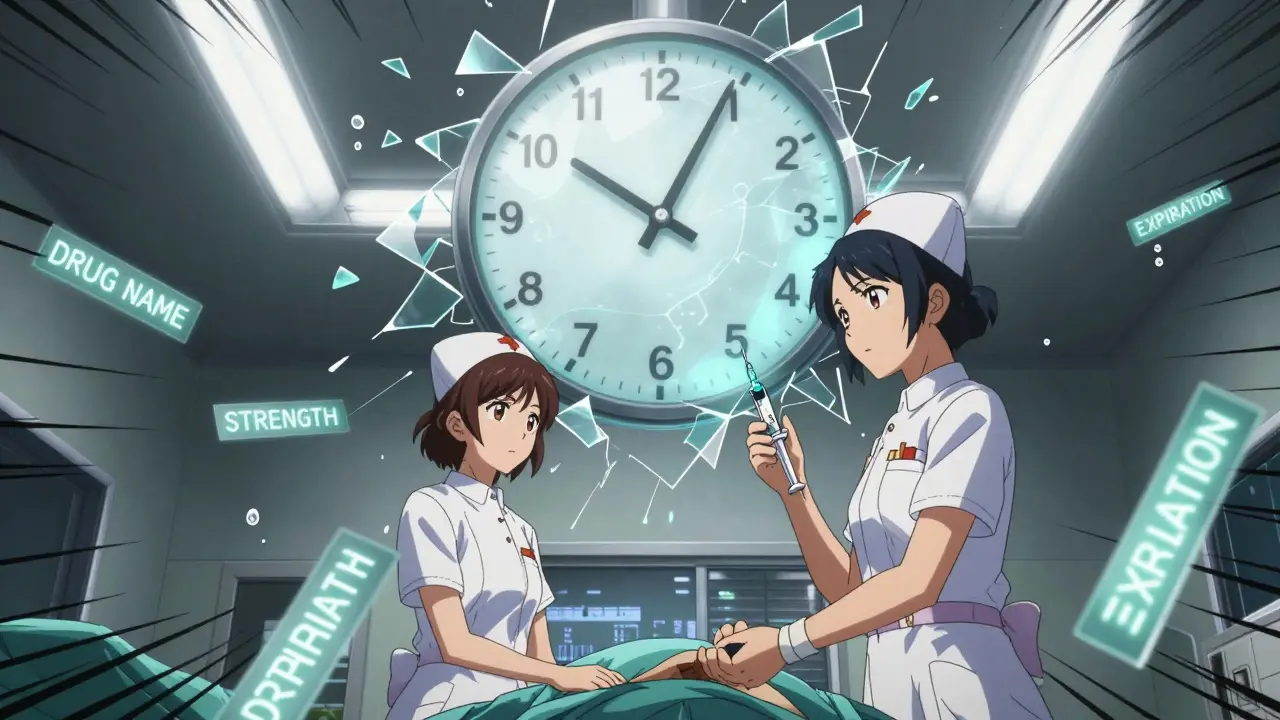
The rule requires labels to include: drug name, strength, concentration, and expiration date. Font size? Minimum 10-point. No cursive. No handwritten scribbles. Why? Because in a dimly lit ER, during a code blue, someone has to read that label in under two seconds. If it’s too small or unclear, they’ll guess. And guessing kills.
Hospitals that enforced this rule saw a 62% drop in wrong-drug errors in perioperative settings. The fix wasn’t expensive. It was consistent. It was enforced. And it started with a label printer and a policy that didn’t allow exceptions.
High-Alert Medications: When the System Must Double-Check
Some drugs are so dangerous that even a tiny mistake can cause death, amputation, or permanent brain damage. These are called high-alert medications. Examples include insulin, heparin, IV potassium, and opioids. The ISMP (Institute for Safe Medication Practices) lists 19 specific scenarios where these drugs cause harm. One case: injectable promethazine. Between 2006 and 2018, 37 patients lost limbs because it was accidentally injected into an artery instead of a vein. That’s not rare. It’s predictable.
The NPSGs don’t just say “be careful.” They require system-level fixes: separate storage, dose limits, mandatory double-checks, and barcode verification at the point of administration. At Children’s Hospital of Philadelphia, they added a double-check requirement for all high-alert meds in pediatric ICU units. Result? A 91% drop in dosing errors. The key wasn’t more staff. It was a rule that forced two people to confirm before the drug left the drawer.
Automated Dispensing Cabinets: A Double-Edged Sword
Automated dispensing cabinets (ADCs) were supposed to reduce errors. Instead, they created a new one: override culture. When a nurse needs a drug “stat,” they can override the system and grab it without pharmacist approval. Sounds helpful. Until you learn that 34% of pharmacies have override rates above the 5% safety threshold. Facilities with override rates over 5% have 3.7 times more medication errors.
Why? Because overrides are used for convenience, not crisis. A nurse grabs morphine because they’re too busy to wait 90 seconds for approval. A pharmacy tech skips the barcode scan because the machine is slow. The system rewards speed over safety. The 2025 NPSGs now require hospitals to analyze override patterns monthly and reduce them through workflow redesign-not just reminders.
One hospital in Ohio cut overrides from 12% to 3% by redesigning their emergency med cart system. Instead of letting nurses bypass the ADC, they stocked a locked emergency cart with the top 10 most-used stat drugs. No override needed. Error rates dropped 51% in six months.
Why the Five Rights Are Not Enough
You’ve heard them: right patient, right drug, right dose, right route, right time. It’s taught in every pharmacy school. But here’s the truth: 83% of medication errors happen even when all five rights are confirmed. Why? Because the Five Rights put the burden on the person at the end of the chain-the nurse or pharmacist-while ignoring the broken systems that made the error possible.
A nurse in a 2023 survey said: “We’re taught to memorize the five rights but not given the tools to actually verify them during 12-hour shifts with 8 patients.” That’s not incompetence. It’s design failure. A patient’s name might be misspelled in the EHR. The barcode on the pill bottle might be faded. The dose might be wrong because the prescriber picked a weight-based dose without entering the patient’s weight.
The real fix? Technology that prevents the error before it reaches the person. Barcode scanning that blocks administration if the drug doesn’t match. EHR alerts that flag a 10x overdose. Automated double-checks triggered by high-risk drugs. The Five Rights are a checklist. They’re not a safety system.
What Works: Real-World Fixes That Save Lives
Some hospitals aren’t waiting for regulations. They’re building safety from the ground up.
- Children’s Hospital of Philadelphia implemented a pediatric-specific safety model. All weight-based doses require two independent calculations. High-alert meds need a second pharmacist sign-off. Result: 91% fewer dosing errors.
- A hospital in Minnesota installed bedside specimen labeling. Nurses now label blood tubes in front of the patient, using two identifiers (name and DOB) and a barcode scanner. Before, 1 in 15 specimens was mislabeled. After? 99.6% accuracy. No more wrong-blood tests. No more misdiagnoses.
- A VA pharmacy started monthly “safety huddles” where pharmacists and nurses review every error-not to blame, but to fix the system. Within a year, dispensing errors dropped by 68%.
These aren’t magic. They’re simple. They’re repeatable. They’re funded by better workflows, not more staff.
Implementation Challenges: Why Most Programs Fail
Here’s what stops most hospitals from succeeding:
- Training under 4 hours per year: 38% of facilities give less than four hours of safety training annually. You can’t teach safety in a 20-minute orientation.
- No executive sponsorship: Programs led by pharmacy directors without C-suite backing die within two years. Safety isn’t a cost center. It’s a core function.
- Technology without workflow redesign: Installing barcode scanners won’t help if nurses are still rushed, understaffed, and discouraged from asking questions.
- Blaming individuals: When an error happens, the first reaction is “Who messed up?” The right question is: “What in the system let this happen?”
The most successful programs treat medication safety like aviation safety. No pilot is expected to remember every checklist. Instead, systems are built so the plane won’t take off if the fuel is low. The same applies to meds. The system should prevent the error. Not rely on human perfection.
The Future: AI, Regulation, and Patient Involvement
The next wave of safety is here. AI-powered clinical decision support is being piloted at Mayo Clinic and Johns Hopkins. These systems scan EHRs in real time and flag potential interactions, wrong doses, or duplicate orders before the med is even dispensed. Early results show a 47% drop in preventable adverse events.
The WHO’s Global Patient Safety Action Plan calls for universal adoption of safety standards by 2030. But here’s the kicker: facilities that include patients in safety checks-asking them to confirm their meds, ask questions, or report concerns-see 42% fewer errors. Patients aren’t passive recipients. They’re the last line of defense.
By 2026, the ISMP will expand its best practices to include vaccine administration errors and transition-of-care reconciliation. These are growing risks. A patient discharged with 12 new meds? If their primary care provider doesn’t know what was changed, the next pharmacist will be guessing.
The future isn’t about more rules. It’s about smarter systems, empowered staff, and engaged patients. And it starts with one question: What’s the next error waiting to happen?

Eimear Gilroy
February 27 2026That 27% of ORs still use unlabeled syringes? I’ve seen it. Not because people are lazy-because the system doesn’t give them time to label. I worked in a trauma center where we’d get 3 stat doses in 90 seconds. Labeling? You’d need a fourth hand. The fix isn’t just more rules-it’s rethinking workflow. What if the syringe was labeled at the automated cabinet before it even left the drawer? No override needed. No guesswork. Just safe, fast, and predictable.
And why aren’t we talking about how EHRs make this worse? If the patient’s weight isn’t auto-filled, the dose is wrong before the nurse even sees the med. We’re blaming the last person in the chain while the software is rigged to fail.
Martin Halpin
February 28 2026Oh here we go again-the same tired sermon about ‘system failures’ while the real problem is that pharmacists and nurses are overworked, underpaid, and treated like disposable cogs. You think a 12-hour shift with 18 patients and zero support staff is going to result in perfect labeling? Please. The Joint Commission doesn’t care about burnout. They care about audit scores. They don’t send auditors to check if nurses have time to breathe, only if their labels are 10-point font. And let’s not forget: the same hospitals that enforce these rules are the ones cutting staff every quarter. You want to reduce errors? Pay people enough to stay. Give them breaks. Stop treating them like robots. The system isn’t broken-it’s intentionally cruel.
Lisandra Lautert
March 1 2026Labeling isn’t optional. It’s life or death. Period.
Cory L
March 2 2026Man, I’ve seen ADC overrides turn into a free-for-all. One nurse I worked with called it ‘pharmacy roulette’-grab what you need, hope the barcode scans, and pray you didn’t just grab fentanyl instead of saline. We had a guy who’d override for *every* med because ‘it’s faster.’ Until one day he grabbed potassium chloride. Didn’t even notice. Just pushed it. Thank God the patient had a cardiac monitor on. That’s not negligence. That’s a system that rewards chaos. The Ohio hospital’s solution? Genius. Stock the damn cart. Let nurses grab what they need fast-without bypassing safety. Why didn’t we think of this sooner? Simple: we thought tech would fix everything. Turns out, sometimes the fix is… less tech.
Bhaskar Anand
March 3 2026This article is complete nonsense. In India we have 10x the patient load with 1/10th the resources and still no unlabeled syringes no override culture no medication errors. Why? Because we work harder. We are disciplined. We don't need fancy EHRs or barcode scanners. We have common sense. Western hospitals are soft. They create systems to compensate for laziness. In India we don't wait for AI to tell us what to do. We think. We act. We save lives. You don't need rules. You need grit. This is why the West is falling behind in healthcare. Too many regulations. Too little responsibility.
William James
March 4 2026What struck me most is how we keep framing safety as a checklist instead of a culture. The Five Rights? They’re not the goal-they’re the bare minimum. Real safety is when the system makes it *impossible* to mess up. Like how planes won’t take off without a flight plan. Or how your phone won’t send a text if you’re driving. We need that same mindset. Imagine a pharmacy where the med drawer *won’t open* unless two people confirm. Where the EHR *blocks* the order if the dose doesn’t match the patient’s weight. No yelling. No blame. Just… prevention.
And yeah, patients? They’re not just bystanders. I’ve had patients stop me and say, ‘Wait-that’s not my pill.’ That’s not interference. That’s partnership. We’ve forgotten that. We treat them like customers, not collaborators.
Dinesh Dawn
March 5 2026I’ve been in community pharmacy for 18 years. Let me tell you-the real issue isn’t the labels or the overrides. It’s the lack of respect. We’re treated like order-fillers, not clinicians. No one asks us about the med interactions. No one listens when we say, ‘This dose is too high for this patient.’ We’re the last line of defense, but we’re the first to be silenced. If we had real authority-not just advisory power-we could prevent so much harm. It’s not about more tech. It’s about giving pharmacists a seat at the table. And then… actually listening.
Vanessa Drummond
March 5 2026So let me get this straight. We’re supposed to believe that 250,000 deaths a year are ‘system failures’ and not just… the natural result of a broken, profit-driven healthcare machine? Please. Hospitals make money off of errors. More meds = more revenue. More readmissions = more revenue. More code blues = more billing codes. The NPSGs? A PR stunt. They’re not here to save lives. They’re here to keep insurers from suing. You think a CEO cares if a patient dies because a label was too small? No. They care if the audit passed. The real fix? Defund the corporations. Put people before profit. Until then, we’re just rearranging deck chairs on the Titanic.
Nick Hamby
March 7 2026One thing I’ve learned from working in pediatric oncology: safety doesn’t come from policies. It comes from rituals. At our unit, every high-alert med gets a double-check-not just by two people, but with a verbal confirmation. One says the drug. The other repeats it. Then they both scan. Then they look at the patient. Then they say the patient’s full name out loud. It takes 45 seconds. But in 10 years? Zero wrong-med errors. Why? Because we made it sacred. Not because we were forced to. Because we chose to.
That’s the difference between compliance and culture. One is enforced. The other is earned. And culture? It’s contagious. When nurses see pharmacists doing this, they start doing it too. It’s not about technology. It’s about dignity. When you treat people like professionals-not problems-you get excellence. Not perfection. Excellence.
John Smith
March 9 2026Wow. A 91% drop in errors? Must be nice to have unlimited funding and a team of 20 pharmacists per shift. In the real world, we’re doing 200 scripts an hour with one tech and a broken barcode scanner. The ‘solution’ here is like telling a starving man to eat a 5-star meal. The NPSGs are beautiful. The reality? A dumpster fire. And now we’re supposed to feel guilty for not living up to some corporate fantasy? Grow up.
Shalini Gautam
March 10 2026In India we have no such luxury of automated cabinets or AI systems. We have handwritten scripts, shared syringes, and nurses who work 16-hour shifts. But we still have fewer medication errors than the US. Why? Because we don't overthink. We don't overcomplicate. We just do. We don't need 10-point font or double-checks. We have focus. We have discipline. We have pride in our work. The West thinks safety is a technical problem. It's not. It's a moral one. And we have more of it.
Eimear Gilroy
March 10 2026Actually, I’ve seen the Indian model. And I’ll tell you this: they reduce errors not because they’re ‘disciplined’-they reduce them because they have no choice. No labeling? No barcode? No double-check? Fine. But then they also have no malpractice insurance. No lawsuits. No oversight. That’s not safety. That’s resignation. When you can’t afford to fail, you don’t design systems-you survive them. That’s not a lesson. That’s a tragedy.