
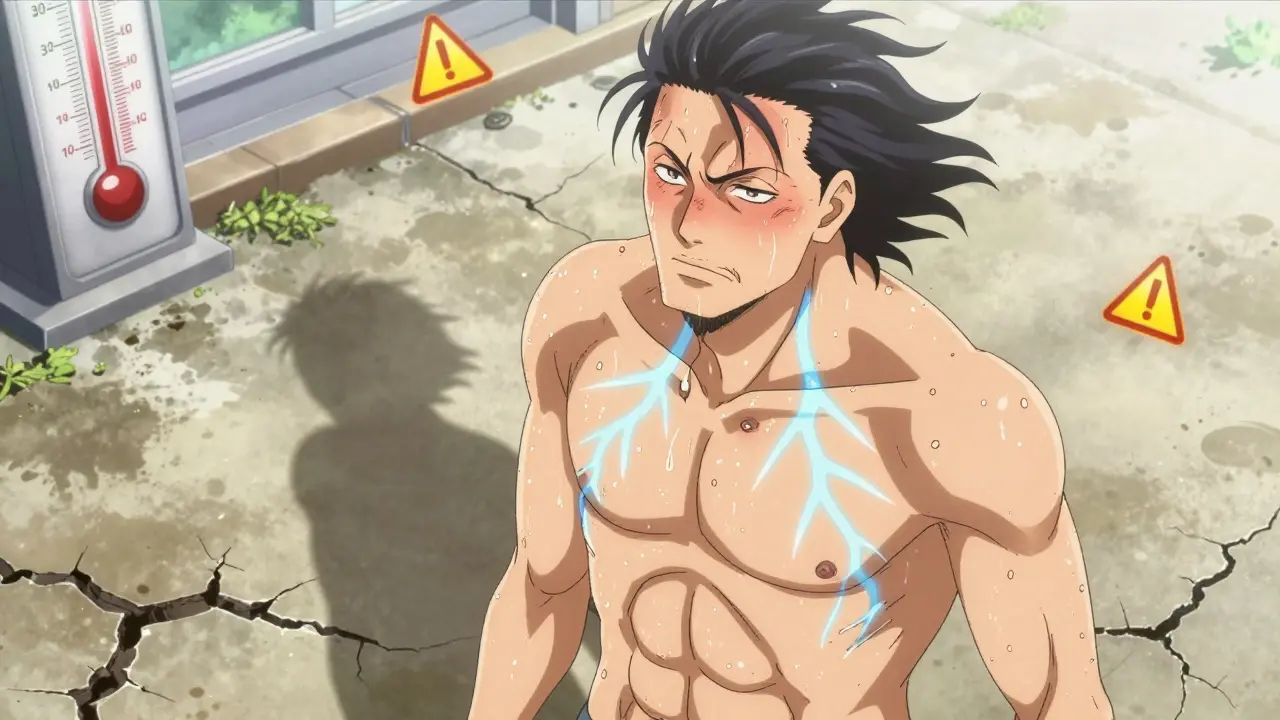
When the temperature rises, your body naturally sweats to cool down. But if you’re taking certain medications, that cooling system might not work the way it should. You could feel overheated, dizzy, or even nauseous - not because you’re out of shape, but because your medicine is silently blocking your body’s ability to regulate heat. This isn’t rare. In fact, decreased sweating from medications is one of the most overlooked dangers of summer, especially for older adults and those on multiple prescriptions.
Why Your Body Can’t Cool Down
Your body loses heat in three main ways: sweating, blood flow to the skin, and breathing. Medications can mess with any or all of these. If you’re not sweating as much as you used to, your core temperature can creep up without you noticing. That’s heat intolerance - when normal warmth starts to feel dangerous. It doesn’t take a heatwave to trigger it. Even a 27°C (80°F) day can become risky if your sweat glands are shut down by a pill.Some drugs reduce sweat production by blocking nerve signals to your sweat glands. Others cut off blood flow to your skin, trapping heat inside. Some make you pee more, dehydrating you before you even feel thirsty. And some actually make your body produce more heat while stopping it from releasing it. The result? A dangerous combo that can lead to heat exhaustion or worse - heat stroke.
Which Medications Are the Biggest Culprits?
Not all drugs affect heat the same way. Here are the top five classes linked to decreased sweating and heat intolerance, based on real clinical data:- Diuretics - Especially thiazides like hydrochlorothiazide and chlorthalidone. These pills make you lose 1.5 to 2.5 liters of fluid a day. Less fluid = less sweat. Studies show people on these meds have up to 50% less sweating capacity, making them 2.3 times more likely to end up in the ER during summer heat waves.
- Beta Blockers - Medications like metoprolol and propranolol. They don’t just lower heart rate - they prevent blood vessels near your skin from opening up. That means heat can’t escape. Research shows skin blood flow drops by 25-40%, so even if you’re sweating, the heat stays trapped.
- Anticholinergics - This includes drugs for overactive bladder (oxybutynin), allergies (diphenhydramine/Benadryl), and some antidepressants. They block acetylcholine, the chemical that tells sweat glands to activate. In some cases, sweating drops by 60-80%. That’s not just uncomfortable - it’s life-threatening in hot weather.
- Antipsychotics - Haloperidol, olanzapine, quetiapine, risperidone. These don’t just affect your mood - they disrupt the hypothalamus, your brain’s thermostat. They cut sweat production by 50-70% and make your body less sensitive to rising temperatures. Heat stroke can happen at just 27-32°C (80-90°F) in people on these drugs.
- GLP-1 Receptor Agonists - Ozempic, Wegovy, and similar weight-loss drugs. They suppress your thirst signal by 40-50%. You might drink plenty of water, but your brain doesn’t tell you when you need more. Dehydration builds up silently, increasing heat risk.
There’s also a key contrast: tricyclic antidepressants like amitriptyline reduce sweating by 65-75%, while newer SSRIs like fluoxetine can actually increase sweating - but that leads to fluid loss, which still raises heat risk. So even "better" drugs aren’t always safer.
How to Spot the Warning Signs
You don’t have to wait for heat stroke to realize something’s wrong. The first signs usually show up within 30 to 90 minutes of being in the heat:- Cramps in arms, legs, or stomach (happens in 65% of cases)
- Dizziness or lightheadedness (55%)
- Headache (70%)
- Flushed skin - but not sweating
- Nausea or vomiting (35%)
- Weakness or fatigue
- Very dry skin - or no sweat at all (85% of affected people)
If you notice even one of these while taking one of the meds listed above, get out of the heat immediately. Don’t wait for confusion or a high fever - those are late signs of heat stroke, which can be fatal.

What to Do to Stay Safe
You can’t always stop your meds. But you can change how you live around them. Here’s what works:- Drink more water - Not just when you’re thirsty. Add 500-1000 mL (about 2-4 cups) to your daily intake during hot weather. Even if you’re on a GLP-1 drug that dulls thirst, you still need the fluid.
- Avoid outdoor activity between 10 a.m. and 4 p.m. - That’s when the sun is strongest and UV exposure hits 70-80% of the daily total. If you must go out, stay in the shade.
- Use air conditioning - Even for a few hours a day. If you don’t have it at home, visit a public library, mall, or cooling center. The CDC says staying under 32°C (90°F) indoors is critical for those on high-risk meds.
- Check your weight daily - A drop of 2% or more (like 1.5 kg for a 75 kg person) means you’re dehydrated. That’s a red flag.
- Use a cooling vest - Especially if you’re on antipsychotics or anticholinergics. These vests can lower your core temperature by 0.5-1.0°C, which might be the difference between discomfort and emergency.
- Use SPF 30+ sunscreen - Some meds like calcium channel blockers and ACE inhibitors make your skin more sensitive to sunburn. That’s another layer of heat stress.
Who’s at Highest Risk?
It’s not just about the drug - it’s about the combo. People taking three or more of these medications are at much higher risk. Older adults, especially those over 65, are the most vulnerable. A 2023 study found that taking five or more medications increases heat stroke risk by 300% compared to younger, healthier people. That’s because aging reduces natural sweating, lowers thirst awareness, and slows how fast your body adjusts to heat.Also, lithium - used for bipolar disorder - is especially dangerous. Dehydration can spike lithium levels in your blood by 25-35%. That can cause toxicity even at temperatures above 29°C (85°F). Regular blood tests during hot months are non-negotiable.

What’s Changing in 2026?
Health systems are finally catching up. In 2023, the CDC updated its guidance, and in 2024, the American Heart Association gave specific warnings for beta blocker and diuretic users. Electronic health records now auto-flag high-risk drug combinations during summer months. The FDA approved the first wearable core temperature monitor, TempTraq, for people on heat-affecting meds - so you can track your internal heat before symptoms start.Research is moving fast. The NIH is funding a $2.5 million project to build AI tools that predict individual heat risk based on your full medication list. That means one day, your doctor might warn you before summer even starts: "Your combo puts you in the high-risk group. Here’s your personalized plan."
Bottom Line
Decreased sweating from medication isn’t a minor side effect. It’s a silent killer that’s getting worse as the planet heats up. If you’re on any of these drugs - especially diuretics, beta blockers, anticholinergics, antipsychotics, or GLP-1 agents - you need a heat safety plan. Talk to your pharmacist or doctor. Ask: "Could this medicine be making me more vulnerable to heat?" Don’t assume it’s just "normal" to feel hot. Your body might be telling you something far more serious.Can drinking more water fix decreased sweating from medication?
Not always. While staying hydrated helps prevent heat stroke, it doesn’t restore sweat production if your medication is blocking the nerve signals to your sweat glands. Drugs like anticholinergics and beta blockers interfere with the body’s physical ability to sweat - not just fluid levels. Drinking more water reduces dehydration risk but won’t make you sweat normally again.
Are over-the-counter meds like Benadryl really dangerous in the heat?
Yes. Diphenhydramine (Benadryl) is a potent anticholinergic. Even at standard doses, it can reduce sweating by 60-80%. Many people take it for allergies or sleep without realizing the risk. In hot weather, this can lead to heat exhaustion or heat stroke - especially in older adults. Avoid using it during summer unless absolutely necessary.
Do all antidepressants cause heat intolerance?
No. Tricyclic antidepressants (like amitriptyline) strongly reduce sweating and carry high heat risk. But SSRIs like fluoxetine or sertraline don’t block sweat glands - instead, they can cause excessive sweating, which leads to fluid loss and dehydration. Both are risky, but in different ways. Your doctor should review which type you’re on and how it affects your body’s cooling system.
Can I stop my medication if it makes me heat intolerant?
Never stop a prescribed medication on your own. Some drugs - like antipsychotics or lithium - can cause serious withdrawal or relapse if stopped suddenly. Instead, talk to your doctor about alternatives. For example, switching from a thiazide diuretic to a potassium-sparing one may reduce heat risk. Or adjusting timing of doses to avoid peak heat hours. Your doctor can help you find a safer balance.
Is heat intolerance more dangerous for older people?
Yes. As we age, our sweat glands become less active, our thirst sense fades, and our bodies take longer to adjust to temperature changes. Add multiple medications into the mix - especially diuretics, beta blockers, or anticholinergics - and heat intolerance becomes a major threat. Adults over 65 with 5+ medications have a 300% higher risk of heat stroke than younger adults. This is why summer heat advisories now specifically warn about medication use in older populations.
Should I avoid the sun completely if I’m on these meds?
Not necessarily - but you need to be strategic. Avoid direct sun between 10 a.m. and 4 p.m. Wear lightweight, loose clothing. Use a wide-brimmed hat and UV-blocking sunglasses. Stay in shaded areas. If you’re on a drug that increases sun sensitivity (like some blood pressure meds), use SPF 30+ sunscreen. You can still enjoy outdoor time - just plan it for early morning or evening, and always carry water.
Raphael Schwartz
March 21 2026This is bs. I take hydrochlorothiazide and I’m fine. Stop scaring people. Just drink water and stop being weak.
Heat? Pfft. I work outside in 100° and don’t even break a sweat.
Namrata Goyal
March 21 2026Oh wow. Another fearmongering article. You know what’s really dangerous? The pharmaceutical industry. They profit from making people paranoid about their own meds. I take Benadryl for sleep and I’m perfectly fine. You’re overcomplicating simple biology.
Also, ‘anticholinergics’? Sounds like a sci-fi villain.
Alex Arcilla
March 22 2026I love how this post is basically a public service announcement disguised as a medical deep dive. Seriously though - if you’re on any of these meds and you live somewhere with AC, you’re already ahead of 80% of the world.
Also, props for mentioning TempTraq. That thing’s a game-changer. My grandma’s been using it since April. She’s still alive. Shocking, I know. 😎
Brandon Shatley
March 23 2026I didn’t realize how many meds mess with sweating. I’ve been taking oxybutynin for years and never thought twice. Now I’m checking my water intake every day. Small change, but I feel smarter already.
Also, I didn’t know SSRIs cause sweating. That’s wild. My doc never mentioned it. Guess I’ll ask next time.
Caroline Dennis
March 23 2026The thermoregulatory cascade is compromised not by dehydration alone, but by neuropharmacological blockade of cholinergic efferents. The clinical implication? We’re not just talking about discomfort - we’re talking about autonomic dysregulation.
Hydration is necessary but insufficient. You need behavioral adaptation. Period.
Zola Parker
March 24 2026I think the real issue is that we’ve turned nature into a villain. Sweat is messy. Heat is natural. We’re afraid of our own bodies now. 🤷♀️
Maybe we should just… let ourselves be hot sometimes?
Also, I took Zoloft last summer. Sweated buckets. Felt amazing. Like a human sauna. 🌞
florence matthews
March 25 2026I’m so glad someone finally wrote this. My mom’s on 6 meds and last summer she nearly passed out in the grocery store. We didn’t connect it until now.
Thank you for the cooling vest tip - I just ordered one. Also, I’ve been drinking 3L of water daily since reading this. Small steps, right? 💙
Kenneth Jones
March 26 2026Stop telling people what to do. If you’re old and on meds, don’t go outside. Simple. No need for 2000 words. You’re not a lab rat. Just stay inside. Done.
Mihir Patel
March 27 2026I just found out my uncle died last July from heat stroke. He was on olanzapine. No one told him. No one knew. I’m crying right now. This post? It’s not just info. It’s a life preserver. Thank you. From the bottom of my heart.
Kevin Y.
March 27 2026Thank you for compiling this with such precision and clarity. The inclusion of clinical percentages, CDC guidelines, and actionable steps elevates this from a warning to a comprehensive public health resource. I’ve shared it with my entire family. Well done.
winnipeg whitegloves
March 28 2026I live in Winnipeg. We got 37°C last week. I was like, ‘oh no, not again.’ My neighbor’s on beta blockers and he’s out there mowing his lawn at noon. I yelled at him. He yelled back. We’re cool now. But I gave him a cooling towel. He didn’t say thank you. But he’s using it. Progress.
Marissa Staples
March 30 2026I wonder if the real problem isn’t the meds, but our cultural obsession with controlling every bodily function. We medicate thirst. We medicate sleep. We medicate heat. Maybe we just need to let the body be the body. Not saying don’t be safe - just… maybe be curious too?