
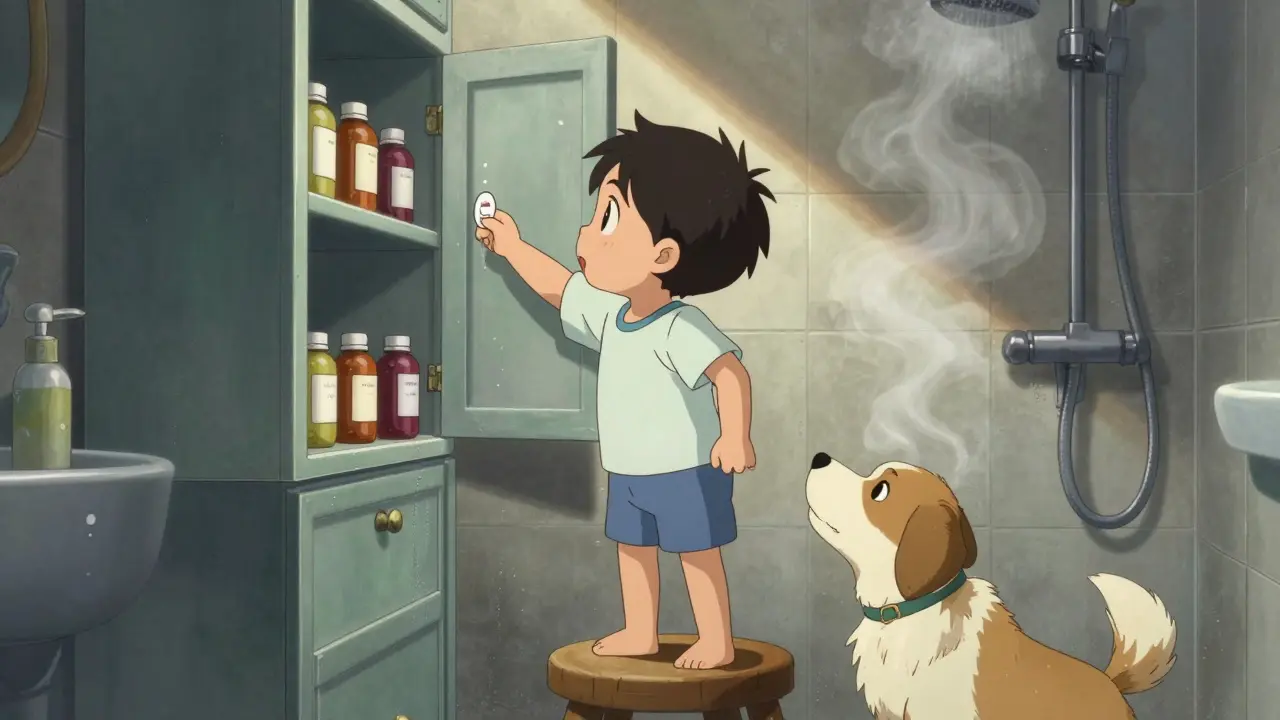
Every year, medication storage mistakes put thousands of children and pets in emergency rooms. It’s not just about forgetting to close the bottle-it’s about where you keep it, how you handle it, and what you do after the dose is given. A child who climbs onto a stool to reach a pill bottle on the counter. A dog that sniffs out a dropped capsule between the couch cushions. These aren’t rare accidents. They’re predictable-and preventable.
Why Your Bathroom Cabinet Is the Worst Place for Medicines
Most people store medicines in the bathroom. It’s convenient. The sink’s right there. But it’s also the most dangerous spot. Humidity from showers and baths can break down pills and liquids, making them less effective-or even unsafe. The CDC reports that 40% of households keep medications in the bathroom, even though humidity levels there often exceed 60%. That’s enough to ruin insulin, thyroid pills, and many antibiotics. But worse than the degradation? Kids and pets can reach it. Bathroom cabinets are usually at eye level for a 3-year-old. And if the door is unlocked? It’s an open invitation. The Up & Away campaign found that children can easily climb, jump, or pull open cabinets to reach things they can see-even if they’re labeled "child-resistant." Switch to a high kitchen cabinet instead. Or a bedroom closet. Something out of sight, out of reach, and dry. The ideal spot is above 5 feet, with no stool or chair nearby that a child could use to climb up.Lock It Down-Even If It’s "Child-Resistant"
Child-resistant caps are not child-proof. They’re designed to slow down a curious child for about a minute. That’s enough time for an adult to open it-but not enough to stop a determined 4-year-old who’s seen you do it a hundred times. The American Academy of Pediatrics says 65% of childhood medication ingestions happen with over-the-counter drugs left in purses, backpacks, or unlocked cabinets. That’s not a failure of packaging. That’s a failure of storage. Use a lockable box. A simple combination lock box like the VADIC Safe Storage Bag (11" x 6") works. Or a biometric safe that opens with a fingerprint. One parent on Reddit said their 3-year-old figured out how to open the "childproof" cabinet in two weeks. After installing a fingerprint lock, they said: "It adds 10 seconds to my routine. But I sleep better." Don’t just lock the bottle. Lock the whole container. If you’re using a weekly pill organizer, make sure it has a lock too. Many models now come with built-in locks and separate compartments for each family member.Separate Human and Pet Medications-Completely
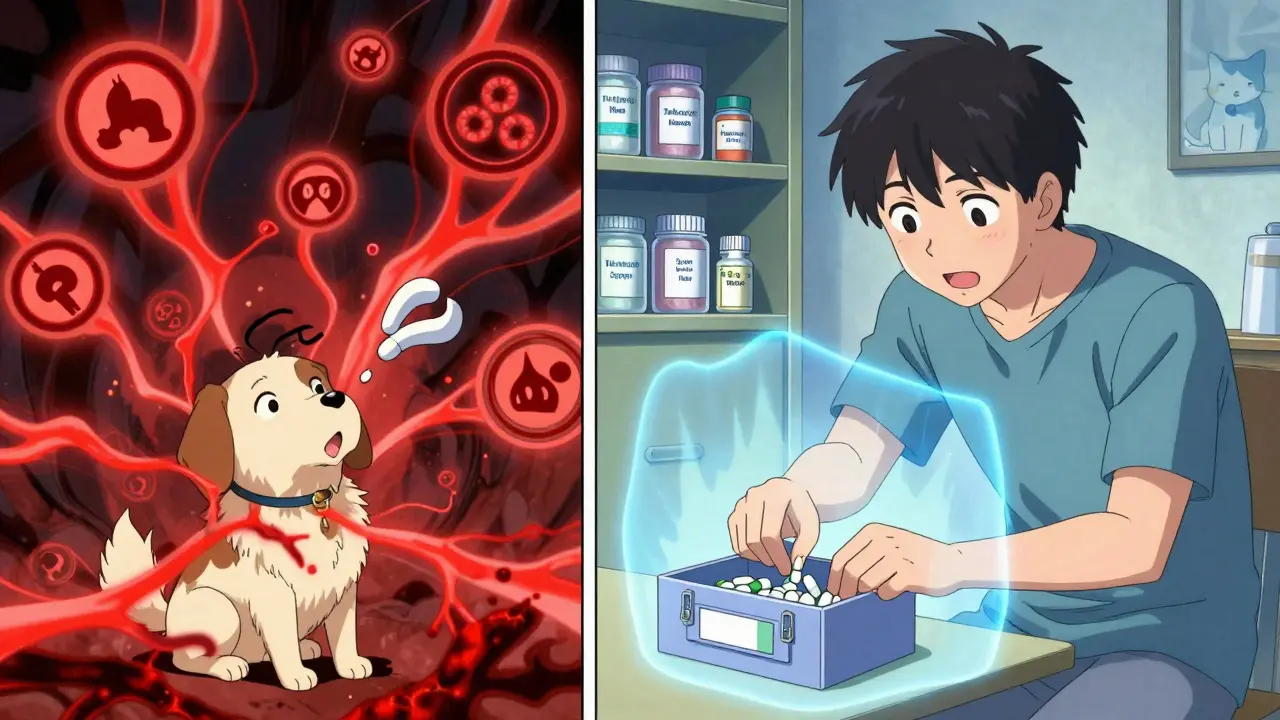
Dogs love flavored pills. So do cats. That’s why pet meds often taste like chicken, beef, or fish. And that’s why they’re deadly if a child gets into them. The FDA warns that human heart medications can be fatal to dogs. Meanwhile, dog arthritis pills can cause kidney failure in cats-even at tiny doses. And here’s the scary part: 25% of pet medication incidents involve humans accidentally taking their pet’s pills. Stop storing them together. Even if they’re in the same cabinet, keep them in separate locked containers. Label them clearly: "Human Meds - Do Not Touch" and "Pet Meds - For Dog Only." Veterinary experts recommend a three-zone system:- Zone 1 (Immediate Use): Only the current dose. Keep it on a flat surface-never on the counter or bedside table-while giving it. Put it away immediately after.
- Zone 2 (Short-Term Storage): Locked container, at least 5 feet high. For meds you use daily.
- Zone 3 (Long-Term Storage): Separate locked boxes for human meds, dog meds, and cat meds. Keep them in different rooms if possible.
Gummy Vitamins Aren’t Candy-Even If They Look Like It
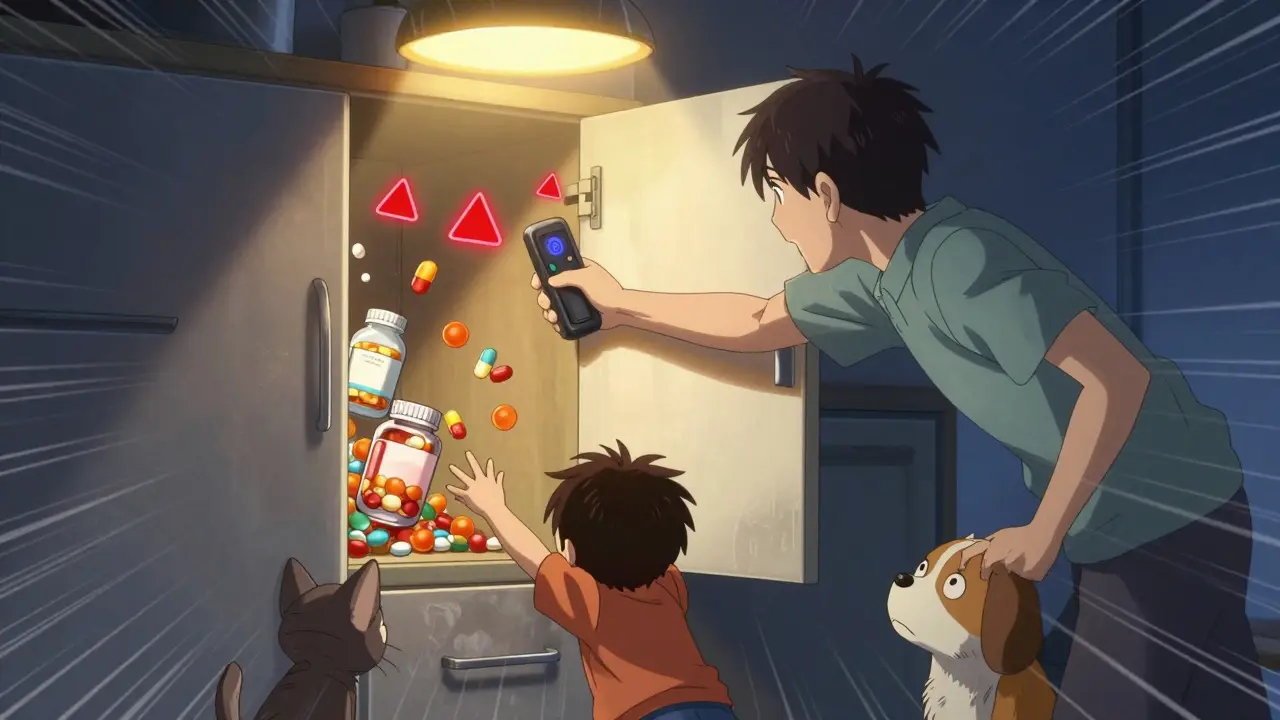
Gummy vitamins, gummy melatonin, gummy probiotics-they’re everywhere. And they’re the #1 cause of supplement poisonings in kids. The CDC says gummy supplements make up only 15% of the market but cause 30% of childhood ingestions. Why? Because they taste like candy. And kids know it. Parents often think, "It’s just a vitamin. It’s harmless." But too much iron from a gummy multivitamin can cause vomiting, seizures, even organ failure. Too much melatonin can lead to drowsiness, low blood pressure, and confusion. Store gummies the same way you store prescription pills. Locked. High up. Out of sight. Don’t leave them on the kitchen counter because "I take them every morning." That’s exactly how accidents happen.The Two-Minute Rule: Secure It Right After Use
Most poisonings don’t happen because someone left a bottle out for days. They happen because someone left it out for two minutes. You’re giving your child their medicine. You set the cup on the counter. You answer the door. You grab a towel. Two minutes later, your toddler grabs the cup. Children’s Mercy Hospital found that 52% of childhood ingestions happen during these brief moments. That’s why they created the "Two-Minute Rule":- When you open a medicine, prepare it on a flat surface-never the counter, bed, or couch.
- Give the dose immediately.
- Put it back in the locked container within two minutes-even if you’re only giving half the dose now.
Dispose of Old or Expired Medications the Right Way
Don’t flush pills. Don’t toss them in the trash. Don’t pour liquid meds down the sink. The EPA recommends mixing old or expired meds with something unappetizing-like used coffee grounds, cat litter, or dirt. Use a 1:1 ratio. Put it in a sealed plastic bag. Then throw it in the outdoor trash. Why? Because even empty bottles can be dangerous. A curious pet might chew through the plastic. A child might find a leftover pill. And if you just toss the bottle, someone else might dig it out of the trash. For extra safety, remove the label or scratch off your name. Some pharmacies offer take-back programs. Check with your local pharmacy or police station. Many have drop boxes for unused meds.What to Do If Something Goes Wrong
If a child or pet swallows medicine that isn’t theirs:- For children: Call Poison Control at 1-800-222-1222 immediately. Don’t wait for symptoms. Don’t try to make them vomit. Have the pill bottle ready to describe what was taken.
- For pets: Call your vet or the ASPCA Animal Poison Control Center at (888) 426-4435. Have the medication name, dosage, and time of ingestion ready.
It’s Not Just About Safety-It’s About Peace of Mind
You don’t need to turn your home into a fortress. You just need to be consistent. Start with one change: Move your meds out of the bathroom. Lock them up. Separate pet and human meds. Use the two-minute rule. The National Safety Council estimates that if every household followed these steps, pediatric medication poisonings could drop by 89%. Pet incidents could fall by 76%. That’s not a guess. That’s data. It’s not about being perfect. It’s about being smarter than the accident.Can child-resistant caps really keep kids from getting into medicine?
No. Child-resistant caps are designed to slow down a child for about a minute, not stop them completely. Many kids learn how to open them after watching adults do it. That’s why locked storage at a height above 5 feet is the only reliable method. Never rely on child-resistant packaging alone.
Is it safe to store medications in the kitchen?
Yes-if you store them in a high, locked cabinet away from heat and moisture. The kitchen is actually better than the bathroom because humidity levels are lower (30-50% vs. 60-80%). Avoid placing meds near the stove, sink, or windows where sunlight can hit them. Always use a lockable container.
What should I do if my dog eats a human pill?
Call the ASPCA Animal Poison Control Center at (888) 426-4435 right away. Have the pill name, dosage, and time of ingestion ready. Even small amounts of medications like ibuprofen, antidepressants, or blood pressure pills can be deadly to dogs. Don’t wait for symptoms-act immediately.
Can I store my pet’s medication next to mine if they’re in separate bottles?
No. Even if they’re in separate bottles, storing them together increases the risk of mix-ups. Human medications can be toxic to pets, and pet meds can be dangerous to humans. Use separate locked containers, preferably in different rooms. Label them clearly to avoid confusion.
Are gummy vitamins safe to leave out on the counter?
No. Gummy vitamins look and taste like candy, and children-and pets-treat them that way. The CDC reports they cause 30% of childhood supplement poisonings. Store them in a locked container, just like prescription pills. Never leave them on the counter, even if you use them daily.
How often should I check my medicine cabinet for expired or unused meds?
Check every 3 to 6 months. Expired medications lose effectiveness, and unused ones become hazards. Dispose of them properly by mixing with coffee grounds or cat litter, sealing in a plastic bag, and tossing in the outdoor trash. Never flush them or throw them in the trash without mixing them with something unappetizing.
Kelly McRainey Moore
January 20 2026Just moved all my meds to the top shelf in the bedroom closet last week. No more bathroom chaos. Also started using those little lockboxes for gummy vitamins-turns out my niece thought they were candy. Who knew? 😅
Kevin Narvaes
January 22 2026child proof my ass. my lil bro opened a bottle in 3 sec. they r just for lazy parents who think the bottle is the problem. its the damn house. lock everything. even the damn fridge.
Dee Monroe
January 23 2026I used to think I was being responsible by keeping meds in the cabinet above the sink-until my dog swallowed half a bottle of my blood pressure pills. He lived, but the vet bill was $2,300. Now? Locked box in the closet. High up. No exceptions. I don’t care if I’m late for work-I don’t leave it out for two minutes. Not anymore. It’s not about convenience. It’s about not having to sit in a vet’s waiting room wondering if your best friend is going to make it. I’m not proud of how long it took me to learn that.
Ashok Sakra
January 24 2026why u lock stuff? kids be curious. let them learn. if they eat a pill they learn not to do it again. i did it when i was kid. no big deal. u overreact. its just medicine.
Gerard Jordan
January 24 2026Just installed a fingerprint lockbox on my kitchen wall. 🤖🔒 Now my toddler can’t reach anything, and I don’t have to play "find the missing pill" every Sunday. Also, I label everything like a boss: "HUMAN MEDS: DO NOT TOUCH" and "DOG PILLS: TASTES LIKE CHICKEN (FOR DOG ONLY)". 🐶💊 My cat looks at me like I’m insane. Good. She should.
michelle Brownsea
January 26 2026Let’s be clear: storing medications in the bathroom is not just "inadvisable"-it’s negligent, irresponsible, and statistically indefensible. The CDC has published data on humidity-induced degradation, and yet people still keep insulin in their shower cabinets? That’s not laziness-that’s a public health hazard. And calling child-resistant caps "child-proof"? That’s not ignorance-it’s dangerous misinformation. You’re not protecting your child-you’re trusting a marketing gimmick. Fix your habits. Now.
Roisin Kelly
January 27 2026they’re all lying. the government wants you to buy locks. they make money off your fear. my cousin’s kid took a vitamin and was fine. stop being paranoid. and why are we even talking about pet meds? who cares if the dog eats a pill? it’s just an animal.
Yuri Hyuga
January 28 2026Thank you for this comprehensive guide. As someone who works in community health, I’ve seen too many preventable tragedies. The Two-Minute Rule is the single most effective behavioral change a household can adopt. I’ve distributed printed versions of this to every family I work with. If you’re reading this and haven’t acted yet-start today. Lock it. Move it. Separate it. It takes less time than scrolling through social media. Your child’s life? Worth more than that.
Steve Hesketh
January 28 2026Man, this hit me hard. I grew up in a home where meds were just… there. On the counter. In the purse. In the drawer with the snacks. My little sister almost died from a gummy vitamin overdose. We didn’t know. No one told us. Now I lock everything. I even got a lockbox for my cat’s thyroid pills. She’s 14. I’m not losing her. And if you’re thinking, "It won’t happen to me"-believe me, it happens to everyone. Until it happens to you. Then you wish you’d listened.
MAHENDRA MEGHWAL
January 29 2026It is imperative that households adhere to the recommended storage protocols outlined herein. The statistical correlation between improper storage and pediatric ingestion incidents is unequivocally established by the National Safety Council. One may consider implementing a biometric safe, as previously suggested, in conjunction with a clearly labeled, temperature-controlled storage environment. Furthermore, the disposal protocol involving coffee grounds and sealed plastic bags is both scientifically sound and ethically responsible. One must not underestimate the gravity of this matter.
Sangeeta Isaac
January 29 2026so i just found out my 5-year-old cousin ate my gummy melatonin because "it looked like gummy bears". and i left it on the nightstand. oops. 🙃 now i lock everything-even my omega-3s. i feel like a paranoid mom, but hey, at least my kid’s alive.
Alex Carletti Gouvea
January 30 2026Why are we letting foreigners tell us how to run our homes? In America, we don’t lock up our medicine. We teach kids respect. This is weak. My grandpa took pills out of the jar every day and nobody died. This is just fear-mongering from the nanny state.