

Macrolide QT Prolongation Risk Estimator
How it works: Select your prescribed macrolide antibiotic and check any applicable patient risk factors below. The tool will calculate a relative risk score based on clinical data regarding Ikr blockade potency, CYP3A4 inhibition, and individual susceptibility factors.
Clarithromycin
High RiskErythromycin
Moderate RiskAzithromycin
Lower RiskSelect all that apply to the patient:
Disclaimer: This tool is for educational purposes only and does not constitute medical advice. Always consult a healthcare professional before making medication decisions. Risk scores are relative estimates based on published literature.
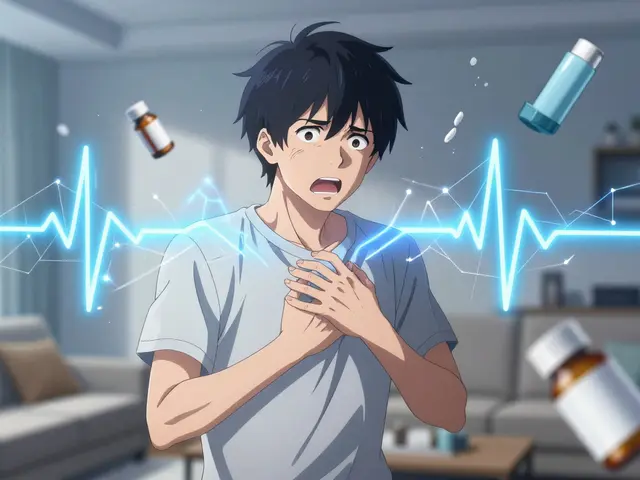
Imagine you’ve just been prescribed a common antibiotic for a respiratory infection. You take the pill, feeling relieved that your cough will soon clear up. But what if that same medication quietly changes the electrical rhythm of your heart? For millions of people, macrolide antibiotics are a widely used class of antimicrobial agents including azithromycin, clarithromycin, and erythromycin are the go-to treatment for everything from sinus infections to pneumonia. Yet, these drugs carry a hidden risk: they can disrupt the heart’s natural electrical cycle, leading to a condition known as QT prolongation is a delay in the heart's electrical repolarization process visible on an electrocardiogram (ECG). While serious complications like Torsades de pointes (TdP) is a potentially fatal polymorphic ventricular tachycardia triggered by prolonged QT intervals are rare, understanding this risk is crucial for patient safety.
How Macrolides Affect Your Heart Rhythm
To understand why macrolides cause heart issues, we need to look at how your heart beats. Each heartbeat involves an electrical signal that travels through the heart muscle, causing it to contract and then relax. This relaxation phase is called repolarization. On an electrocardiogram (ECG), this phase is measured as the QT interval. Normally, this happens quickly and smoothly. However, certain medications can slow down this process.
Macrolides interfere with specific proteins in your heart cells called hERG potassium channels are ion channels encoded by the human ether-a-go-go-related gene that regulate rapid potassium current (Ikr) during cardiac repolarization. These channels act like tiny doors that let potassium ions flow out of heart cells, helping them reset for the next beat. When macrolides bind to these channels, they block the flow of potassium. This blockade prolongs Phase 3 of the cardiac action potential, effectively stretching out the time it takes for the heart to recharge. If this stretch becomes too long, it creates a window where extra electrical signals-called early afterdepolarizations (EADs)-can fire off randomly. These rogue signals can trigger Torsades de pointes, a chaotic and dangerous heart rhythm that can lead to fainting or sudden cardiac death if not treated immediately.
The mechanism isn't uniform across all heart tissue. Research indicates that this repolarization delay occurs primarily in the His-Purkinje system and ventricular M cells, but not significantly in the endocardium or epicardium. This uneven effect creates what experts call "transmural dispersion of repolarization." Think of it like a choir where some singers finish their note much later than others; this mismatch provides the perfect substrate for arrhythmias to start.
Risk Profiles: Not All Macrolides Are Equal
If you’re worried about heart risks, you might assume all macrolides are equally dangerous. They aren’t. The risk varies significantly depending on which specific drug you take, how it interacts with your liver enzymes, and its direct potency on heart channels.
| Antibiotic | Ikr Blockade Potency | CYP3A4 Inhibition | Primary Risk Factor |
|---|---|---|---|
| Clarithromycin | High | Strong (50-70%) | Dual mechanism: Direct channel block + drug interactions |
| Erythromycin | Moderate | Moderate (20-30%) | Gastrointestinal side effects leading to hypokalemia |
| Azithromycin | Low | Minimal (<10%) | Accumulation in tissues; additive risk with other QT drugs |
Clarithromycin carries the highest risk profile. It directly blocks hERG channels strongly and also inhibits the CYP3A4 enzyme in the liver. This enzyme is responsible for breaking down many other medications. When Clarithromycin shuts it down, levels of other QT-prolonging drugs in your blood can spike, creating a dangerous cocktail. Because of this, it often comes with black box warnings in the United States.
Erythromycin is a bit older and has a moderate risk. Its main danger often comes indirectly. It frequently causes severe nausea and vomiting, which can lead to low potassium levels (hypokalemia). Low potassium makes the heart even more sensitive to QT prolongation, compounding the risk.
Azithromycin is generally considered the safest option among the three. It has minimal impact on liver enzymes and weaker direct blockade of heart channels. This is why it accounts for about 65% of macrolide prescriptions in the US. However, "safer" doesn't mean "risk-free." A landmark 2012 study by Dr. Wayne H. Ray analyzed over 1.3 million treatment courses and found an excess of 2.85 cardiovascular deaths per 1,000 courses during the first five days of treatment compared to amoxicillin. During the COVID-19 pandemic, when Azithromycin was often paired with hydroxychloroquine, the combination increased the QTc interval by an average of 26.2 milliseconds, highlighting that context matters immensely.

Who Is Most Vulnerable?
You don’t need to have a history of heart disease to be at risk, but certain factors dramatically increase your vulnerability. The American Heart Association and various clinical studies have identified six major risk factors that clinicians must consider before prescribing these antibiotics.
- Female Sex: Women account for approximately 68% of Torsades de pointes cases associated with macrolides. Hormonal differences and body size may play a role in how drugs affect heart repolarization.
- Age Over 65: Older adults face a 2.4-fold increased risk. Aging hearts often have reduced "repolarization reserve," meaning they have fewer backup mechanisms to maintain stable rhythms when challenged by medication.
- Baseline QTc >450 ms: If your resting ECG already shows a slightly prolonged QT interval, taking a macrolide increases your risk by 4.7 times. This is a critical red flag for doctors.
- Concomitant Medications: Taking other drugs that prolong QT adds up. Each additional QT-prolonging drug increases risk by 1.8 times. Common culprits include certain anti-nausea meds, antipsychotics, and antidepressants.
- Electrolyte Abnormalities: Low potassium (hypokalemia) or low magnesium (hypomagnesemia) increases risk by 3.1 times. These minerals are essential for proper heart function.
- Structural Heart Disease: Patients with heart failure have a 5.3-fold increased risk. The European Society of Cardiology specifically warns against using macrolides in these patients unless absolutely necessary.
Interestingly, 5-20% of patients who develop TdP after taking these drugs actually have subclinical congenital long QT syndrome. They didn’t know they had it until the medication triggered the issue. This highlights why family history of sudden cardiac death is a vital piece of information to share with your doctor.
Clinical Monitoring and Safety Thresholds
So, how do doctors keep you safe? They rely on strict monitoring protocols and clear thresholds. The goal is to catch QT prolongation before it turns into Torsades de pointes.
According to the American College of Cardiology’s 2023 guidelines, if you have two or more risk factors, you should get a baseline ECG before starting treatment. If your initial QTc is normal, doctors monitor for specific warning signs. The critical threshold established by Dr. Charles Antzelevitch is simple but vital: if your corrected QT interval (QTc) exceeds 500 milliseconds, or if it increases by more than 60 milliseconds from your baseline, the medication should usually be stopped immediately.
For men, repeat ECG monitoring is recommended if QTc exceeds 470 ms. For women, the threshold is slightly higher at 480 ms. These numbers aren't arbitrary; they represent the point where the risk of triggering an arrhythmia outweighs the benefit of continuing the antibiotic course.
The FDA has also issued specific contraindications. Clarithromycin is strictly forbidden in patients with known QT prolongation or existing ventricular arrhythmias. All macrolides should be avoided if you have hypokalemia or are taking Class IA or III antiarrhythmic drugs. Ignoring these warnings can have life-threatening consequences.

New Tools and Future Directions
Medicine is evolving, and so are the tools we use to manage these risks. In 2023, the FDA approved a point-of-care device called the CardioCare QT Monitor. This handheld gadget provides automated QTc measurements with less than 5 milliseconds of error, allowing doctors to check your heart rhythm in real-time while you’re still in the clinic or hospital. This eliminates the guesswork and delays associated with traditional ECG interpretation.
Another significant advancement is the Macrolide Arrhythmia Risk Calculator (MARC), launched in 2024 by researchers at Brigham and Women's Hospital. This digital tool uses 12 clinical variables-including age, sex, electrolyte levels, and concurrent medications-to predict an individual’s risk of TdP with 89% accuracy. Instead of relying on general rules, doctors can now tailor decisions to your specific biology.
Looking ahead, scientists are working on "cardiosafe" macrolide derivatives. One candidate, solithromycin, showed 78% less Ikr blockade than clarithromycin in trials, though development was paused due to liver toxicity concerns. Meanwhile, pharmacogenomic studies aim to identify genetic variants in the hERG gene. Preliminary data suggests that 15% of the population carries variants that make them 4.2 times more sensitive to macrolide-induced QT prolongation. In the future, a simple genetic test could tell you exactly which antibiotics are safe for you.
Practical Advice for Patients
If you’ve been prescribed a macrolide, don’t panic. For most healthy people, the absolute risk of developing Torsades de pointes is extremely low-less than one case per 10,000 prescriptions. However, being informed helps you stay safe.
- Review Your Meds: Bring a complete list of all prescription drugs, over-the-counter medications, and supplements to your doctor. Ask specifically: "Do any of these interact with my new antibiotic to affect my heart?"
- Check Your Electrolytes: If you’ve been vomiting, diarrhea-ing, or sweating heavily, ask your doctor to check your potassium and magnesium levels before starting the drug.
- Know Your History: Tell your doctor if you have ever fainted unexpectedly or if anyone in your family died suddenly before age 50. This could indicate a hidden heart rhythm disorder.
- Watch for Symptoms: If you experience dizziness, lightheadedness, palpitations (feeling like your heart is skipping beats or racing), or shortness of breath while taking the medication, seek medical attention immediately. These can be early signs of an arrhythmia.
- Ask About Alternatives: If you have multiple risk factors, ask if a non-macrolide antibiotic like amoxicillin or doxycycline would be effective for your infection. Often, there are safer options available.
Is Azithromycin safe for everyone?
While Azithromycin is generally safer than other macrolides, it is not risk-free for everyone. People with pre-existing heart conditions, electrolyte imbalances, or those taking other QT-prolonging drugs remain at elevated risk. Always consult your doctor to assess your individual risk profile.
What should I do if I feel dizzy after taking a macrolide?
Dizziness can be a sign of an irregular heart rhythm. Stop taking the medication and contact your healthcare provider immediately. If you experience chest pain, severe shortness of breath, or fainting, call emergency services right away.
Can food affect the risk of QT prolongation?
Food itself does not directly cause QT prolongation, but maintaining proper hydration and electrolyte balance through diet is crucial. Avoid excessive alcohol consumption, which can lower potassium and magnesium levels, thereby increasing cardiac risk.
How long does the risk last after finishing the antibiotic?
The highest risk period is during the first five days of treatment when drug levels in the blood are highest. Once you stop taking the medication, the drug clears from your system relatively quickly, and the risk diminishes significantly within a few days.
Are there alternatives to macrolides for respiratory infections?
Yes, several alternatives exist. Amoxicillin, doxycycline, and cephalosporins are commonly used for respiratory infections and do not carry the same QT prolongation risks. Your doctor can choose the best option based on the type of bacteria causing your infection.

Kenny Pines
May 5 2026Great article 👍 but honestly who reads this before taking their meds? 🙄
Brian Lee
May 6 2026I am glad you shared this information because it is very important for everyone to know about the risks of these medicines. I have taken azithromycin many times and never knew that it could affect my heart rhythm so much. It is good to be informed so we can make better choices for our health and safety in the future. Thank you for writing such a clear post about this topic.
Brian Fibelkorn
May 7 2026The pharmacokinetic implications of hERG channel blockade are often trivialized in layman's discourse, yet the transmural dispersion of repolarization represents a critical failure point in cardiac electrophysiology. One must consider the ethical ramifications of prescribing agents with such pronounced Ikr inhibition without rigorous ECG monitoring protocols. The systemic neglect of these mechanistic details by primary care providers constitutes a profound moral failing in modern medical practice. We cannot ignore the structural vulnerabilities inherent in the His-Purkinje system when subjected to macrolide-induced potassium flux alterations.
Liz and Nick
May 9 2026this is just fear mongering really i take erythromycin all the time and nothing happens to me why do people always try to scare us about every little thing they should focus on real problems instead of making us worry about our hearts beating funny its ridiculous how they push these drugs anyway
David Rangkhal
May 9 2026Interesting perspective here 🌏 In India we see similar patterns with antibiotic resistance leading to stronger prescriptions. It is vital that patients understand their medication profiles fully. We must balance trust in healthcare with personal awareness of side effects. Knowledge empowers us to have better conversations with our doctors regarding treatment options.
swetha r
May 10 2026They want you to think it is just the drug but what if it is the water supply affecting your electrolytes first then the drug does the rest? Big Pharma knows exactly what they are doing to weaken our immune systems while selling us the cure at the same time. Do not fall for the narrative that it is only the macrolides causing the issue there is a deeper conspiracy at play here involving global health agendas.
Brian LeClercq
May 11 2026This is absolute nonsense designed to keep you dependent on expensive cardiology appointments. My grandfather took clarithromycin daily for decades and lived to be ninety-two without a single arrhythmia. These alarmist studies are funded by insurance companies who want to deny claims based on pre-existing conditions they manufactured through fear. Stop letting pharmaceutical propaganda dictate your health decisions and start trusting your own body's resilience against these overblown warnings.
Frances Kendall
May 13 2026As a clinical pharmacist, I appreciate this nuanced breakdown of the mechanisms involved. The distinction between direct channel block potency and CYP3A4 inhibition is crucial for risk stratification. Clarithromycin indeed presents a dual threat profile that necessitates careful review of concomitant medications. Patients often underestimate the significance of drug-drug interactions, particularly with statins or antiarrhythmics. Educating the public on these specific pathways helps demystify the black box warnings and encourages proactive dialogue with healthcare providers before initiating therapy.
Natali Brown
May 14 2026I was so worried after reading this because I just started a course of antibiotics last week and now I feel like I need to run to the hospital immediately but then I remembered that the doctor said it was safe for me specifically since I don't have any other heart conditions or take other medications that might interact badly with it which makes me feel a lot better about continuing my treatment plan as prescribed even though the internet can be scary sometimes 😊
Kelsey Thomas
May 16 2026Thanks for sharing this info! 💖 It is really helpful to know the differences between the types of macrolides. I always forget that azithromycin is generally safer than the others. Good to keep in mind for next time!
Sarah Kwiatkowski
May 17 2026This is an incredibly detailed explanation of a complex physiological process. Understanding the specific role of hERG channels helps clarify why certain individuals are more susceptible to QT prolongation than others. It is empowering to have this level of insight into how medications interact with our cellular biology. I encourage everyone to discuss their full medication history with their provider to mitigate these risks effectively.