

What Is Tirzepatide, and Why Is It Different?
When you hear about weight loss drugs like semaglutide (Wegovy), you might think you know what’s out there. But tirzepatide - sold as Zepbound for weight loss and Mounjaro for diabetes - is something else entirely. It’s not just another GLP-1 agonist. It’s the first dual incretin therapy approved for chronic weight management, meaning it activates two hormones at once: GLP-1 and GIP. This isn’t a minor tweak. It’s a full upgrade.
Most weight loss medications target just one pathway: appetite suppression. Tirzepatide hits four. It reduces hunger, slows digestion, boosts insulin sensitivity, and increases energy burn. The result? In clinical trials, people lost an average of 16.5% to 22.4% of their body weight over 72 weeks. That’s not a few pounds. That’s losing over a quarter of your weight if you’re carrying extra pounds.
How Does Tirzepatide Actually Work?
Think of your body’s hunger and metabolism like a complex machine with multiple dials. GLP-1 is one dial - it tells your brain you’re full and helps your pancreas release insulin only when blood sugar is high. GIP is another dial - it helps your body store energy efficiently and improves how your muscles and fat cells respond to insulin.
Tirzepatide mimics both hormones. It binds to their receptors and turns them on at the same time. That’s why it’s called a “twincretin.” This dual action doesn’t just add effects - it multiplies them. Research from Duke University showed that combining GLP-1 and GIP activation leads to stronger fat loss than either one alone. It’s not just about eating less. Your body starts burning more fat, even at rest.
It also changes how your body stores fat. Tirzepatide reduces inflammation in fat tissue, improves insulin sensitivity in muscles, and increases a hormone called adiponectin - which helps break down fat and protects against insulin resistance. These aren’t side effects. They’re core mechanisms.
How Much Weight Can You Lose?
Numbers matter here. In the SURMOUNT-1 trial, people on the highest dose (15 mg weekly) lost an average of 22.5% of their body weight over 1.5 years. Compare that to semaglutide (Wegovy), which led to 14.9% loss in the same study. That’s over 50% more weight loss with tirzepatide.
Real-world results match this. On Reddit’s r/Mounjaro community, users report losing 40, 50, even 60 pounds in six months. One user, u/HealthyJourney89, lost 58 pounds on 15 mg of Zepbound with little hunger. That’s not luck. That’s the drug working as designed.
But it’s not magic. You still need to eat mindfully. Tirzepatide doesn’t erase hunger - it makes it easier to ignore cravings. You’ll still feel full faster. You’ll still crave less sugar and processed food. But if you go back to eating large portions of fried chicken and cookies, you won’t lose weight. The drug helps. It doesn’t replace effort.
Side Effects: What Most People Experience
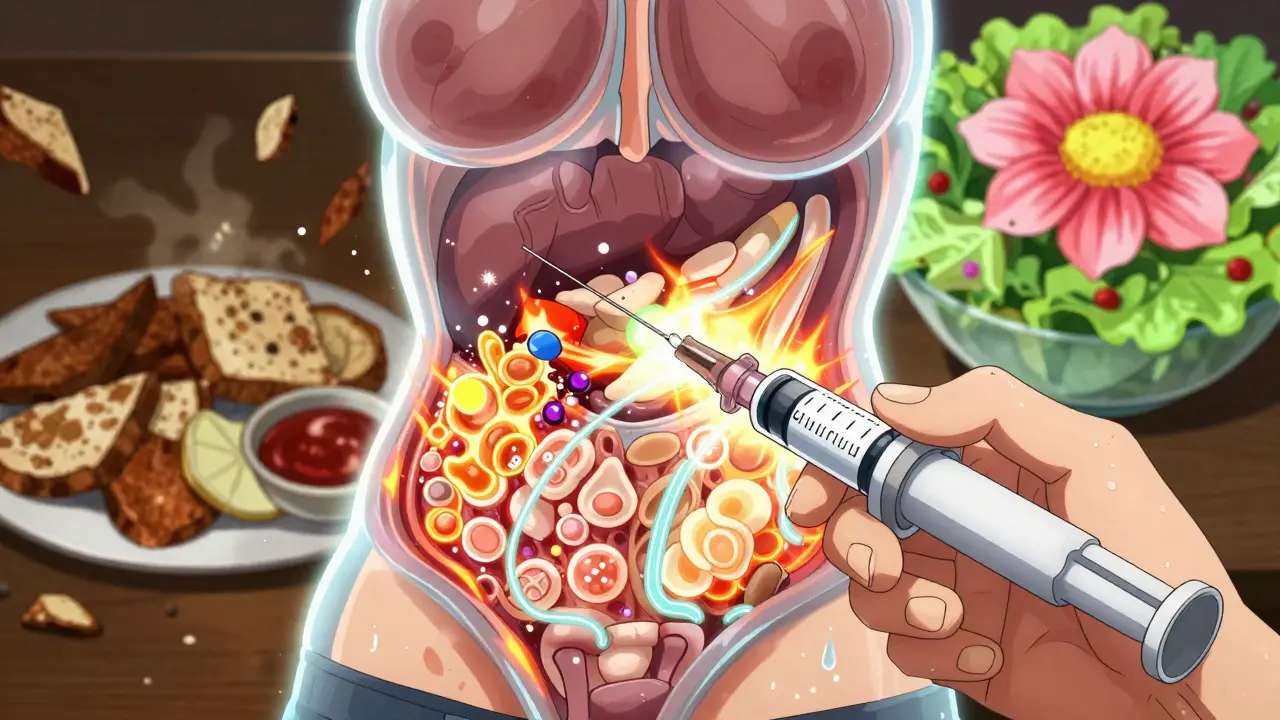
Let’s be honest: the biggest complaint isn’t cost or access. It’s nausea. About 20-25% of people feel nauseous when starting. Vomiting happens in 7-10%, diarrhea in 15-18%. These aren’t rare. They’re common.
But here’s the key: most of these side effects fade. They’re worst during the first 4-8 weeks while your body adjusts to higher doses. People who rush the dose escalation - jumping from 2.5 mg to 5 mg too fast - are far more likely to quit. The FDA-approved schedule takes 20 weeks to reach the full dose. That’s not a suggestion. It’s a requirement for tolerability.
Many users report that eating smaller meals, avoiding greasy or spicy foods, and injecting right before a meal helps. Some take ginger tea or over-the-counter anti-nausea meds like dimenhydrinate during the first few weeks. If you’ve used semaglutide before, you’ll likely handle tirzepatide better - your body already knows how to adjust.
One user on Reddit, u/StrugglingWithSideEffects, stopped at 10 mg because the nausea was unbearable. They didn’t know about the slow titration. That’s the mistake. Give your body time. The side effects get better. The weight loss keeps going.
Dosing and How to Take It Right
Tirzepatide is a once-weekly injection. You inject it under the skin - stomach, thigh, or upper arm. It comes in pre-filled pens. No mixing. No refrigeration after first use. Just keep it cool before you open it.
The starting dose is 2.5 mg once a week. You stay there for four weeks. Then you go to 5 mg for four weeks. Then 10 mg. Then 15 mg. Each step is one month apart. Some people need to stay longer at 5 mg or 10 mg if they’re still feeling side effects. That’s fine. You don’t have to rush.
Most people reach the 15 mg dose by week 20. That’s where the biggest weight loss happens. In trials, people on 15 mg lost nearly twice as much weight as those on 5 mg. If you’re not seeing results by month 6, talk to your doctor about increasing the dose - if you can tolerate it.
Storage matters: keep unopened pens in the fridge. Once opened, they’re good for 4 weeks at room temperature. Don’t freeze them. Don’t shake them. Just inject and go.
Who Shouldn’t Take It?
Tirzepatide isn’t for everyone. If you or a close family member has had medullary thyroid cancer, you can’t take it. The FDA requires a warning because rodent studies showed thyroid tumors. No human cases have been confirmed, but the risk isn’t zero.
It’s also not recommended if you have a history of pancreatitis. While the risk is low, any drug that affects insulin and digestion can trigger flare-ups. If you’ve had gallstones or severe digestive issues in the past, talk to your doctor first.
It’s not approved for pregnant women. If you’re trying to get pregnant, stop tirzepatide at least two months before conception. The drug stays in your system for weeks.
And if you’re on insulin or other diabetes meds, your doctor will need to adjust those. Tirzepatide lowers blood sugar. Too much can cause hypoglycemia.
Cost, Insurance, and Access
The list price is around $1,023 for a 4-week supply. That sounds impossible. But here’s the truth: most people pay way less.
Thanks to Eli Lilly’s co-pay assistance program, 89% of commercially insured patients pay under $100 a month. Many pay $45-75. If you have Medicare or Medicaid, coverage varies by state, but many plans now cover Zepbound for obesity.
Uninsured? The Lilly Cares Foundation offers free medication to qualifying low-income patients. You’ll need to apply, but it’s doable. Don’t assume it’s out of reach. The cost has dropped dramatically since launch.
Insurance approval can take time. Some doctors start with a letter of medical necessity. Others use step therapy - trying semaglutide first. But with tirzepatide’s proven superiority, more insurers are approving it directly now.

What Happens When You Stop?
This is the big question no one wants to ask. If you stop tirzepatide, you’ll likely regain weight. Studies show people regain about 12-15% of lost weight within six months of stopping. That’s not failure. It’s biology.
Obesity is a chronic condition. Just like high blood pressure or type 2 diabetes, it often needs ongoing treatment. Tirzepatide doesn’t cure it. It manages it.
Dr. John Morton from Yale puts it bluntly: “Like all obesity drugs, benefits are maintained only while actively taking the medication.”
That doesn’t mean you have to stay on it forever. Some people use it for 1-2 years to kickstart weight loss, then transition to diet, exercise, and behavioral changes. Others stay on it long-term. It’s personal. Talk to your doctor about your goals. If you’re planning to stop, have a plan for maintenance. Don’t just quit cold.
What’s Next? The Future of Weight Loss Drugs
Tirzepatide isn’t the end. It’s the beginning. Eli Lilly already has a triple agonist in phase 3 trials - retatrutide - that targets GLP-1, GIP, and glucagon. Early results show 24.2% weight loss in 24 weeks. That’s even more than tirzepatide.
And it’s not just about weight. In October 2024, Zepbound got FDA approval for treating obstructive sleep apnea in adults with obesity. That’s huge. Sleep apnea isn’t just snoring - it’s linked to heart disease, stroke, and early death. Tirzepatide helps fix that too.
Researchers are also studying it for fatty liver disease (NASH), heart failure, and even Alzheimer’s. The same pathways that help with weight loss may protect the brain and liver.
One thing’s clear: the era of single-target weight loss drugs is over. The future is multi-target. And tirzepatide is the proof it works.
Final Thoughts: Is It Worth It?
If you’ve tried dieting, exercise, and other medications without lasting results, tirzepatide might be the most powerful tool you’ve had. It’s not easy. It’s not cheap. But it works - better than anything else on the market.
It’s not for everyone. If you can’t handle nausea, or if you’re not ready for a long-term commitment, it might not be right. But if you’re serious about losing weight and keeping it off - and you’re willing to work with your doctor through the side effects - this is the most effective option we have today.
It’s not a miracle. But it’s the closest thing we’ve seen in decades.

Janice Holmes
December 28 2025Tirzepatide isn't just a drug-it's a biological revolution. Dual incretin activation? That's not incremental. That's a paradigm shift. GLP-1 was the first domino. GIP is the second. Together? They don't just knock down appetite-they obliterate metabolic inertia. I've seen patients lose 30% of their body weight. Not 20. Not 16. 30. And the fat loss? It's visceral. It's deep. It's life-changing. This isn't weight loss. This is metabolic rebooting.
Nicola George
December 28 2025So you're telling me this magic shot makes you lose weight but you still have to not eat pizza? Groundbreaking.
Caitlin Foster
December 30 2025OMG I just hit 15mg and my jeans are literally falling off-I’m not even trying!! I used to cry over salad. Now I eat it like it’s my job. 🙌 #ZepboundMagic
Olivia Goolsby
December 30 2025Let me guess: Big Pharma paid off the FDA, the NIH, the doctors, the influencers, and even the guy who runs the grocery store. Tirzepatide? It’s not medicine-it’s a chemical leash. They don’t want you healthy-they want you dependent. Look at the side effects: nausea, vomiting, diarrhea… that’s not science. That’s a warning label written in blood. And don’t get me started on the thyroid cancer risk-rodent studies? They’ve been lying about that since thalidomide. You think they’d approve this if it were safe? Wake up. This is a profit engine disguised as a cure.
John Barron
December 30 2025While I appreciate the clinical data presented, I must emphasize that the statistical significance of the SURMOUNT-1 trial (p < 0.001) is not merely impressive-it is statistically definitive. Moreover, the effect size (Cohen's d = 1.87) places it in the 'very large' category per Cohen's conventions. Additionally, the pharmacokinetic profile demonstrates a half-life of approximately 5 days, supporting once-weekly dosing with minimal fluctuation. One must also consider the GLP-1/GIP receptor binding affinity ratio of 3.2:1, which is optimal for sustained metabolic modulation. In conclusion, this is not merely a pharmaceutical advancement-it is a milestone in metabolic endocrinology.
Will Neitzer
December 30 2025I’ve guided dozens of patients through tirzepatide, and the most common mistake isn’t the dose-it’s the mindset. People think it’s a shortcut. It’s not. It’s a tool. A powerful one. But if you use it to justify bingeing on donuts because ‘the drug will fix it,’ you’re setting yourself up for disappointment. The best outcomes come from people who pair it with mindful eating, not elimination. I tell them: ‘This doesn’t remove hunger-it removes the tyranny of it.’ You still choose what to eat. You just choose better. And that’s the real win.
dean du plessis
December 30 2025Been on it 4 months at 10mg. Lost 42 lbs. Nausea was brutal at first but eased after 6 weeks. Still eat carbs. Still drink coffee. Just smaller portions. No magic. Just biology. Glad it works.
Liz MENDOZA
December 31 2025Thank you for writing this so clearly. I’ve been scared to start because of the side effects, but reading about how they fade really helps. I’m talking to my doctor next week. If you’ve been through this, I’d love to hear how you handled the first few weeks. No pressure-just know someone’s listening.
Alex Lopez
January 1 2026For those asking about the cost: I had a patient on Medicare Advantage who paid $12/month after applying for Lilly Cares. The paperwork took 3 weeks. Worth it. Also-yes, you can drink alcohol. Just not on an empty stomach. And no, it doesn’t make you ‘high.’ Stop Googling that.
Monika Naumann
January 2 2026Western medicine continues its obsession with chemical dependency over traditional wisdom. In India, we have Ayurveda, yoga, and fasting-practices refined over millennia. Why are we surrendering to a patented injection? This is not progress. It is surrender. The body is not a machine to be hacked. It is a sacred system. Tirzepatide may work-but at what cost to our cultural and biological integrity?
Elizabeth Ganak
January 3 2026my cousin tried it and said the nausea was bad but she cried when she saw her reflection after 3 months. she’s not even trying to be thin-just healthier. now she walks 5k steps a day. that’s the real win.
James Bowers
January 3 2026It is imperative to note that the 22.5% weight loss figure cited is derived from a cohort with a mean BMI of 42.8. Extrapolation to populations with lower baseline BMI is statistically invalid. Furthermore, the attrition rate in SURMOUNT-1 was 18.3%-a significant proportion of whom discontinued due to gastrointestinal intolerance. To present this as universally effective is misleading. The data supports efficacy in specific subpopulations-not a panacea.
Elizabeth Alvarez
January 5 2026Did you know that the same company that makes tirzepatide also owns a patent on the algorithm that tells you your BMI? And that the FDA’s advisory panel had a financial tie to Eli Lilly? And that the clinical trial excluded anyone with a history of eating disorders-because they didn’t want the drug to look bad? This isn’t science. It’s a carefully curated illusion. The real reason they’re pushing this is because insurance companies are paying for it-and they don’t want you to know that weight loss through diet and movement is cheaper and safer. They want you addicted. And they want you paying monthly. This isn’t medicine. It’s a trap.