
Drug Label Safety Checker
This tool helps you identify if you might have contraindications or warnings for common medications based on your health conditions. Remember, this is for educational purposes only and does not replace professional medical advice. Always consult your doctor or pharmacist before making any changes to your medication.
Contraindication Alert
You have a potential contraindication that may require you to avoid this medication. This means the drug should NOT be taken under your current health conditions.
Consult your doctor or pharmacist immediately about this contraindication.
Warning Alert
You have a potential warning that may require additional monitoring or precautions with this medication.
You may still take the medication but should be aware of these risks and monitor for specific symptoms.
No Major Issues Found
Based on your inputs, no major contraindications or warnings appear to apply. However, always review the full drug label before taking any new medication.
This does not replace a professional medical consultation. Discuss your specific situation with your healthcare provider.
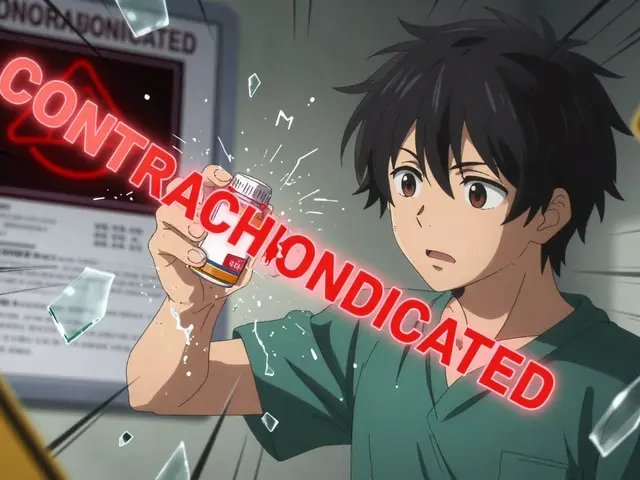
Every time you pick up a new prescription or grab a bottle of over-the-counter medicine, you’re holding a legal document that could save your life-or hurt you if you don’t understand it. The tiny print on the side of the box, the folded insert in the bag, the PDF you downloaded from your pharmacy’s website-it’s all part of something called drug labeling. And buried in there are two critical sections: contraindications and warnings. These aren’t just fine print. They’re your first line of defense against dangerous side effects, deadly interactions, and avoidable harm.
What’s the Difference Between a Contraindication and a Warning?
Think of contraindications as red lights. If you see one, you stop. No exceptions. A contraindication means the drug should not be used at all under certain conditions. For example, if you have severe liver disease, your doctor won’t prescribe certain painkillers because your body can’t process them safely. That’s an absolute contraindication. It’s not a suggestion. It’s a rule.
Warnings, on the other hand, are yellow lights. They don’t say “don’t take this.” They say, “be careful.” These are serious risks that might happen-but only under certain conditions. Maybe you have high blood pressure. Maybe you’re over 65. Maybe you’re taking another drug that reacts badly. The warning tells you what to watch for, when to call your doctor, and what to do if something goes wrong.
Here’s how they show up on different labels:
- Prescription drugs: Contraindications are in Section 4. Warnings are in Section 5. Boxed warnings (the big black rectangle at the top) are the most serious alerts.
- Over-the-counter (OTC) drugs: No separate sections. Everything is under “Warnings.” Look for phrases like “Do not use” (that’s a contraindication) and “Ask a doctor before use if...” (that’s a warning).
Spotting the Boxed Warning: The FDA’s Highest Alert
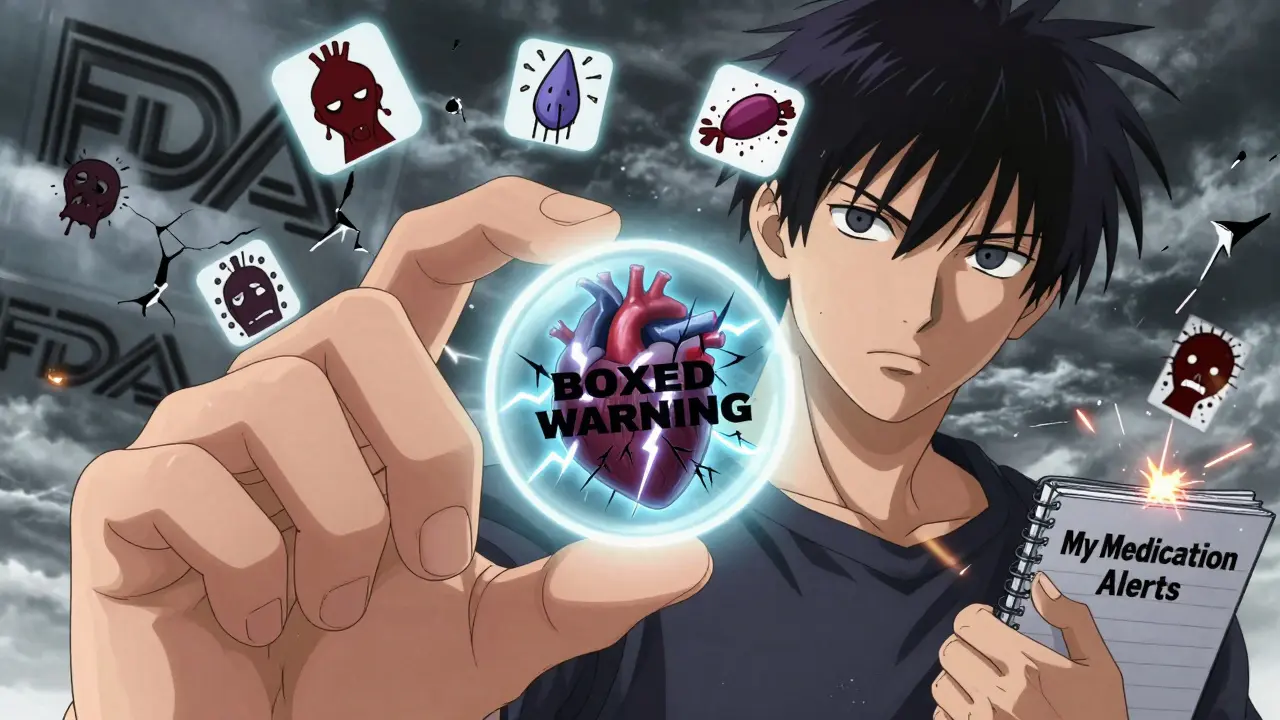
If you open a prescription drug’s full prescribing information and see a thick black border around a paragraph, that’s a boxed warning. It’s the FDA’s strongest safety signal. These aren’t added lightly. They’re reserved for risks that can cause death or serious injury.
Examples:
- Warfarin (Coumadin): Boxed warning for major or fatal bleeding.
- Bupropion (Wellbutrin): Boxed warning for increased risk of suicidal thoughts in young adults.
- Insulin glargine (Lantus): Boxed warning for hypoglycemia if used incorrectly.
These warnings are placed at the very top of the label because they’re meant to be seen first-even before you read the rest. If you see a boxed warning, don’t skip it. Don’t assume your doctor already knows. Ask: “Why is this here? What does it mean for me?”
Reading Contraindications Like a Pro
Contraindications are short, blunt, and specific. They don’t say “maybe” or “possibly.” They say “do not use if...”
Here’s how to decode them:
- “Hypersensitivity to any component of this product.” That means if you’ve ever had a rash, swelling, or trouble breathing after taking any ingredient in this drug-even something you didn’t know was in it-you shouldn’t take it.
- “Active bleeding.” Not “history of bleeding.” Not “mild bruising.” Active means it’s happening right now. If you’re on blood thinners and you’ve had a recent nosebleed or stomach ulcer, this applies.
- “Severe renal impairment.” Don’t guess what “severe” means. Your doctor will check your kidney function with a blood test. If your eGFR is below 30, this contraindication kicks in.
One common mistake? Assuming a contraindication doesn’t apply because “it’s not that bad.” A patient once told me they were told not to take rivaroxaban because of “high bleeding risk,” but they’d only had a minor cut last year. They didn’t realize the label meant current or ongoing bleeding risk. That’s why specificity matters. If the label says “severe,” “active,” or “uncontrolled,” those words aren’t there by accident.
Understanding Warnings and Precautions
This section is longer. It’s dense. It lists everything that could go wrong-from common side effects to rare but deadly ones. But here’s the trick: it’s ordered by severity. The most dangerous risks come first.
Look for these phrases:
- “Serious infections including...” (e.g., tuberculosis, fungal infections) - This means your immune system might be suppressed. If you’ve had TB before, or live in an area where it’s common, your doctor needs to screen you.
- “May increase risk of...” - This is where numbers matter. If it says “increases risk of heart attack by 1.8 times in patients over 65,” that’s a concrete number. Compare it to your age, your history, your family’s health.
- “Monitor for...” - This tells you what to watch for. Maybe it’s liver enzymes, blood pressure, or mood changes. Write down what you’re supposed to check and when.
- “Discontinue if...” - If you develop a rash, sudden swelling, or unexplained fatigue, stop the drug and call your doctor. Don’t wait. Don’t power through.
Many patients miss the hidden meaning here. Warnings aren’t just about what the drug does to you. They’re about what you do to the drug. If you drink alcohol, take other meds, have kidney disease, or are pregnant-those things change how the drug behaves in your body. The warning tells you which combinations are dangerous.
OTC Labels: Don’t Skip the Warnings Section
You might think OTC drugs are safe because you can buy them without a prescription. But that’s not true. The FDA requires the same level of safety info on OTC labels-just formatted differently.
On the Drug Facts label, look for:
- “Do not use” - This is your contraindication. Example: “Do not use if you are allergic to aspirin.”
- “Ask a doctor before use if...” - This is your warning. Example: “Ask a doctor before use if you have high blood pressure, heart disease, or diabetes.”
- “Stop use and ask a doctor if...” - This is your emergency signal. Example: “Stop use and ask a doctor if you experience ringing in the ears or dizziness.”
A 2022 FDA study found only 52% of people could correctly identify a contraindication on an OTC label. That’s almost half of people taking pills they shouldn’t. Don’t be one of them. Read the “Warnings” section like you’re reading a safety manual for a power tool. Because that’s what it is.
What to Do When You Don’t Understand
It’s okay to be confused. Drug labels are written for doctors, not patients. But you don’t have to guess.
Before you take any new medication, ask your pharmacist or doctor these three questions:
- “Is there anything in the contraindications that applies to me?”
- “What’s the most serious warning here-and what should I watch for?”
- “If I notice [symptom], should I stop the drug right away, or call you first?”
Also, write down your answers. Don’t rely on memory. Keep the label. Take a photo of the “Warnings” section. Bring it to your next appointment.
And if your pharmacist hesitates to fill your prescription because of a warning? Don’t argue. Ask them to explain why. They’re trained to spot these things. They might be protecting you.
Why This Matters More Than You Think
The Institute of Medicine estimates that poor drug labeling contributes to over 1.3 million injuries in the U.S. every year. That’s not a small number. That’s more than all car accidents combined. Most of these aren’t from bad doctors or bad drugs. They’re from people not knowing what the label says.
The FDA has spent over $150 million trying to fix this. They’ve added boxed warnings, standardized formats, and even tested color-coded risk levels. But until you learn to read these labels yourself, you’re still at risk.
Medications save lives. But they can also kill you-if you don’t know how to read the signs. The difference between safety and danger isn’t always in the pill. Sometimes, it’s in the paragraph you skipped.
What’s the difference between a contraindication and a warning on a drug label?
A contraindication means you should not take the drug at all under certain conditions-like having severe liver disease or an allergy to an ingredient. It’s a hard stop. A warning tells you about serious risks that require caution-like increased chance of bleeding or infection-but doesn’t necessarily mean you can’t take the drug. You might still use it, but with monitoring, dose changes, or extra care.
What does a boxed warning mean?
A boxed warning is the FDA’s strongest safety alert. It appears as a black rectangle at the top of a prescription drug’s labeling and highlights risks that could cause death or serious injury. Examples include life-threatening bleeding with blood thinners or suicidal thoughts with certain antidepressants. These warnings are required to be reviewed and updated within 30 days of new safety data becoming available.
Can I still take a drug if it has a contraindication?
No-if the contraindication applies to you, you should not take the drug. Contraindications are based on strong evidence of harm. Even if your symptoms seem mild, the risk might be too high. Always confirm with your doctor or pharmacist whether your specific condition matches the contraindication exactly.
Why do some OTC labels say “Ask a doctor before use if...”?
This phrase signals a precaution-a situation where the drug might be risky for you but isn’t completely forbidden. It means you should talk to a healthcare provider first if you have conditions like high blood pressure, kidney disease, are pregnant, or take other medications. It’s not a contraindication, but it’s a red flag that needs attention.
How can I tell if a warning applies to me?
Look for specific details: age, existing conditions, lab values, or other drugs you’re taking. If a warning says “in patients over 65” and you’re 67, it applies. If it says “with severe kidney disease” and your eGFR is 45, it likely doesn’t. Don’t guess-ask your doctor to explain how the warning relates to your health history.
What should I do if I see a new warning on my medication label?
Don’t panic. First, compare the new warning to your current health. If it doesn’t apply to you, you may not need to change anything. But if it does-like a new interaction with a drug you’re now taking-contact your doctor or pharmacist right away. The FDA requires updates within 30 days of new safety data, so these changes are important.
Next Steps: Make This a Habit
Reading drug labels isn’t a one-time task. It’s a skill you build over time. Start with one new prescription. Read the label before you take the first pill. Highlight the contraindications and warnings. Write down your questions. Bring it to your next appointment.
Keep a small notebook or a digital note on your phone titled “My Medication Alerts.” List each drug, its boxed warning, and the top two risks you need to watch for. Update it every time you get a new prescription or refill.
And if you ever feel unsure-ask. Pharmacists are trained to explain these labels. Doctors expect you to ask. You’re not being difficult. You’re being smart.
John Hay
December 21 2025Most people don’t realize that contraindications are legally binding, not suggestions. I’ve seen pharmacists ignore them because the patient ‘seems fine.’ That’s how people end up in the ER. If the label says ‘do not use with severe liver disease,’ and your ALT is 120, you’re not ‘fine.’ Stop guessing. Ask for the lab results. Your life isn’t a gamble.
Stacey Smith
December 22 2025OTC drugs are just as dangerous as prescriptions. The FDA lets companies bury warnings in tiny font because they know most people won’t read them. This isn’t oversight-it’s profit-driven negligence.
Jason Silva
December 23 2025Did you know the FDA gets pressured by Big Pharma to delay boxed warnings? I’ve seen internal emails from 2018 where they buried a cardiac risk for 14 months because ‘sales were down.’ That’s why I always cross-check with Medscape and the WHO database. The label? It’s a marketing tool. The truth? You need to dig deeper. 🕵️♂️
mukesh matav
December 24 2025Back in India, we don’t get detailed inserts. Most people just trust the doctor or the pharmacy. I wish we had this kind of clarity. Maybe we need a global standard-not just for the US. People die everywhere because of this.
Theo Newbold
December 25 2025Let’s be real: 90% of patients can’t interpret eGFR values or understand what ‘active bleeding’ means. The entire system is designed to keep them dependent. The real solution? Remove all OTC meds from shelves and make every drug prescription-only. Then you’ll see compliance.
Adrian Thompson
December 25 2025Boxed warnings? More like boxed lies. They put those on drugs after lawsuits, not science. Look at metformin-used for 60 years, now suddenly it’s ‘risk of lactic acidosis’? That’s a scare tactic to push newer, pricier drugs. The FDA’s not protecting you. They’re protecting the patent clock.
Southern NH Pagan Pride
December 26 2025they dont want you to know that the 'warnings' section is often written by lawyers, not doctors. and the contraindications? mostly based on studies funded by the same company that makes the drug. i found a 2019 internal memo that said 'keep the language vague so patients dont panic but doctors still feel pressured to prescribe.' i'm not paranoid. i'm informed. 🤫
Orlando Marquez Jr
December 27 2025While the article provides a commendable and methodical framework for interpreting pharmaceutical labeling, it is imperative to acknowledge the structural inequities in health literacy that render such guidance inaccessible to a significant portion of the population. The burden of comprehension is disproportionately placed upon the patient, despite systemic failures in public health education. A more equitable approach would involve mandatory, standardized patient counseling sessions at point of dispensing, delivered in culturally and linguistically appropriate formats. This is not merely a matter of individual responsibility-it is a public health imperative.