
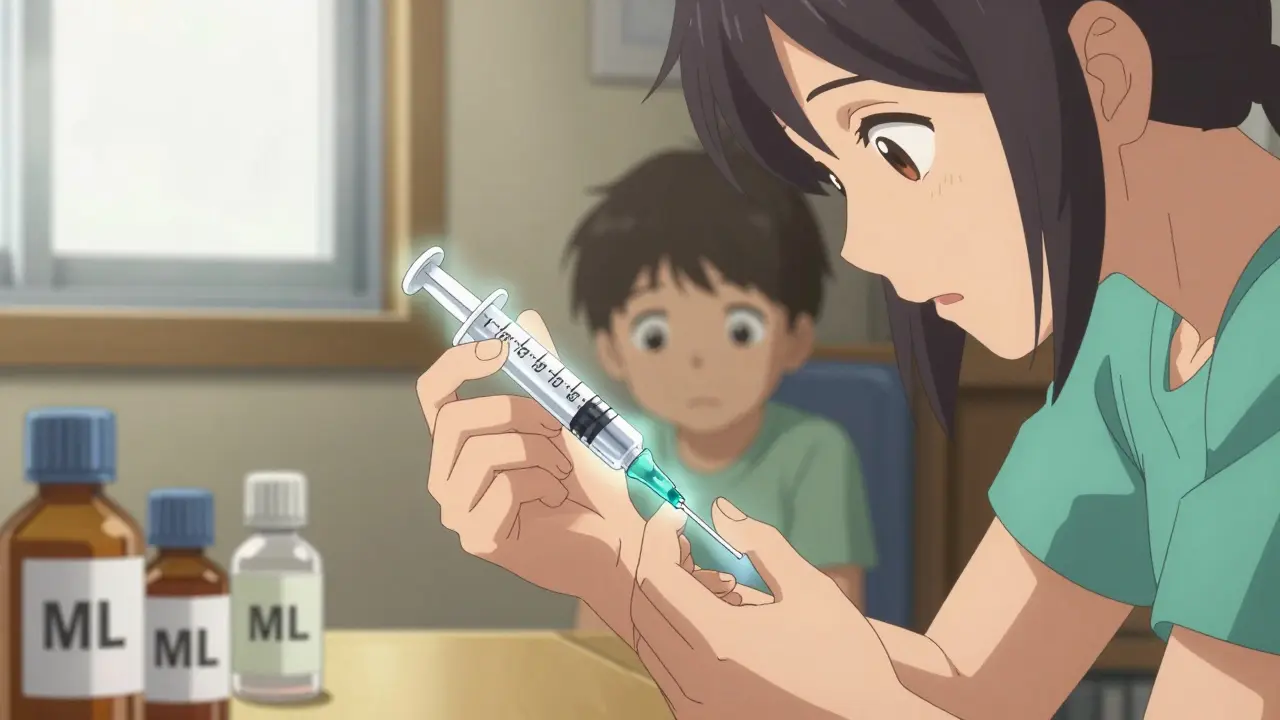
Giving liquid medicine to a child isn’t as simple as pouring it into a spoon. One wrong milliliter can mean the difference between relief and danger. Dosing syringes are the gold standard for giving kids their medicine, and if you’re using a kitchen spoon or even a cup, you’re risking an overdose or underdose. The American Academy of Pediatrics says 40% of parents make dosing mistakes with liquid meds - and most of those errors come from using the wrong tool. But with the right syringe and the right technique, you can cut that risk by over 80%.
Why Dosing Syringes Are the Only Safe Choice
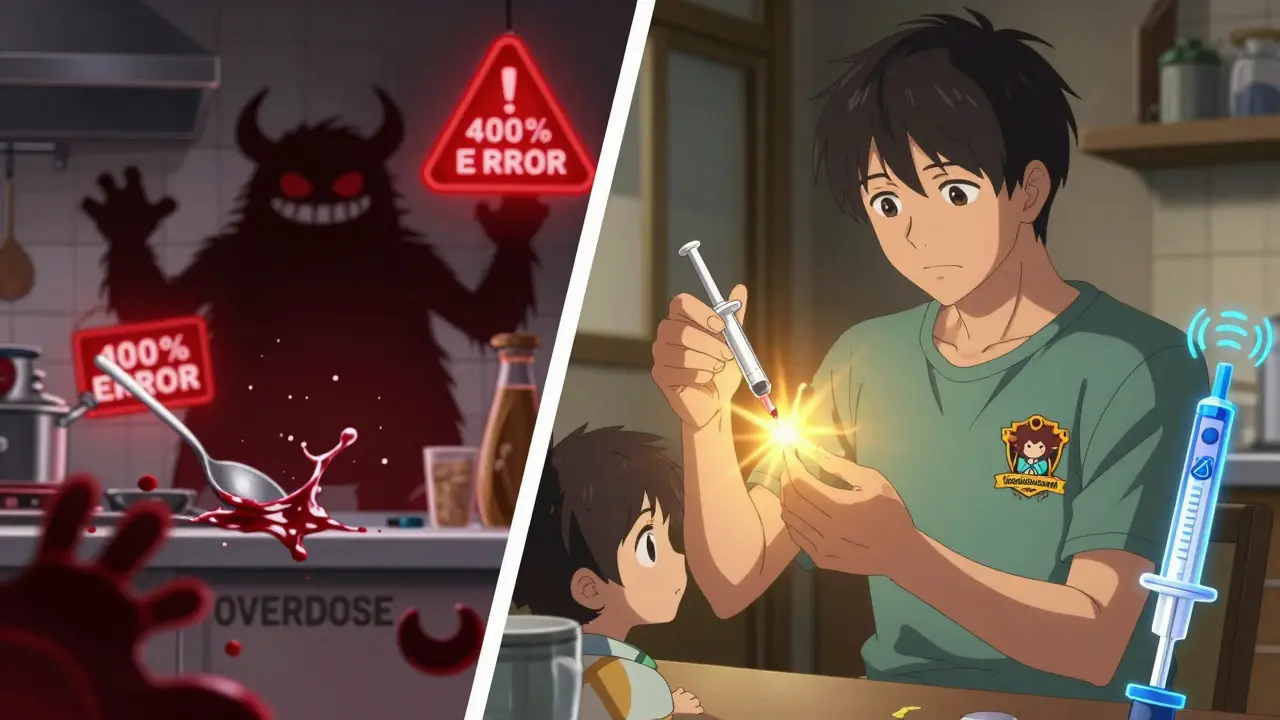
Kitchen teaspoons aren’t just inaccurate - they’re dangerous. A regular spoon can hold anywhere from 2.5 to 10 milliliters. That’s a 400% variation. One parent might give 5 mL thinking it’s a teaspoon, while another gives 10 mL with the same spoon. That’s a full double dose of acetaminophen or ibuprofen - enough to cause liver damage or stomach bleeding. Oral syringes, on the other hand, are calibrated to within ±5% accuracy. They’re designed for kids’ tiny doses - often under 3 mL. The FDA banned teaspoons and tablespoons from prescription labels in 2018 because they were causing 1 in 5 dosing errors. Now, every bottle says “mL” only. That’s because medical experts agree: if you’re giving liquid medicine to a child under 6, you need a syringe.Choosing the Right Syringe Size
Not all oral syringes are the same. They come in four sizes, each for a different dose range:- 1 mL syringe - for doses under 1 mL (like some antibiotics or heart meds). Marked in 0.01 mL increments.
- 3 mL syringe - for 1-3 mL doses (most common for fever reducers). Marked in 0.1 mL increments.
- 5 mL syringe - for 3-5 mL doses (like higher doses of ibuprofen). Marked in 0.2 mL increments.
- 10 mL syringe - for doses over 5 mL (rare, but used for some antibiotics or antifungals). Marked in 0.5 mL increments.
Always pick the smallest syringe that can hold your child’s dose. A 10 mL syringe for a 1.5 mL dose is like using a garden hose to water a single plant - you won’t measure accurately. Most pharmacies give you a 3 mL syringe with prescriptions because it covers the most common doses.
How to Draw the Right Dose
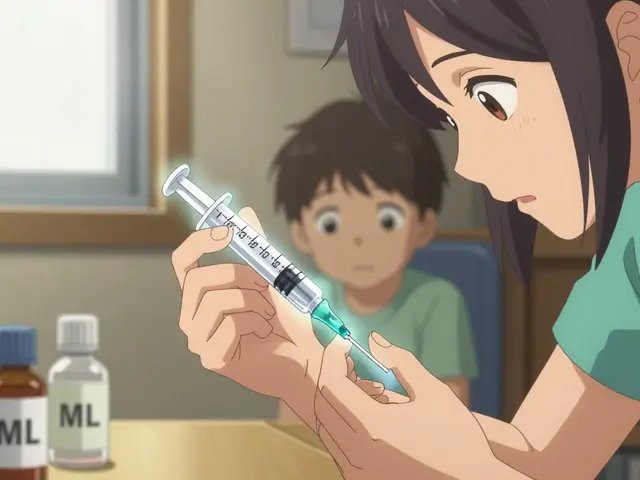
Follow these steps every single time:- Shake the bottle for 10-15 seconds. Liquid meds often settle. If you don’t shake, you might give too much of the active ingredient or too little.
- Remove the cap and insert the syringe tip into the bottle. Don’t let the tip touch anything else - keep it clean.
- Pull the plunger back slowly until the top edge of the rubber stopper lines up with your child’s exact dose mark. Don’t guess. Don’t eyeball it. Look at the lines on the syringe - they’re tiny for a reason.
- Check the dose twice. Hold the syringe up to the light. Is the liquid exactly at the right line? If not, start over.
- Don’t fill the syringe to the top. That’s a common mistake. You’re measuring the liquid level, not the plunger position.
Some parents struggle with thick meds like amoxicillin. If it’s hard to pull up, try warming the bottle in your hand for a minute. Don’t use hot water - it can break the medicine’s effectiveness. And never use a needle syringe. Even if it fits, it’s dangerous. Oral syringes have a wide tip so they can’t be used for injections.
How to Give the Medicine Without a Fight
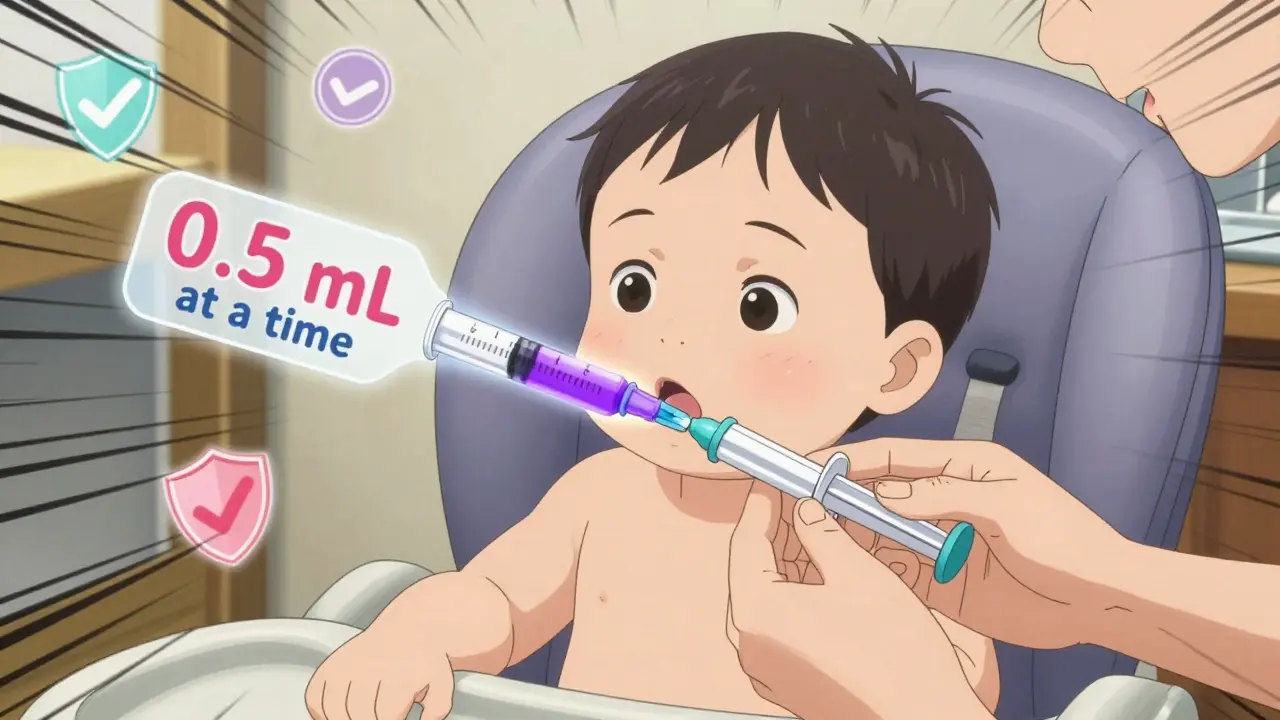
The hardest part isn’t measuring - it’s getting the child to swallow it. Most parents make the same mistake: they squirt it straight to the back of the throat. That’s how choking starts. Here’s what works:- Keep your child sitting upright. Never lay them flat.
- Place the syringe tip between the cheek and gum, not between the teeth. This avoids biting and makes swallowing easier.
- Push the plunger slowly - just 0.5 mL at a time. Wait 5-10 seconds between each push. Let them swallow naturally.
- Don’t force it. If they gag or spit, stop. Wait a minute, then try again with less at a time.
Many parents report success by letting the child hold the syringe themselves. It gives them control. Others use a pacifier after the dose to soothe the taste. You can also mix the dose with a small amount of applesauce or yogurt - but only if the medicine label says it’s okay. Some antibiotics lose effectiveness if mixed.
What to Avoid
Here are the top mistakes parents make - and how to fix them:- Using a kitchen spoon - Even if it’s labeled “teaspoon,” it’s not accurate. Use the syringe every time.
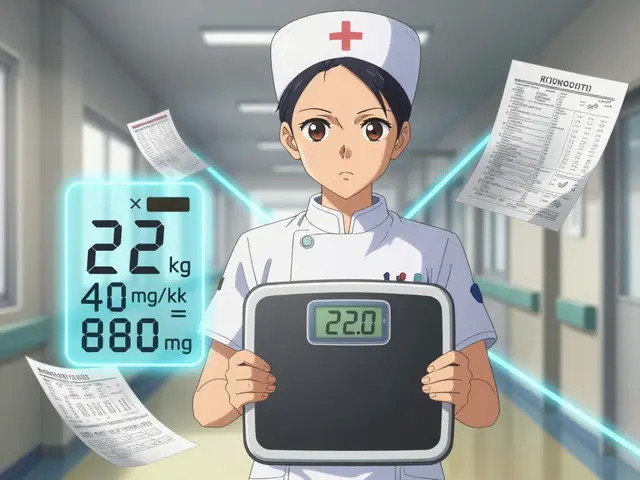
- Not checking the label - Doses change with weight. Your 20-pound toddler might need 5 mL, but your 40-pound child needs 10 mL. Always check the weight-based dose.
- Forgetting to remove the cap - The cap is a choking hazard. Always take it off before drawing the dose.
- Using the wrong syringe - A 10 mL syringe for a 1 mL dose = inaccurate. Always use the smallest size that fits.
- Reusing syringes - If it’s not labeled “reusable,” throw it away after one use. Bacteria grow in leftover medicine.
One parent on Reddit said switching from a cup to a syringe dropped her toddler’s fever from 104°F to 101°F in one dose - because she’d been giving too little before. That’s the power of precision.
What About Oral Dispensers?
Oral dispensers are the same thing as oral syringes - just a different name. Some brands call them “oral dosers,” “medication dispensers,” or “liquid medicine syringes.” They all work the same way. But avoid anything labeled “dosing cup” or “measuring cup” for kids under 3. Even the best cups have 12-18% error rates for small doses. Syringes don’t.For older kids (over 5) who can drink from a cup without spilling, a dosing cup is fine for doses over 5 mL. But for infants and toddlers, syringes are non-negotiable.
Color-Coded Syringes and Smart Tech
Newer syringes come with color-coded plungers: green for acetaminophen, purple for ibuprofen. This helps prevent mix-ups - especially if you keep both meds at home. Some pharmacies now offer them for free. In 2023, the FDA approved the first color-changing syringe. It turns from blue to green when you’ve drawn the right dose. In trials, it cut measurement errors by 37%. And by late 2025, smart syringes with Bluetooth will connect to apps that track when and how much your child took. But for now, the basic plastic syringe - used correctly - is still the most reliable tool you have.When to Call the Doctor
Call your pediatrician if:- Your child spits up the full dose within 10 minutes - they may need a repeat dose.
- You’re unsure how much you gave - don’t guess. Call the pharmacy.
- Your child has a reaction - rash, vomiting, trouble breathing.
- The medicine looks cloudy or has particles - don’t use it.
Always keep the original bottle and syringe together. If you lose the syringe, ask the pharmacy for a new one. Don’t borrow one from a neighbor. Doses vary.
Can I use a syringe from an old prescription?
Only if it’s clean, undamaged, and the right size for the new dose. But it’s safer to get a new one from the pharmacy. Old syringes can have dried medicine inside, which blocks the tip or changes the dose. Most pharmacies give them for free.
What if my child bites the syringe?
Biting is common, especially with teething toddlers. Use a syringe with a soft, rounded tip - many brands offer silicone-coated ones. You can also try giving the medicine with a spoon after drawing it into the syringe, or use a pacifier to distract. Never use a needle syringe - even if it fits.
How do I clean the syringe?
Rinse it with cool water right after use. Don’t use soap unless the instructions say so - some medicines react to soap residue. Let it air dry on a clean paper towel. Store it in a clean, dry place - not in the medicine cabinet with other pills.
Why do some syringes say “for oral use only”?
It’s a safety feature. In the past, people accidentally gave oral syringes through IV lines, causing serious injuries. Since the FDA required this label in 2010, those incidents have dropped by 92%. Never use an oral syringe for anything but the mouth.
Is it okay to mix medicine with juice or milk?
Only if the doctor or label says yes. Some antibiotics (like amoxicillin) lose strength if mixed with dairy. Others can be mixed with apple juice to hide the taste. Always check first - and if you do mix it, make sure your child drinks the whole thing.
Sally Denham-Vaughan
January 1 2026Just used a syringe for the first time with my 2-year-old last week. No more crying, no more spilled medicine, no more guessing. It’s weird how something so simple changes everything. I used to think spoons were fine until I saw the dose chart. Now I keep three syringes in the fridge with the meds. Game changer.
Liam George
January 3 2026Let’s be real - this whole syringe thing is just corporate propaganda disguised as safety. The FDA banned teaspoons because pharmaceutical companies wanted to sell you branded syringes at $5 a pop. Meanwhile, parents have been giving kids medicine with spoons for centuries. You think your 0.1 mL precision matters when the medicine’s already been diluted by industrial supply chains? The real danger is trusting a system that profits off your fear. Wake up.
Austin Mac-Anabraba
January 4 2026Interesting how you frame this as a technical issue when it’s fundamentally a cognitive bias problem. Parents don’t make dosing errors because they’re stupid - they make them because they’re operating under bounded rationality. A 3 mL syringe doesn’t fix the fact that 78% of caregivers can’t reliably distinguish between 1.5 mL and 2.0 mL under stress. The real solution isn’t better tools - it’s better cognitive offloading. Like QR codes on bottles that auto-calculate dose based on weight, synced to a pharmacy database. Syringes are just Band-Aids on a systemic failure.
Also, the color-coded plungers? Brilliant. But why stop there? Why not integrate with Alexa to audibly confirm dose before administration? We’re in 2025, not 1995.
sharad vyas
January 5 2026In India, we use spoons because syringes are expensive and hard to find in small towns. But we also know our children’s bodies. We watch how they react. We adjust. Medicine is not just numbers - it’s love, patience, and observation. Maybe the West needs the syringe because it has lost touch with that. Not saying spoons are better. But maybe the answer is not just precision - it’s presence.
Richard Thomas
January 7 2026I’ve been thinking a lot about the philosophical implications of medical precision in parenting. We’ve moved from intuitive care - where a mother’s instinct guided dosage - to algorithmic compliance, where trust is outsourced to calibrated plastic. Is this progress? Or are we replacing embodied knowledge with institutional authority? The syringe gives us control, yes - but at the cost of surrendering our autonomy to a system that defines safety in milliliters, not in moments of comfort, in quiet cuddles after the dose, in the softness of a child’s breath after the fever breaks. We measure the liquid, but we forget to measure the love.
Paul Ong
January 8 2026Just got a 3 mL syringe from the pharmacy and it was free. Best thing I ever did. No more arguing with my kid. No more panic when the bottle says 5 mL and I’m not sure if that’s a spoon or what. I just pull it up and go. Done. Easy. Stop overthinking it. Use the syringe.
Andy Heinlein
January 9 2026OMG I just tried the cheek trick and my 18 month old didn’t spit it out once. I thought she’d hate it but she actually liked holding the syringe. Like a toy. And I gave her a pacifier after. Magic. Thank you so much for this post. I’ve been stressing for weeks.
Ann Romine
January 11 2026Does anyone know if the color-coded syringes are available outside the US? I’m in a rural area and my pharmacy only had the plain ones. I’d love to avoid mixing up ibuprofen and acetaminophen - especially since my twins are on different schedules.
Todd Nickel
January 11 2026One thing the article doesn’t address is the psychological resistance parents feel toward syringes. Many associate them with needles, injections, pain - even when they’re clearly labeled oral. This cognitive dissonance leads to avoidance behavior, which is why kitchen spoons persist. The solution isn’t just education - it’s rebranding. Call them ‘dosing wands’ or ‘medicinal sip tools.’ Remove the medical stigma. Make them feel like a parenting superpower, not a clinical tool. Language shapes behavior more than accuracy ever will.
Also, the 10 mL syringe for a 1 mL dose analogy is perfect. It’s like using a firehose to fill a thimble. But we do this all the time in parenting - overcomplicating simple things because we’re afraid of getting it wrong.
Layla Anna
January 11 2026My son used to gag every time I gave him medicine 😭 I tried everything - juice, ice cream, hiding it in pudding. Then I found the cheek trick and now he just sits there like it’s nothing. I even let him hold the syringe. He thinks he’s the doctor. 😅 Thank you for this. You saved my sanity.
Donna Peplinskie
January 12 2026I just want to say - thank you for writing this with such care. I’m a single mom, working two jobs, and I was terrified of giving the wrong dose. This didn’t just help me - it gave me peace. I printed it out and taped it to the fridge. I’m not alone in this. And I’m not failing. You made me feel seen.
Kristen Russell
January 14 2026Best parenting tip I’ve ever read. Do it. Just do it.
Bryan Anderson
January 15 2026Thank you for the detailed guidance. I particularly appreciated the note about not using soap to clean the syringe - I had assumed it was standard practice. Your attention to these subtle details reflects a deep understanding of both pharmacology and practical caregiving. I will be sharing this with my sister, who is expecting her first child next month.