
Getting the right dose of medicine for a child isn’t about age. It’s about weight. A 2-year-old weighing 10 kg needs a completely different amount of medicine than another 2-year-old weighing 15 kg. If you guess based on age alone, you could give too little - and the medicine won’t work - or too much - and risk serious harm. That’s why weight-based dosing is the gold standard in pediatric care.
Why Weight Matters More Than Age
Children aren’t small adults. Their bodies process medicine differently. Liver and kidney function, body fat, and water content change as kids grow. A 6-month-old and a 5-year-old might both be labeled as "toddlers," but their weights can differ by more than 50%. Giving the same dose to both could be dangerous.Age-based dosing charts - like "give 1 tsp for ages 1-3" - are outdated and risky. A 2022 study in Pediatric Pharmacology found that switching from age-based to weight-based dosing cut medication errors by 42%. Hospitals now require exact weights in kilograms before any dose is calculated. Even small mistakes can lead to big problems. One case reported in the Journal of Pediatric Pharmacology and Therapeutics involved a 15 kg child who got 10 times the correct dose of amoxicillin because the nurse misread pounds as kilograms. The child ended up in the hospital with severe vomiting and dehydration.
How Weight-Based Dosing Works
Every pediatric medication comes with a recommended dose in milligrams per kilogram (mg/kg). That means for every kilogram of body weight, the child gets a certain number of milligrams of medicine.Here’s the basic math:
- Get the child’s weight in kilograms (kg)
- Multiply that number by the dose per kg (e.g., 15 mg/kg)
- That gives you the total daily dose
- Divide by how many times a day the medicine is given
- Convert to volume if it’s a liquid (using the concentration on the bottle)
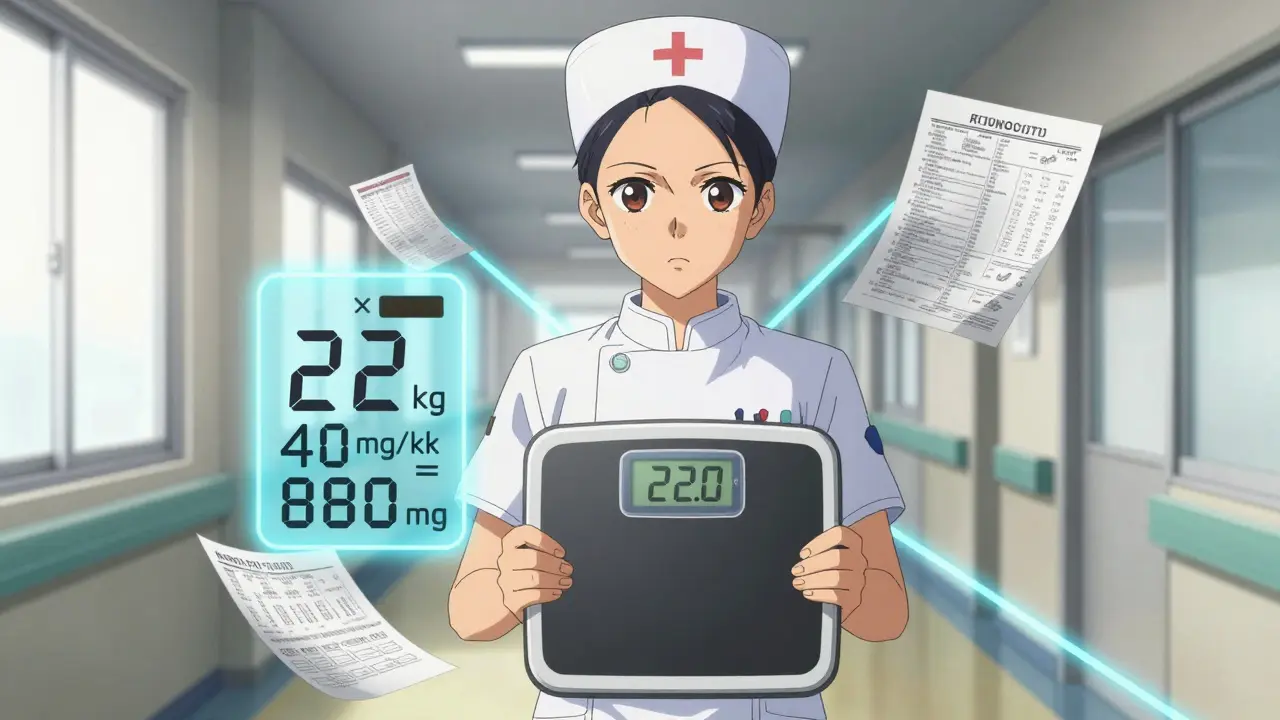
Example: A child weighs 22 kg and needs amoxicillin at 40 mg/kg/day, given twice daily. The liquid is 250 mg per 5 mL.
- 22 kg × 40 mg/kg = 880 mg total per day
- 880 mg ÷ 2 = 440 mg per dose
- 440 mg ÷ 250 mg per 5 mL = 8.8 mL per dose
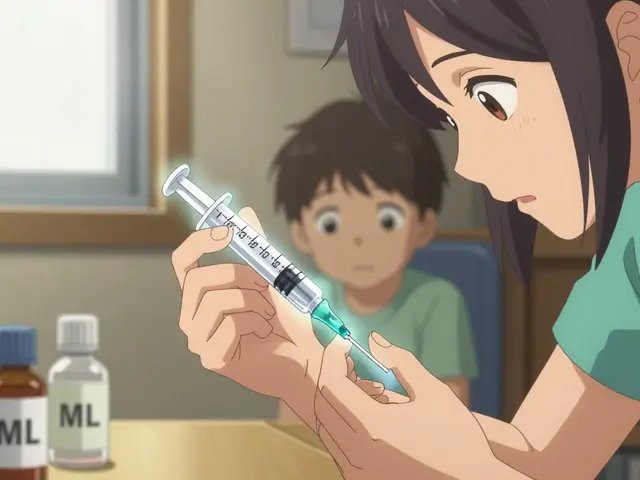
That’s 8.8 mL - not 9 mL. Precision matters. Using a syringe, not a spoon, ensures accuracy.
Unit Conversion: The Most Common Mistake
In the U.S., scales often show pounds. But every pediatric dosing guideline uses kilograms. That means you must convert pounds to kilograms. The rule is simple: divide pounds by 2.2.Example: A child weighs 56 pounds.
56 ÷ 2.2 = 25.45 kg
That’s not 25 kg. That’s 25.45 kg. Rounding too early can throw off the whole dose. A 2023 report from the Institute for Safe Medication Practices found that 80% of pediatric dosing errors come from wrong unit conversions. Nurses, doctors, and even parents have given wrong doses because they used 2.0 instead of 2.2, or forgot to convert at all.
Always double-check: 1 kg = 2.2 lb. Never assume. Write it down.

Concentration Confusion
Not all liquid medicines are made the same. Acetaminophen, for example, comes in two common concentrations:- Infant drops: 80 mg per 0.8 mL (or 160 mg per 5 mL)
- Children’s syrup: 160 mg per 5 mL
Parents often switch between these without realizing the difference. Giving a dose meant for infant drops using the children’s syrup can lead to a 2x overdose. St. Louis Children’s Hospital reports that 65% of parental dosing errors happen because of this mix-up.
Always check the label. Write down the concentration before you measure. If you’re unsure, ask a pharmacist. Never guess.
When Weight Isn’t Enough: Body Surface Area
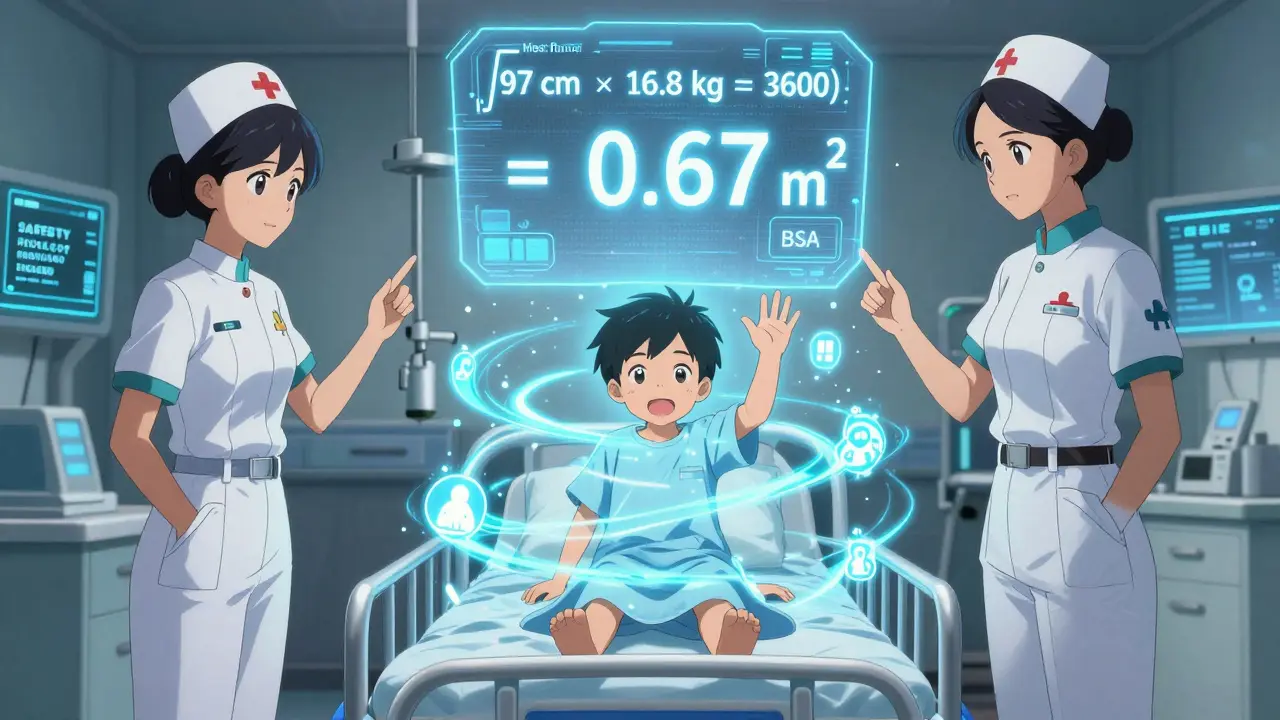
For some drugs - especially chemotherapy like vincristine or certain antibiotics - weight alone isn’t precise enough. These medications have a narrow safety window. Too little won’t help. Too much can be deadly.In those cases, doctors use Body Surface Area (BSA), measured in square meters (m²). The Mosteller formula is the standard:
BSA (m²) = √[height (cm) × weight (kg) ÷ 3600]
Example: A child is 97 cm tall and weighs 16.8 kg.
97 × 16.8 = 1629.6
1629.6 ÷ 3600 = 0.4527
√0.4527 = 0.67 m²
Then the dose is calculated as mg per m². This method is more accurate for kids who are very small or very large for their age. It’s standard in hospitals but rarely used at home.
What About Dosing Frequency?
Some orders say “mg/kg/day.” Others say “mg/kg/dose.” Big difference.If a prescription says “amoxicillin 80 mg/kg/day,” that’s the total for the whole day. You divide it by how many times you give it - usually 2 or 3 times.
If it says “80 mg/kg/dose,” that’s the amount for each time you give it. No division needed.
Confusing these two is one of the most common causes of medication errors. The Institute for Safe Medication Practices launched a 2023 initiative to stop writing “mg/kg/d” entirely. Now, they insist on writing out “per day” or “per dose” to avoid confusion.
Safety Protocols in Hospitals
Hospitals don’t rely on one person to do the math. They use layers of safety:- Electronic health records (like Epic or Cerner) auto-calculate doses when weight is entered
- Two nurses verify high-risk doses before giving them
- Standardized order sets prevent free-text dosing
- Weight is always entered in both pounds and kilograms to force conversion
A 2023 study in JAMA Pediatrics showed these systems reduce dosing errors by 57%. That’s why hospitals now treat pediatric dosing as a safety-critical task - not just math.
What Parents Should Know
You’re not expected to be a pharmacist. But you are responsible for giving the right dose at home.- Always weigh your child in kilograms. Use a pediatric scale if possible.
- Write down the weight, the dose per kg, the total daily dose, and the volume per dose.
- Use a syringe, not a teaspoon or tablespoon. Kitchen spoons vary too much.
- Check the concentration on the bottle every single time. Don’t assume it’s the same as last time.
- Never give adult medicine to a child, even if you cut it in half.
- Some medicines, like Benadryl, are unsafe for children under 2 years - no matter their weight.
When in doubt, call your pediatrician or pharmacist. Don’t rely on internet charts or apps that don’t ask for your child’s exact weight.
What’s Changing in 2026
New tools are coming. Children’s Hospital of Philadelphia is testing AI systems that compare your calculated dose against thousands of past doses. If your math is off by more than 15%, the system flags it. Early results show 92% accuracy.Also, the FDA now requires all new pediatric drugs to include weight-based dosing data. The Pediatric Research Equity Act ensures that drugs aren’t approved without proper dosing studies for kids.
Still, the core hasn’t changed: weight-based dosing saves lives. It’s not perfect, but it’s the best system we have. And it only works if you get the weight right, convert it right, and double-check everything.
How do I convert my child’s weight from pounds to kilograms?
Divide the weight in pounds by 2.2. For example, if your child weighs 44 pounds, 44 ÷ 2.2 = 20 kg. Never round until the final step. Use a calculator and write it down.
Can I use a kitchen spoon to give liquid medicine?
No. Kitchen spoons vary in size and can give you 30-50% more or less than the right dose. Always use a dosing syringe or oral dosing cup that comes with the medicine. These are marked in milliliters (mL) for accuracy.
Why does the same medicine come in different concentrations?
Manufacturers make different formulations for different age groups. Infant drops are more concentrated than children’s syrups. Mixing them up can cause dangerous overdoses. Always read the label: 160 mg/5 mL is not the same as 80 mg/0.8 mL.
What if my child’s weight isn’t listed on the dosing chart?
Dosing charts are guides, not rules. If your child’s weight falls between two ranges, calculate the dose using the mg/kg formula. For example, if the chart lists 10-20 kg and 20-30 kg, and your child is 21 kg, use the 20-30 kg range but calculate based on their exact weight: 21 kg × dose per kg.
Are there medicines that shouldn’t be given based on weight alone?
Yes. Some drugs, like Benadryl, are unsafe for children under 2 years regardless of weight. Others, like chemotherapy, require body surface area (BSA) calculations. Always check the prescribing information. Some medications have dose caps - for example, buprenorphine is capped at 0.4 mg/kg/h even for heavier children.
How can I avoid making a dosing mistake at home?
Follow these steps: 1) Weigh your child in kg. 2) Write down the prescribed dose (mg/kg). 3) Multiply to get total daily dose. 4) Divide by frequency. 5) Check the concentration on the bottle. 6) Measure with a syringe. 7) Double-check with another adult. If anything feels off, call your doctor before giving the dose.
Alex Fortwengler
January 11 2026So let me get this straight - we’re trusting nurses who can’t even convert pounds to kilograms with a calculator? 😂 I’ve seen hospitals use those dumb automated systems that still mess up because someone typed in 100 instead of 10.0. And don’t even get me started on parents using kitchen spoons. That’s how kids end up in the ER with liver failure. This isn’t medicine - it’s Russian roulette with Tylenol. The FDA? They’re asleep at the wheel. Someone’s gotta wake up and stop this charade.
jordan shiyangeni
January 12 2026It is, without a shadow of a doubt, an unconscionable failure of the medical establishment - and, by extension, the educational system - that parents are left to perform complex pharmacological calculations on their own, with no formal training, no standardized certification, and no accountability. The fact that a parent might, in good faith, confuse 80 mg/0.8 mL with 160 mg/5 mL - two formulations that are chemically identical but numerically divergent - speaks volumes about the erosion of professional responsibility. We have turned pediatric dosing into a DIY puzzle, and the consequences are not merely statistical - they are visceral, they are traumatic, and they are entirely preventable. This is not negligence; it is systemic abandonment.
Abner San Diego
January 14 2026Y’all are overcomplicating this. If you’re using a syringe and you know your kid’s weight, you’re already ahead of 90% of parents. The real problem? Doctors who write ‘give 10 mg/kg’ and then don’t even tell you the concentration. I had a nurse hand me a bottle and say ‘it’s the same as last time’ - yeah, right. Last time was infant drops, this time was syrup. My kid threw up for 12 hours. Don’t blame the parents. Blame the system that lets this happen. And yeah, I’m American. We’re not dumb. We just get screwed by bad communication.
Eileen Reilly
January 14 2026ok so i just used a kitchen spoon once bc my kid was screaming and i was tired and honestly it was fine?? like i did the math and it was 5ml and my tsp was kinda close?? maybe i got lucky?? but like… why do we make this so scary?? also why do all the charts use kg?? we live in america. why not just give us a chart in pounds?? 🤦♀️
Monica Puglia
January 16 2026Thank you for writing this. 🙏 I’m a mom of a 14kg toddler and I’ve been terrified of giving meds since day one. I keep a notebook with weight, dose, concentration, and syringe measurement written out every time. I use a syringe. I double-check with my partner. I’ve called the pharmacy 3 times just to confirm. You’re right - it’s not just math. It’s peace of mind. And yes, the 80mg/0.8mL vs 160mg/5mL thing? I almost messed that up last month. I’m so glad someone’s talking about this. 💙
Rebekah Cobbson
January 17 2026This is the kind of post that should be mandatory reading for every parent before their child’s first prescription. I work in a pediatric clinic, and I’ve seen too many near-misses because someone assumed the concentration was the same. I always print out the dosing instructions with the concentration circled and the syringe measurement written in big letters. And I make parents repeat it back to me. It’s not about distrust - it’s about safety. You don’t have to be a doctor to save a life. Just be careful.
Jose Mecanico
January 17 2026My cousin’s kid got the wrong dose because the nurse used 2.0 instead of 2.2 to convert pounds. Kid was fine, but the hospital had to send a letter of apology. That’s not a one-off. That’s a pattern. I work in IT and I’ve built a simple web tool for parents - you enter weight in lbs, pick the med, it auto-calculates and tells you the syringe measurement. No ads. No tracking. Just a calculator. If anyone wants the link, DM me. I’ll make it public if there’s interest.
laura manning
January 18 2026It is imperative to underscore that the utilization of body surface area (BSA) in the context of chemotherapeutic agents is not merely a recommended practice - it is an evidentiary necessity. The Mosteller formula, while mathematically elegant, remains underutilized in outpatient settings due to a confluence of logistical, cognitive, and systemic barriers. The absence of standardized BSA calculators in consumer-facing pharmaceutical applications represents a critical gap in pediatric pharmacovigilance. Furthermore, the persistent reliance on weight-based dosing for agents with narrow therapeutic indices constitutes a latent, preventable hazard. This is not a matter of preference - it is a matter of bioethical obligation.
Sumit Sharma
January 20 2026As a pediatric pharmacist in India, I’ve seen this exact scenario repeat - parents using adult syrups because they’re cheaper, or giving adult tablets crushed into milk. No one teaches them. No one checks. The WHO guidelines are clear: weight-based dosing is non-negotiable. But here’s the real issue: 70% of Indian households don’t own a scale. So what do they do? Guess. And then blame the medicine. This isn’t just a U.S. problem - it’s a global failure of health literacy. We need community health workers trained to weigh kids and explain dosing in local languages. Not apps. Not posters. People.
Jay Powers
January 21 2026I used to be the guy who rolled his eyes at all this ‘safety stuff’ - until my daughter had a reaction to an overdose of amoxicillin. Turned out the pharmacy gave her the 250mg/5mL instead of the 125mg/5mL. I didn’t even notice. We were lucky. Now I always ask for the concentration. I always write it down. I always use the syringe. And I never assume. This post? It saved me from a second mistake. Thanks.
Lawrence Jung
January 21 2026Weight-based dosing is just another illusion of control. We think we’re safe because we have numbers - but numbers don’t care if the kid is sick, if the liver is inflamed, if the gut is absorbing differently today. Medicine isn’t math. It’s biology. And biology doesn’t follow rules. We’re just pretending we can calculate safety. The real hero isn’t the nurse who does the math - it’s the kid who survives anyway. Maybe we should stop trying to control everything and just… be kinder.