
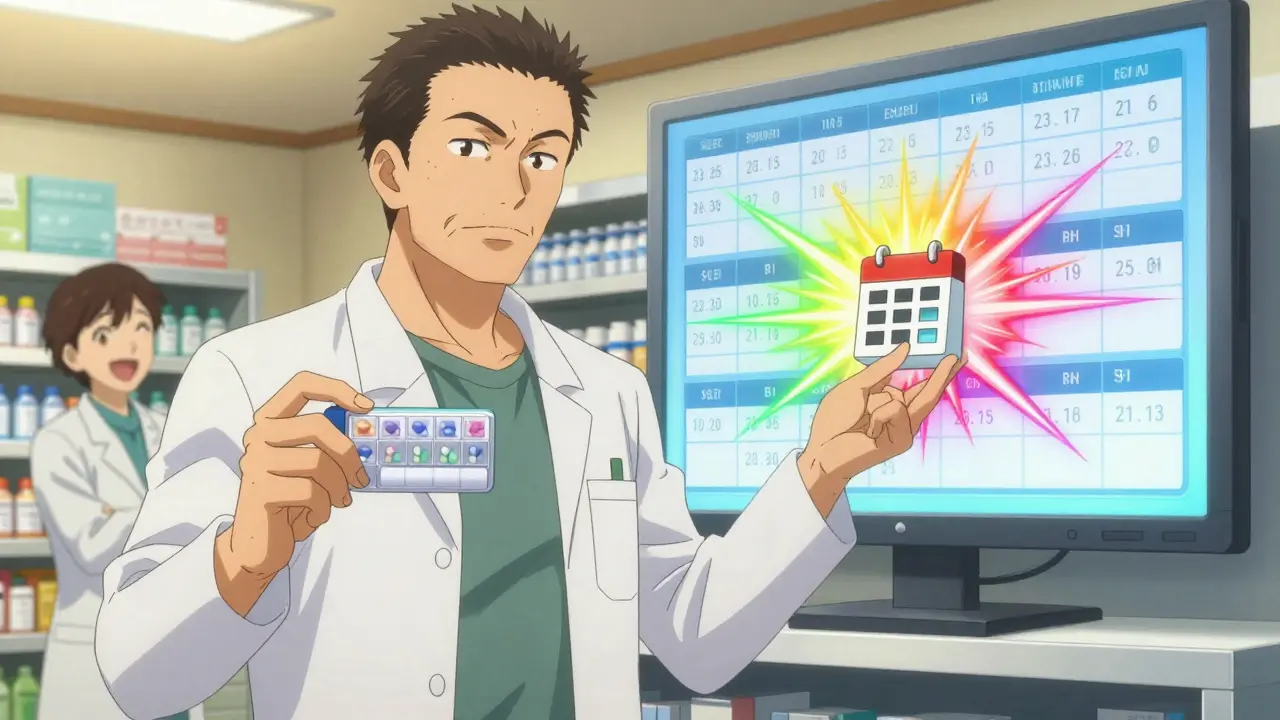
Managing multiple medications is hard. If you’re taking pills for high blood pressure, diabetes, cholesterol, and maybe even depression, keeping track of different refill dates can feel like juggling flaming torches. One dose missed here, a delay there-and before you know it, you’re running low, skipping doses, or worse, ending up in the hospital. That’s where refill synchronization comes in. It’s not magic. But it’s one of the most practical, proven ways to make sure you actually take your meds like you’re supposed to.
What Is Refill Synchronization (Med Sync)?
Refill synchronization, often called med sync, is a pharmacy service that lines up all your regular medications to be refilled on the same day each month. Instead of checking your calendar for five different dates-some on the 5th, some on the 12th, others on the 28th-you get one date. That’s it. You walk into the pharmacy, or get your meds delivered, on that one day, and everything you need is ready. It sounds simple. But the impact is huge. The World Health Organization says about half of people with chronic conditions don’t take their meds as prescribed. One big reason? Complexity. Forgetting when to refill. Running out between visits. Getting confused over which pill to take when. Med sync cuts through that noise. Studies show it works. In a 2017 analysis of Medicare Advantage patients, those enrolled in med sync programs had a 3 percentage point higher proportion of days covered (PDC)-a clinical measure of adherence-than those who didn’t. For patients who only used retail pharmacies (not mail-order), the jump was even bigger: up to 11 percentage points. That’s not just a number. That’s fewer trips to the ER, fewer hospital stays, and better control over your health.How It Actually Works: The Four-Step Process
You don’t just walk in and ask for it. There’s a process. But it’s not complicated. Here’s how it unfolds:- Initial consultation: Your pharmacist sits down with you-usually in private-and reviews every medication you’re taking. They check for duplicates, interactions, and which ones are maintenance drugs (the ones you take daily, long-term). If you’re on five or more of these, you’re a perfect candidate.
- Synchronization plan: The pharmacist figures out the best refill date for you. Maybe it’s the 15th. They’ll adjust your current prescriptions so you get enough pills to cover the gap. If your last refill was two weeks ago but your sync date is the 15th, they’ll give you an extra two weeks’ supply now so you don’t go without.
- Monthly refill day: Every month, on that same date, your meds are ready. The pharmacy calls or texts you ahead of time. You pick them up, or they’re shipped. No more guessing. No more last-minute panic.
- Monthly check-in: Your pharmacist doesn’t just hand you the pills. They ask: Are you feeling okay? Any side effects? Did your doctor change anything? This isn’t just refill service-it’s ongoing care.
Who Benefits the Most?
Not everyone needs med sync. But if you fit this profile, you’ll see a real difference:- You take three or more daily medications for chronic conditions (hypertension, diabetes, high cholesterol, asthma, depression, etc.)
- You’ve run out of meds before, or missed doses because you forgot
- You’re on Medicare Advantage or have commercial insurance that covers early refills
- You prefer picking up your meds at a local pharmacy instead of mail-order
Why It Beats the Old Way
Before med sync, most people managed refills one of two ways: call the pharmacy every time you’re running low, or wait until you’re almost out and then scramble. Both lead to gaps. And gaps mean your condition isn’t controlled. Compare that to med sync:| Feature | Traditional Refill | Med Sync |
|---|---|---|
| Refill schedule | Multiple dates, spread out | One coordinated date |
| Reminders | Occasional phone call or text | Proactive monthly contact |
| Pharmacist interaction | Only when you pick up | Monthly check-in, medication review |
| Adherence improvement | Typically low | 3-11% higher PDC |
| Run-out risk | High | Very low |
What Gets in the Way?
It’s not perfect. There are hurdles. The biggest one? Insurance. Some plans won’t let you refill early-even if it’s for synchronization. You might need your doctor to write a special note authorizing the early fill. Pharmacists often handle this, but it adds time. Another issue? Patient confusion. When the pharmacist gives you extra pills upfront, some people think, “Wait, why am I getting more now? Is this wrong?” That’s why counseling matters. Good pharmacists spend 20-30 minutes explaining it the first time. They use simple language: “We’re giving you a head start so you never have to worry again.” And then there’s the time factor. Pharmacists are busy. Setting up med sync takes effort. That’s why some pharmacies only offer it to patients with three or more meds. But once it’s set, maintenance is quick-just 5-10 minutes a month.Real Stories, Real Results
Reddit user u/MedicationMama posted in early 2022: “Since my pharmacist synced my 5 medications to the 15th of each month, I haven’t missed a single dose in 18 months. This has literally changed my diabetes management.” Another patient in Bristol told her pharmacist she used to keep her pills in five different containers, labeled with sticky notes. She’d forget which was which. After med sync, she got one pill organizer, filled once a month. She said, “I feel like I finally have control.” These aren’t outliers. A 2016 Walgreens survey found 87% of patients were “very satisfied” with the service. And the numbers back it up: patients with low baseline adherence saw adherence improve three to six times more than those already doing okay.
What’s Next for Med Sync?
The program is growing fast. In 2014, about 355,000 people in the U.S. were enrolled. By 2022, that number jumped to 12-15 million. CVS and Walgreens now link med sync to digital tools-text reminders, app alerts, even copay discounts through programs like Walgreens’ “Sync & Save.” Kroger Health is testing virtual consultations tied to refill days. Imagine: you pick up your meds, then hop on a 10-minute video call with your pharmacist to review how you’re doing. That’s the future. Medicare Part D Star Ratings now include adherence metrics. Plans that help patients stay on their meds get higher ratings-and more money. That’s why pharmacies are pushing med sync harder than ever.How to Get Started
If you’re taking three or more daily medications for chronic conditions, here’s what to do:- Call your pharmacy and ask: “Do you offer medication synchronization?”
- If they say yes, ask to speak with the pharmacist about enrolling.
- Bring a list of all your meds-including over-the-counter and supplements.
- Ask if your insurance allows early refills for synchronization. If not, ask if the pharmacy can contact your doctor to get approval.
- Once enrolled, mark your calendar. That’s your new refill day.
FAQ
Can I use med sync if I take medications from different pharmacies?
No. Med sync only works if all your maintenance medications are filled at the same pharmacy. If you’re splitting prescriptions between two or more pharmacies, you’ll need to consolidate them. Talk to your pharmacist-they can help you switch one or more prescriptions to their location. Most insurance plans allow this, and your doctor can reissue the prescriptions if needed.
What if my doctor changes my dose or adds a new medication?
That’s why monthly check-ins matter. When you pick up your meds, your pharmacist will ask if anything changed. If you got a new prescription or your dose was adjusted, they’ll update your sync schedule right away. You don’t have to remember to call them. Just show up on your refill day.
Is med sync covered by insurance?
The synchronization service itself is free-it’s part of the pharmacy’s care model. You still pay your usual copay for each medication. Some insurance plans may restrict early refills, but your pharmacist can often work with your prescriber to get approval. Medicare Advantage plans and many commercial insurers now encourage or even promote med sync because it reduces overall healthcare costs.
How long does it take to get set up?
The first appointment usually takes 20 to 30 minutes. After that, it’s just a quick 5-10 minutes each month. Most people are fully synced within one to two months, depending on how many meds they have and whether insurance approvals are needed.
Can I still use mail-order refills if I enroll in med sync?
Technically yes, but it defeats the purpose. Mail-order refills come on their own schedule, usually every 90 days. If you’re mixing mail-order and in-store refills, your dates won’t sync. For the best results, use one pharmacy for all your maintenance meds. It’s simpler, safer, and more effective.

Napoleon Huere
January 26 2026It's wild how something so simple can fix a system designed to make you fail. We treat chronic illness like it's a homework assignment you forget because you're busy living. But medicine isn't a to-do list-it's oxygen. Syncing refills doesn't just help you remember-it reminds you you're worth remembering.
Shweta Deshpande
January 26 2026Oh my goodness, this is exactly what my aunt needed! She was taking 7 meds, juggling 5 different refill dates, and once ended up in the ER because she mixed up her blood pressure pills with her diabetes ones. After she synced everything to the 10th of every month, her pharmacist started calling her every week just to check in. She says she feels like she has a personal health guardian now. No more sticky notes, no more panic. And guess what? Her A1C dropped from 9.2 to 6.8 in six months. I cried when she told me. This isn't just convenience-it's dignity.
Aishah Bango
January 28 2026Of course it works. People who can't manage their meds shouldn't be allowed to live alone. This isn't a service-it's a bandaid for poor life choices. If you can't remember to refill your pills, maybe you shouldn't be taking them. The system shouldn't coddle irresponsibility. Just because you're old doesn't mean you get a pass.
Simran Kaur
January 29 2026As someone from India, I’ve seen this happen in my own family. My grandmother used to keep her pills in old candy tins, labeled in Hindi, and she’d forget which was which. One day she took her insulin with her heart pills-and collapsed. After we got her synced at the local pharmacy in Delhi, they gave her a little plastic organizer with English and Hindi labels. Now she wakes up every morning at 7:30, takes her meds, and sips chai. She says, ‘I feel like I’m not just surviving-I’m living again.’ This isn’t just medicine. It’s love in a pill bottle.
Jessica Knuteson
January 29 20263-11% PDC improvement? That’s statistically significant but clinically negligible. You’re talking about a few extra days covered per year. The real cost is pharmacist time. This is just a cost-shifting scheme disguised as care. Pharmacies get reimbursed for ‘medication therapy management’ but the patient still pays copays. It’s a revenue stream wrapped in virtue signaling. Don’t mistake convenience for cure.
Robin Van Emous
January 30 2026I think this is beautiful. I’ve seen my dad struggle with his meds after his stroke. He’s 78. He doesn’t use a phone. He forgets names. But his pharmacist, Maria, remembers everything. She calls him every Friday. She knows his dog’s name. She brings him his meds when it snows. This isn’t about technology. It’s about someone caring enough to show up. And that’s rare. We need more Marias. Not more apps.
rasna saha
January 31 2026If you're reading this and you're taking 3+ meds, please, just call your pharmacy today. Don't wait until you're out. Don't wait until you feel dizzy. Don't wait until your kid has to call 911. This one step-just one phone call-can change your whole year. I've helped three friends do this. All of them said, 'Why didn't I do this sooner?' You don't need to be perfect. You just need to start.
James Nicoll
January 31 2026So the solution to America’s healthcare crisis is... having a pharmacist remember your pills? Wow. What a revelation. Next they’ll invent ‘breathing synchronization’ so you don’t forget to inhale. This is like giving a toddler a sticker chart for brushing teeth. Cute. Doesn’t fix the system. Just makes the pain less noticeable.
Uche Okoro
January 31 2026Refill synchronization represents a paradigmatic shift in pharmaceutical care delivery, leveraging algorithmic coordination of pharmacokinetic adherence trajectories within a longitudinal therapeutic framework. The integration of automated dispensing systems (e.g., PioneerRx) with biometric feedback loops enables non-adherent populations to achieve statistically significant improvements in PDC metrics, thereby reducing hospitalization rates via anticipatory intervention protocols. However, structural barriers persist, particularly in fragmented insurance ecosystems where prior authorization delays induce therapeutic inertia.
Ashley Porter
February 1 2026Been doing med sync for 2 years. Honestly? It’s the only reason I’m still alive. I have lupus, RA, and depression. I used to skip meds when I felt ‘fine.’ Now? I don’t even think about it. The pharmacy texts me. I show up. I get my pills. I go home. No guilt. No stress. Just routine. It’s not sexy. But it’s the reason I’m still here to scroll Reddit at 2 a.m.
shivam utkresth
February 2 2026Back home in Jaipur, my uncle used to get his meds from three different shops-sometimes he’d forget which one had his insulin. Then he switched to one pharmacy that synced everything. They even gave him a little brass keychain with his refill date engraved. He says it’s his ‘magic key’ now. He walks there every month like it’s a ritual. He says, ‘It’s not just pills. It’s a promise I keep to myself.’ That’s the real win. Not the stats. The story.
John Wippler
February 3 2026You know what’s even better than med sync? Having a pharmacist who remembers your kid’s name, your dog’s birthday, and the fact that you hate grapefruit juice. That’s the secret sauce. The tech is nice. But the human? That’s the cure. I used to hate going to the pharmacy. Now? I go because I like seeing Linda. She asks how my mom is. She knows I’m scared of needles. She doesn’t just hand me pills-she hands me peace. And that? That’s priceless.
Shawn Raja
February 4 2026So let me get this straight-our solution to a broken healthcare system is… a calendar? Wow. We spent billions on AI, telemedicine, and wearable tech, and the best we can do is remind people to pick up their pills on the 15th? This is like using duct tape to fix a leaking dam. It’s not innovation. It’s triage. And we’re calling it progress?
Napoleon Huere
February 5 2026And that’s why we need more of this-not less. We treat chronic illness like a moral failure. But it’s not. It’s biology. It’s fatigue. It’s grief. It’s trauma. It’s being poor. It’s being old. It’s being overwhelmed. Med sync doesn’t fix the world. But it gives people back a sliver of control. And sometimes? That’s all you need to keep going.