
Why Side Effects Don’t Have to Be a Silent Problem
Imagine taking a new medication for high blood pressure and suddenly feeling dizzy every afternoon. You call your doctor’s office, but the receptionist says the earliest appointment is in two weeks. Meanwhile, the dizziness makes it hard to drive, and you start skipping doses. This isn’t rare-it’s the norm in traditional care. But what if your pharmacist caught that side effect the same day you picked up your prescription? What if they talked to your doctor before you even felt worse?
That’s the power of real teamwork between pharmacists, doctors, and specialists. It’s not just about who prescribes what. It’s about who notices what’s going wrong-and fixes it before it becomes a crisis.
Who Does What When Side Effects Show Up
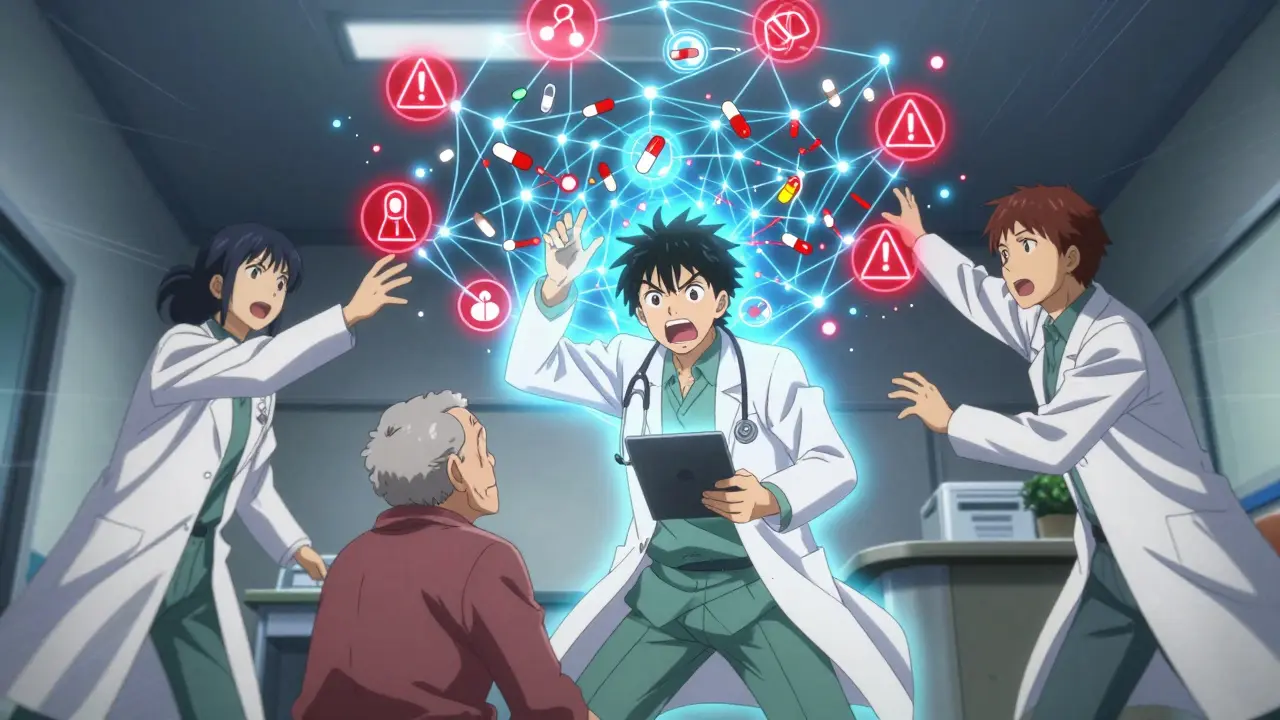
Doctors diagnose conditions and decide which drugs to start. But they don’t always know how a patient responds to each pill. A cardiologist might prescribe a beta-blocker. A rheumatologist might add an NSAID. A neurologist might throw in a sleep aid. Suddenly, a 72-year-old patient is on seven medications. That’s when side effects multiply.
Pharmacists are the only clinicians trained to see the full picture of all those drugs. They know that mixing a blood thinner with an NSAID can cause stomach bleeding. They know that certain antidepressants make dizziness worse in older adults. They know which medications interact with common supplements like St. John’s wort or grapefruit juice.
In a collaborative model, the pharmacist reviews every new prescription before it’s filled. They flag risks. They call the doctor with alternatives. They don’t wait for the patient to suffer. They act.
Real Results: Blood Pressure, Diabetes, and Beyond
In a 2019 study published in the New England Journal of Medicine, researchers tracked African-American men with uncontrolled high blood pressure. One group got standard care. The other had a pharmacist working directly with their doctor. The pharmacist adjusted doses, checked for side effects like coughing or swelling, and followed up weekly by phone.
Result? 94% of the collaborative group reached their target blood pressure. Only 29% in the standard group did. Why? Because side effects didn’t get ignored. They got fixed.
Same thing happened in diabetes care. In a 2022 meta-analysis, teams with pharmacists reduced HbA1c levels by 1.2% more than usual care. That’s not just a number-it’s fewer nerve problems, fewer kidney issues, fewer hospital stays.
And it’s not just chronic diseases. In anticoagulation therapy, pharmacist-led teams cut bleeding events by 31%. Why? Because they caught drug interactions early. They adjusted doses based on lab results. They taught patients how to spot signs of internal bleeding-like unusual bruising or dark stools-before it was too late.
How the Team Talks: Communication That Actually Works
Good teamwork doesn’t mean everyone just emails each other. It means using structured tools that leave no room for miscommunication.
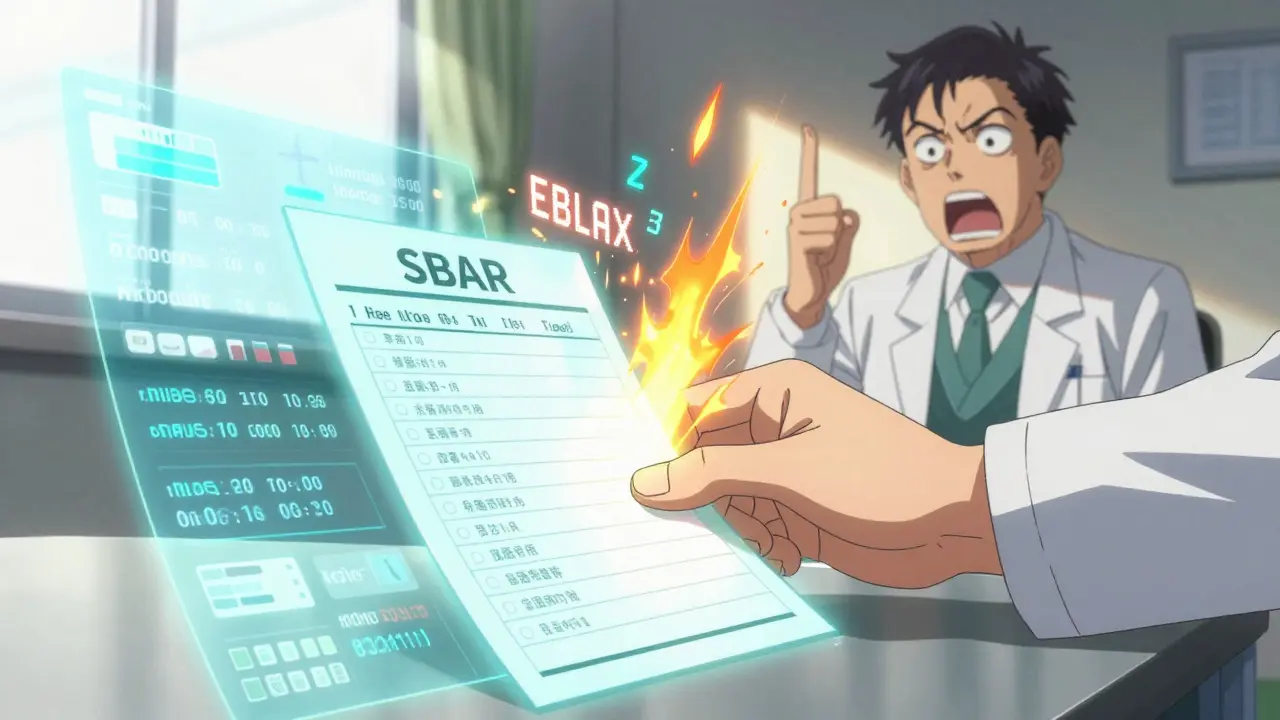
One common method is SBAR: Situation, Background, Assessment, Recommendation. A pharmacist might say:
- Situation: “Mr. Rivera, 68, started lisinopril last week and now has a persistent dry cough.”
- Background: “He’s on metformin, atorvastatin, and low-dose aspirin. No history of asthma.”
- Assessment: “This is a known ACE inhibitor side effect. He’s already skipping doses because of it.”
- Recommendation: “Can we switch to losartan? It’s equally effective and doesn’t cause cough.”
This isn’t a suggestion. It’s a clear, evidence-based action plan. And the doctor responds within hours-not days.
Electronic health records (EHRs) make this possible. When pharmacists have real-time access to lab results, allergy lists, and medication histories, they can spot problems before the patient even walks in the door. In hospitals, pharmacists join daily rounds. In clinics, they sit in the same room as the doctor. No more silos.
Why This Isn’t Happening Everywhere
Despite the data, most patients still don’t get this kind of care. Why?
First, reimbursement is broken. Only 28 states reimburse Medicaid for pharmacist services. Medicare only started covering medication reviews in team-based settings in 2022-and even then, many providers don’t know how to bill for it.
Second, some doctors still see pharmacists as order-fillers, not clinicians. A 2021 survey found 37% of pharmacists reported resistance from physicians when suggesting changes. That’s changing, slowly. But trust takes time.
Third, paperwork. Pharmacists in community settings spend 2.5 hours a day just documenting interactions. That’s time they could be talking to patients or doctors. If systems don’t make documentation easy, the model burns out.
What’s Changing Fast-And What’s Next
Things are shifting. In 2023, 41% of U.S. primary care practices had pharmacists embedded on-site-up from 22% in 2018. CVS and Walgreens now have pharmacists working in over 1,200 clinics. Academic medical centers are expanding roles. CMS is proposing direct reimbursement for comprehensive medication management in 2025.
Telehealth is helping too. During the pandemic, pharmacist-led virtual check-ins cut therapy delays by 63%. Now, many teams keep that model. A patient with new-onset dizziness can get a video call with their pharmacist the same day-no waiting.
By 2030, the Institute for Healthcare Improvement predicts 75% of U.S. primary care will use this model. The data is too strong to ignore. Side effects aren’t inevitable. They’re preventable. But only if the right people are talking to each other.
What Patients Can Do Right Now
You don’t have to wait for the system to change. Here’s what you can do today:
- Ask your pharmacist: “Do you have access to my full medication list?” If they say no, ask your doctor to send it.
- Request a medication review. Many pharmacies offer it free. They’ll go through every pill, supplement, and OTC drug you take.
- Keep a simple list: drug name, dose, reason, and any side effect you’ve noticed. Bring it to every appointment.
- If you’re on five or more medications, ask if a pharmacist can help manage them. You’re not being difficult-you’re being smart.
Side effects aren’t just annoying. They’re dangerous. And they’re often missed-until it’s too late. But with the right team, they don’t have to be.
How This Model Saves Money-And Lives
Collaborative care isn’t just better for patients. It’s cheaper for the system.
A 2023 Avalere Health analysis found these teams save $28.7 billion a year in the U.S. alone. How? Fewer ER visits. Fewer hospital readmissions. Fewer costly complications from avoidable side effects.
One study showed a 23.1% drop in hospital readmissions when pharmacists were part of the team. Another showed 15.7% fewer emergency visits. That’s not just numbers. It’s someone staying home instead of going to the ER. It’s a family not losing a paycheck because their parent isn’t hospitalized.
And patient satisfaction? 89% report higher satisfaction with collaborative care. Why? Because someone was listening. Someone cared enough to act.

Glendon Cone
December 31 2025This is literally the best thing I've read all week. 🙌 Pharmacist called me last month when my blood pressure med made me dizzy. Switched me to a different one same day. No waiting. No drama. Just good care. 🥹
Colin L
January 1 2026I mean, sure, pharmacists are great and all, but let's be real-this whole team-based model is just a fancy way of saying we're outsourcing the doctor's job to someone who used to count pills behind a counter. I've seen pharmacists in my town get confused about whether lisinopril causes cough or just makes people feel weird, and they're the ones supposedly 'catching' side effects? Come on. And don't get me started on how EHRs are just glorified spaghetti code that crashes every time someone tries to send a note. I spent three hours last Tuesday trying to get my med list synced between three different systems. Three hours. For a list of five pills. That's not innovation, that's a bureaucratic nightmare dressed up in a white coat. And don't even get me started on the fact that Medicare only pays for this if you use the right billing code, which no one actually knows, so half the time the pharmacist just gives up and goes back to filling prescriptions like a glorified robot. This isn't progress-it's just more paperwork with a new name.
Hayley Ash
January 1 2026Oh wow so now pharmacists are doctors but we still pay them 1/3 the salary? Brilliant. And of course the study only looked at African-American men-because nothing says evidence-based medicine like cherry-picking demographics. Also, did anyone check if the 94% success rate was because the pharmacist was calling patients weekly or because they were just more motivated to take their meds when someone was checking in? Maybe it's not the system, maybe it's just human contact. Oh wait, we can't afford that so we invented a new job title instead. Classic.
Henry Ward
January 3 2026This is why America is dying. We're outsourcing responsibility to people who aren't even licensed to diagnose. You want to fix side effects? Stop prescribing so many drugs in the first place. Stop letting patients self-diagnose on WebMD. Stop letting pharmacists act like they're neurologists. This isn't healthcare-it's a corporate scam to make more money off the same pills. And now we're supposed to believe this is 'progress'? I've seen pharmacists give out antibiotics like candy because a guy said he 'felt sick.' This isn't collaboration. It's chaos with a spreadsheet.
Aayush Khandelwal
January 4 2026The pharmacokinetic synergy in this model is absolutely paradigm-shifting. We're witnessing a tectonic shift in polypharmacy risk mitigation-pharmacists as clinical gatekeepers with real-time pharmacovigilance integration. The SBAR framework? That's not just communication-it's a cognitive load reduction architecture. And the cost savings? $28.7B annually? That's not a number, that's a systemic recalibration. We're not talking about pill counting anymore-we're talking about precision medicine at the point of dispensing. This isn't the future. This is the now. And if your clinic still treats pharmacists as order-takers, you're operating in the analog dark ages.
Sandeep Mishra
January 5 2026I've seen this work in my village clinic in Delhi. The pharmacist, Dr. Mehta, sits right next to the doctor. He catches when an elderly patient is taking three different painkillers that all wreck the liver. He calls the doctor. They adjust. The patient smiles. No one dies. No one goes broke. It’s simple. We don’t need fancy jargon or billion-dollar studies. We just need people to talk. And to listen. 🙏
Joseph Corry
January 6 2026The romanticization of pharmacist-led care is a classic symptom of late-stage healthcare capitalism. You're not solving systemic failures-you're creating a new layer of performative clinical labor to absorb the fallout of underfunded primary care. The real issue isn't communication-it's the commodification of human health. This model doesn't reduce suffering; it just redistributes the burden to a lower-paid professional who now has to carry the emotional weight of a broken system. And don't even get me started on the epistemic arrogance of assuming pharmacists have some kind of divine insight into polypharmacy. They're trained to read labels, not interpret human biology in context. This isn't innovation. It's institutional gaslighting.
kelly tracy
January 8 2026I used to work in a pharmacy. Let me tell you-90% of the time, the pharmacist doesn't even read the full chart. They're too busy arguing with insurance companies about why a $2 pill isn't covered. And the doctors? They don't care. They're too busy running from room to room. This whole thing is a PR stunt. The only people benefiting are the ones selling the EHR software. And don't even get me started on 'medication reviews.' I had a guy come in with 17 meds. The pharmacist said 'everything looks fine.' He was on five different blood thinners. He died two weeks later. This isn't care. It's a death sentence with a smiley face.
srishti Jain
January 8 2026pharmacists are not doctors stop pretending they are
Cheyenne Sims
January 10 2026The notion that pharmacists should assume clinical decision-making authority without medical licensure is not only legally indefensible, it is ethically reckless. The practice of medicine requires rigorous training, clinical judgment, and accountability-none of which are conferred by pharmacy school. This model represents a dangerous erosion of professional boundaries. If we are to improve patient outcomes, we must invest in physician training, not dilute the scope of practice for non-physicians. This is not collaboration. It is credential inflation masquerading as innovation.
Shae Chapman
January 11 2026I had a pharmacist save my life. 💔 I was on a new antidepressant and started having heart palpitations. I didn’t tell my doctor because I didn’t want to be ‘that patient.’ But my pharmacist noticed-I’d picked up the script three times in two weeks. She called my doctor right away. They switched me. I cried in her aisle. She didn’t charge me. She just said, ‘You matter.’ That’s what this is. Not data. Not dollars. Just someone who cares enough to look.
Nadia Spira
January 13 2026Let’s not confuse operational efficiency with therapeutic efficacy. The 94% blood pressure control stat? That’s selection bias wrapped in a meta-analysis. The study excluded patients with non-adherence, cognitive decline, or socioeconomic barriers-i.e., the entire population that actually needs this model. The real issue isn’t communication-it’s poverty, food deserts, and systemic neglect. You can’t fix structural inequality with a pharmacist and an EHR. That’s like trying to stop a tsunami with a paper towel. This isn’t progress-it’s neoliberal distraction.
henry mateo
January 13 2026i had a pharmacist call me last week because i was taking ibuprofen with my blood thinner and i didnt even know that was a thing. she said 'hey, you might start bleeding internally' and i was like... wait what? i just thought the bruising was normal. she saved me. thank you. sorry for the typos im typing on my phone at 2am
Kunal Karakoti
January 15 2026There is a deeper philosophical question here: Is healthcare a system of intervention, or a practice of presence? The pharmacist’s role, in its ideal form, is not merely to correct drug interactions-but to bear witness. To sit with the patient’s fear, confusion, and fatigue. To remind them that they are not a list of prescriptions, but a human being navigating a labyrinth of side effects. The technology is useful. The structure is helpful. But the soul of this model lies in the quiet moment when someone says, 'I see you.' And that, I think, is what we’ve forgotten how to do.
Kelly Gerrard
January 16 2026This model is not just beneficial-it is essential for the sustainability of our healthcare infrastructure. The integration of clinical pharmacists into primary care teams represents a paradigm shift toward preventive, patient-centered care. The reduction in hospital readmissions and emergency visits is not incidental-it is the direct result of deliberate, evidence-based, interdisciplinary collaboration. We must advocate for universal reimbursement policies and standardized training protocols to ensure equitable access. This is not a luxury. It is a moral imperative.