Imagine picking up a prescription for high blood pressure. The pharmacist hands you a bottle that looks different from the one your doctor wrote on the pad, but it costs a fraction of the price. You take it, and it works just as well. This everyday scenario is the result of a complex regulatory machine designed to balance patient safety with healthcare affordability. At the center of this system is the FDA, which holds the ultimate authority over generic drug approval in the United States.
The agency doesn't just rubber-stamp these cheaper alternatives. It enforces a rigorous scientific standard known as therapeutic equivalence. If you are curious about how a generic drug earns its place on the shelf next to the brand-name original, you need to understand the Abbreviated New Drug Application (ANDA) pathway. This isn't just bureaucratic paperwork; it is the legal framework that ensures your medication is safe, effective, and truly equivalent to the innovator product.
The Legal Foundation: Hatch-Waxman and the ANDA Pathway
To get generic drugs approved without repeating expensive clinical trials, manufacturers rely on a specific legal loophole created by Congress. In 1984, the passage of the Hatch-Waxman Act established the legal framework for generic drug competition in the US. This act amended Section 505(j) of the Federal Food, Drug and Cosmetic Act, creating the ANDA pathway.
Before this law, bringing a new drug to market required billions of dollars and decades of research. The Hatch-Waxman Act allowed generic companies to skip the preclinical animal studies and large-scale human efficacy trials because those data already existed for the brand-name reference listed drug (RLD). Instead, the focus shifted entirely to proving that the generic version behaves the same way in the body as the original.
This system is managed by the FDA's Office of Generic Drugs (OGD), which sits within the Center for Drug Evaluation and Research (CDER). The OGD reviews applications to ensure they meet strict criteria. Without this streamlined process, the cost savings we see today would not exist. The goal is simple: maintain the high bar for safety while lowering the barrier to entry for competitors.
What Proves a Generic Is Equivalent?
When the FDA approves a generic, it means two things: pharmaceutical equivalence and bioequivalence. These are not vague concepts; they are measurable scientific standards defined in Title 21 of the Code of Federal Regulations (21 CFR 314.94).
First, the drug must be pharmaceutically equivalent. This means the generic must contain the exact same active ingredient, at the same strength, in the same dosage form (like a tablet or capsule), and administered via the same route (such as orally). Inactive ingredients, like dyes or binders, can differ, but they cannot affect the drug's performance.
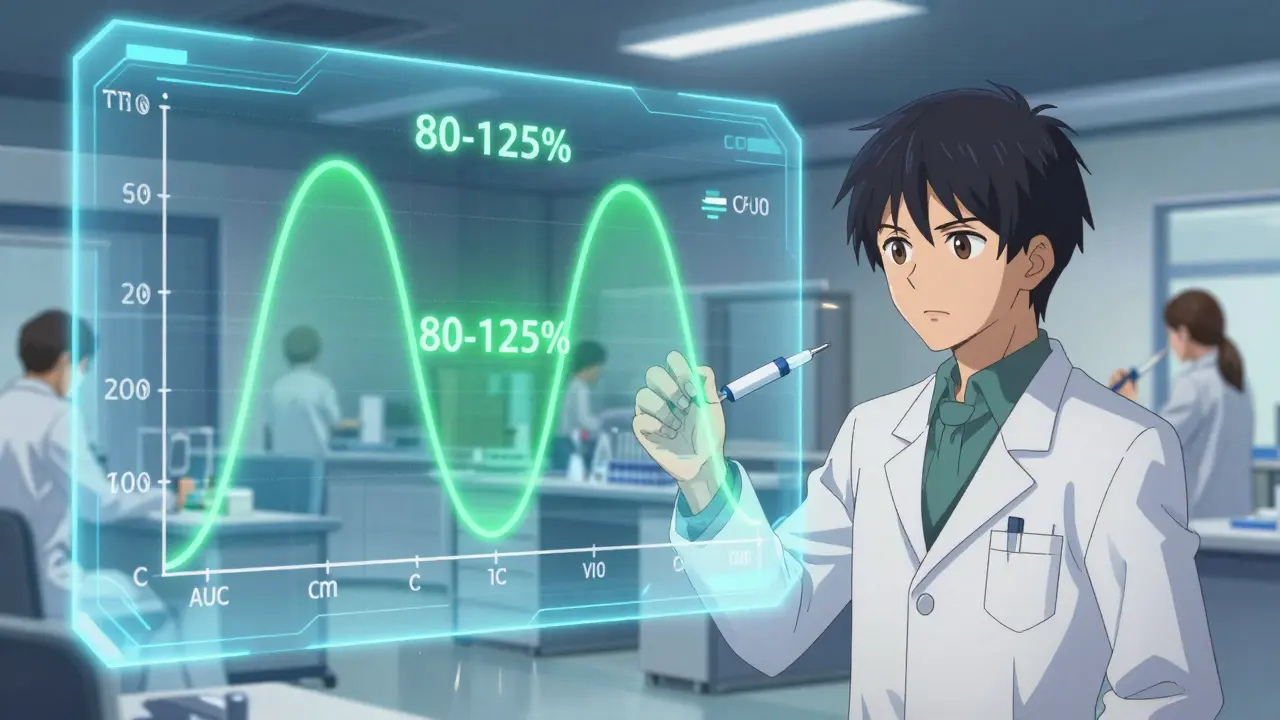
Second, and more critically, the drug must demonstrate bioequivalence. This involves pharmacokinetic studies where the rate and extent of drug absorption are measured in healthy volunteers. Typically, 24 to 36 participants take both the generic and the brand-name drug under fasting conditions. Blood samples are taken over time to create a curve showing how much drug enters the bloodstream.
The FDA requires that the 90% confidence interval for the ratio of geometric means between the generic and the brand falls within 80.00% to 125.00% for key parameters like AUC (total exposure) and Cmax (peak concentration). If the generic absorbs too slowly or too quickly, it fails. This narrow window ensures that patients experience the same therapeutic effect without unexpected spikes or drops in drug levels.
| Feature | New Drug Application (NDA) | Abbreviated New Drug Application (ANDA) |
|---|---|---|
| Primary Goal | Prove safety and efficacy of new molecule | Prove equivalence to existing RLD |
| Clinical Trials | Required (Phase I-III) | Not required (Bioequivalence only) |
| Development Cost | ~$2.6 billion | $2.4 - $6.3 million |
| Time to Market | 10-15 years | 3-4 years |
| Regulatory Basis | Section 505(b) FD&C Act | Section 505(j) FD&C Act |
The Review Timeline and GDUFA Standards
The FDA does not review these applications randomly. Since 2012, the process has been governed by the Generic Drug User Fee Amendments (GDUFA). The current cycle, GDUFA III, runs through September 2027 and sets strict performance metrics for the agency. These user fees, paid by manufacturers, fund the review staff and infrastructure, ensuring predictable timelines.
When a company submits an ANDA, it first goes through a Filing Review. If the submission is incomplete-missing critical chemistry data or having formatting errors-the FDA issues a Refuse-to-Receive (RTR) letter. In 2022, about 15.3% of submissions faced this hurdle. Common reasons include incomplete Chemistry, Manufacturing, and Controls (CMC) sections.
If the application passes filing, it moves to Substantive Review. Here, the clock starts ticking toward a Target Action Date (TAD). For standard applications, the FDA aims to complete the review within 10 months. For priority cases, such as drugs in shortage or first-time generics that break patent monopolies, the target is reduced to 8 months. These deadlines are legally binding commitments in the GDUFA commitment letter, holding the agency accountable for efficiency.
In fiscal year 2023, the FDA approved 1,256 ANDAs, a significant increase from previous years. However, the backlog remains a concern. As of late 2022, nearly 1,800 ANDAs were pending, with some waiting over three years. To address this, the FDA launched initiatives to streamline reviews and hire more specialists, particularly for complex generics.

Quality Control: CGMP and Facility Inspections
Approval is not just about the paper trail; it is about the physical product. The FDA mandates that all generic drug facilities comply with Current Good Manufacturing Practice (CGMP) regulations found in 21 CFR Parts 210 and 211. These rules cover everything from the cleanliness of the manufacturing floor to the calibration of equipment and the training of personnel.
The FDA conducts inspections to verify compliance. According to their 2023 report, the inspection rate for generic drug facilities averaged 82.7% annually. Inspectors look for deviations in production records, proper handling of raw materials, and robust quality control testing. If a facility fails an inspection, the FDA can issue warning letters, seize products, or even shut down operations until corrections are made.
This scrutiny is vital because many active pharmaceutical ingredients (APIs) for generics come from overseas. The FDA’s 2023 Supply Chain Resilience Assessment noted that 78% of APIs originate outside the United States. This global supply chain introduces risks, making domestic oversight and rigorous import testing essential components of the regulatory authority.
Complex Generics and Future Challenges
Not all generics are simple tablets. Complex generics include inhalers, topical creams, extended-release formulations, and injectables. These products pose unique challenges for bioequivalence testing. For example, proving that a generic asthma inhaler delivers the same amount of drug to the lungs as the brand-name version requires specialized apparatuses and sometimes additional clinical data.
The proportion of complex generics in the pipeline is growing. In 2023, 42.3% of new ANDAs involved complex products, up from 28.7% in 2018. The FDA has responded with the Complex Generic Drugs Initiative, aiming to refine guidance documents and improve review consistency. By 2026, the agency plans to integrate real-world evidence into 25% of complex generic approvals, moving beyond traditional lab-based studies.
Looking ahead, the FDA announced a pilot prioritization program in October 2025. This initiative offers faster reviews for companies manufacturing generics domestically, reducing TADs by 30%. This move aligns with broader national security and health resilience goals, encouraging reshoring of production while maintaining the high standards of the ANDA pathway.
How long does it take for the FDA to approve a generic drug?
Under the GDUFA III agreement, the FDA targets a 10-month review period for standard ANDAs and 8 months for priority applications. However, actual times can vary based on the complexity of the drug and whether the submission requires additional information or inspections.
Are generic drugs as effective as brand-name drugs?
Yes. The FDA requires generics to demonstrate bioequivalence, meaning they deliver the same amount of active ingredient into the bloodstream in the same amount of time as the brand-name drug. Studies show that 9 out of 10 prescriptions filled in the U.S. are generics, and they provide the same clinical outcomes.
What is the difference between an NDA and an ANDA?
An NDA (New Drug Application) is used for new, innovative drugs and requires extensive clinical trials to prove safety and efficacy. An ANDA (Abbreviated New Drug Application) is used for generics and relies on existing data from the brand-name drug, focusing instead on proving bioequivalence and manufacturing quality.
Why do some generic drugs have different inactive ingredients?
Inactive ingredients, such as fillers, binders, and dyes, do not have a therapeutic effect. While the active ingredient must be identical, generic manufacturers may use different inactive ingredients due to patent restrictions, availability, or cost. The FDA ensures these differences do not impact the drug's safety or effectiveness.
How does the FDA handle drug shortages for generics?
The FDA prioritizes the review of ANDAs for drugs in shortage. They also work with manufacturers to identify bottlenecks in the supply chain, conduct expedited inspections, and encourage new entrants into the market for critical medications to restore supply stability.