
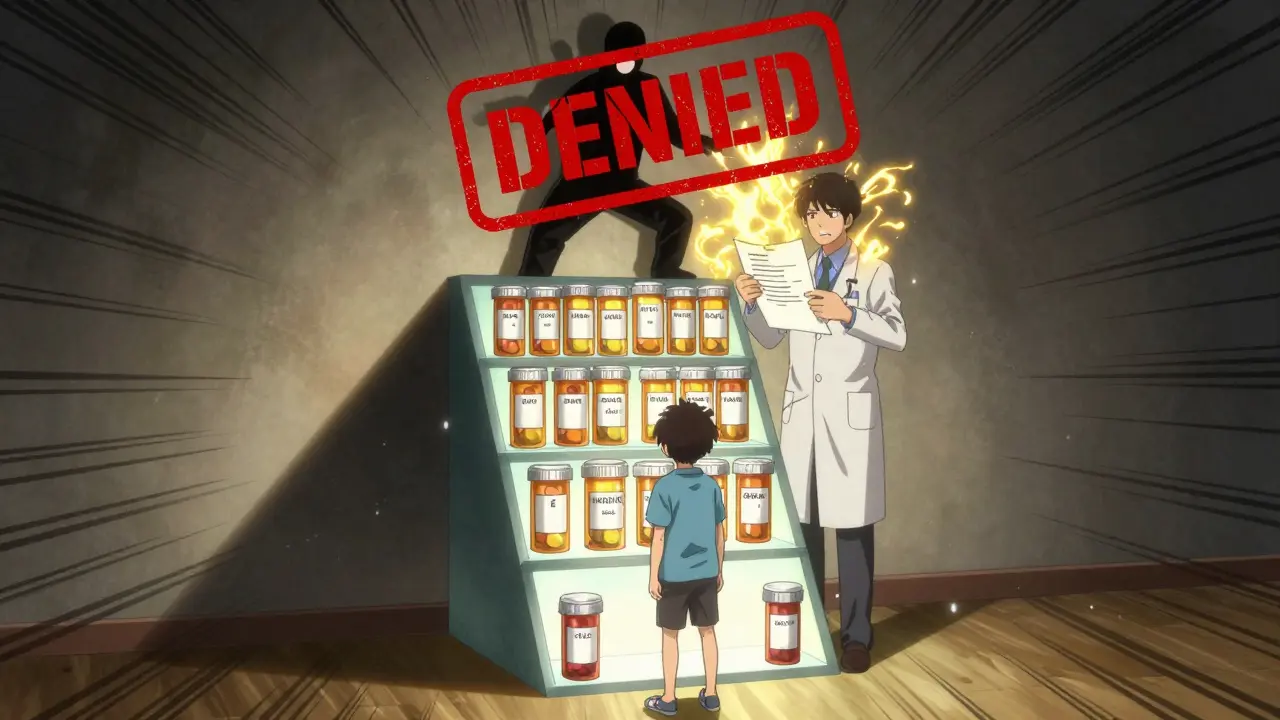
When your doctor prescribes a medication, you expect to get it-fast. But if you’re on a health insurance plan, there’s a good chance you’ll be forced to try cheaper, generic drugs first-even if your doctor says they won’t work for you. This is called step therapy, and it’s now part of how nearly 40% of U.S. health plans handle prescription drugs. It’s not a glitch. It’s policy. And it’s changing how you get treated.
What Is Step Therapy, Really?
Step therapy, sometimes called a "fail-first" rule, means your insurer won’t pay for the medication your doctor picked unless you’ve tried and failed one or more cheaper alternatives first. These lower-cost options are almost always generics. For example, if your rheumatologist prescribes a biologic for rheumatoid arthritis, your insurance might require you to try three different NSAIDs or a generic DMARD like methotrexate before approving the expensive drug. Only after those fail-or if they cause side effects-can you move to the next step. This isn’t about choice. It’s about cost control. Insurers use step therapy to push patients toward cheaper drugs, hoping to cut spending. According to a 2021 Congressional Budget Office analysis, step therapy can reduce pharmaceutical costs by 5% to 15% in some drug categories. But that savings doesn’t come without risk.How It Works: The Three-Step Ladder
Most step therapy protocols follow a simple structure:- Step One: Start with the lowest-cost, FDA-approved generic or older brand drug. This is usually covered without restrictions.
- Step Two: If that doesn’t work or causes side effects, move to a slightly more expensive brand-name drug or newer generic.
- Step Three: Only after both previous steps fail do you get access to the original prescribed drug-often a specialty medication that costs hundreds or thousands per month.
Why It’s Controversial
The American College of Rheumatology (ACR) calls step therapy a "dangerous practice." Why? Because waiting for a drug to fail can mean permanent damage. In a 2022 patient survey by the Arthritis Foundation, 68% of respondents said they experienced worsening symptoms during step therapy delays. One Reddit user, ChronicPainWarrior, described waiting six months to get a biologic after failing three NSAIDs. By then, joint damage had already advanced. He needed surgery. Doctors aren’t just frustrated-they’re overwhelmed. ACR data shows physicians spend an average of 18.3 hours per week just handling step therapy appeals and prior authorizations. That’s nearly half a workday spent on paperwork instead of patients. And it gets worse when you switch jobs or plans. If you’ve been stable on a brand-name drug for two years, then switch to a new insurer, you might have to start the whole step therapy process again-even if your body already rejected the cheaper options. Healthinsurance.org reports this happens to thousands each year, leading to dangerous treatment gaps.
When Step Therapy Actually Helps
It’s not all bad. For some people, step therapy works. A 2023 GoodRx survey found that 17% of patients ended up doing just as well-or better-on the generic drug their insurer required. One woman with mild hypertension was switched from a brand-name ACE inhibitor to lisinopril. Her blood pressure stabilized, and she saved $120 a month. The goal of step therapy isn’t to punish patients. Insurers argue it prevents overprescribing of expensive drugs when cheaper options are equally effective. And with 90% of U.S. prescriptions filled with generics, the system does work for many. But the problem is when the system ignores individual biology. A drug that works for one person might be useless-or dangerous-for another. Step therapy doesn’t account for that.How to Fight Back: Step Therapy Exceptions
You don’t have to accept this. Federal and state laws give you rights. The Safe Step Act, introduced in Congress multiple times since 2017, outlines five clear situations where insurers must grant exceptions:- You’ve already tried the required drug and it didn’t work.
- The required drug would cause severe or irreversible harm.
- The required drug is contraindicated for your condition or medical history.
- Trying the cheaper drug would prevent you from doing daily activities.
- You’re already stable on your current medication and it was previously approved.
State Laws Vary-Big Time
As of 2025, 29 states have passed laws forcing insurers to offer exceptions. But here’s the catch: these laws don’t apply to self-insured employer plans. And those cover 61% of Americans. That means if you get insurance through your job, your rights depend on whether your employer pays claims directly-or outsources them to a third party like UnitedHealthcare or Cigna. States like Virginia, California, and New York have strong protections. They require insurers to respond to appeals within 72 hours and list clear exception criteria. But in states without laws, you’re at the mercy of the insurer’s internal policy. Medicaid programs are even more unpredictable. Only a handful of states have applied step therapy rules to Medicaid through legislation. Most rely on agency guidelines, which can change without notice.
What You Can Do Right Now
If you’re facing step therapy:- Ask your doctor: Do they have experience filing exceptions? Can they help you document why the generic won’t work?
- Call your insurer: Ask for their step therapy protocol for your medication. Request the written policy-it’s your right.
- Check your state’s rules: Search "step therapy laws [your state]" to see if you have legal protections.
- Use patient assistance programs: Many drugmakers offer co-pay cards or free trials that can bypass step therapy. Check the manufacturer’s website.
- Appeal in writing: If denied, file a formal appeal. Keep copies of every email, form, and phone call.
The Future of Step Therapy
By 2025, analysts at Avalere Health predict step therapy will apply to 55% of specialty drug prescriptions-up from 40% today. That means more people will face delays. But pressure is growing. Patient advocacy groups are pushing for federal legislation to close the self-insured loophole. The Safe Step Act, reintroduced in 2021, could finally make step therapy rules consistent across all plans-if it passes. Until then, you’re left navigating a system designed to save money-not to protect your health. The truth? Step therapy isn’t inherently wrong. But when it ignores your body, your doctor, and your timeline-it becomes a barrier, not a bridge.What If You Can’t Wait?
If you’re in pain, your condition is worsening, or you’re at risk of hospitalization, don’t wait. Ask your doctor to label your request as "urgent." Some insurers will fast-track you. If they don’t, contact your state’s insurance commissioner’s office. They can intervene on your behalf. You have rights. You just have to know how to use them.What is step therapy?
Step therapy is an insurance rule that requires you to try cheaper, generic medications before the insurer will pay for a more expensive drug your doctor prescribed. It’s often called a "fail-first" policy because you must prove the lower-cost options didn’t work before moving up.
Why do insurance companies use step therapy?
Insurance companies use step therapy to reduce drug costs. By pushing patients toward generics and older, cheaper medications, they can cut spending by 5% to 15% in some drug categories. The goal is to avoid prescribing expensive drugs unless absolutely necessary.
Can I skip step therapy if my doctor says it’s unsafe?
Yes, you can request an exception. Federal and state laws require insurers to grant exceptions if the required drug won’t work for you, causes harm, is contraindicated, prevents daily activities, or you’re already stable on your current medication. Your doctor must submit medical records to support your case.
How long does a step therapy appeal take?
Insurers are supposed to respond within 72 business hours for standard requests and 24 hours for urgent cases. But in practice, many take four to eight weeks. If you’re in danger of serious harm, demand an urgent review and contact your state insurance commissioner.
Does step therapy apply to all insurance plans?
No. Step therapy rules apply to individual, small group, and fully-insured employer plans. But about 61% of Americans are covered by self-insured employer plans, which are regulated by federal law and often exempt from state step therapy protections. That means your rights depend on how your employer gets insurance.
What if I switch jobs and my new insurance makes me restart step therapy?
You may have to restart the process, even if you’ve been successfully taking the same drug for years. This is a major flaw in the system. You can appeal based on your prior treatment history and stability, but it’s not guaranteed. Always ask your new insurer for their step therapy policy before switching plans.
Are there programs to help me afford drugs during step therapy?
Yes. About 78% of major drug manufacturers offer patient assistance programs, including co-pay cards, free samples, or discount coupons. These can sometimes help you access your prescribed drug without going through step therapy. Check the manufacturer’s website or ask your pharmacist.
Jody Kennedy
December 27 2025My mom had to wait 5 months just to get her biologic for RA. By then, her hands were already deforming. Insurance doesn't care about your quality of life-only their quarterly profits. I'm so tired of this system.
Doctors are drowning in paperwork while patients suffer. It's not healthcare-it's corporate roulette.
christian ebongue
December 27 2025step therapy = fail first = profit second. genius. really. who thought of this? a boardroom full of guys who’ve never had a headache?
also my dr had to spend 3 hrs on the phone just to get me on my med. 3 hours. for a pill.
Alex Ragen
December 27 2025Ah, the tragicomic ballet of bureaucratic healthcare: where the alchemy of cost-efficiency transforms human suffering into actuarial tables-each failed trial a sacrificial lamb on the altar of shareholder value.
And yet, we call this ‘rational’? One wonders if the architects of this system ever considered that biology, unlike Excel, refuses to be optimized.
Sarah Holmes
December 27 2025This is not merely a flawed system-it is a moral catastrophe. To force a patient to endure avoidable pain, irreversible damage, and psychological torment for the sake of corporate savings is not policy. It is cruelty dressed in insurance jargon.
And those who defend it? They are complicit. Every delay, every denial, every ignored appeal-they are blood on your hands if you do nothing.
Michael Bond
December 27 2025I get why insurers do it. But they need better exceptions. And faster. I’ve seen people lose months-and joints-because of red tape.
Maybe we need a national standard. No more loopholes.
Matthew Ingersoll
December 29 2025In India, we don’t have step therapy. If your doctor prescribes it, you get it. If you can’t afford it, there are public programs or NGO support.
It’s not perfect, but at least the system doesn’t make you prove you’re sick enough to deserve care.
josue robert figueroa salazar
December 29 2025they dont care. you suffer. they save. end of story.
call your rep. do nothing. same result.
jesse chen
December 31 2025My sister got approved for her biologic after 11 weeks-only because her doctor threatened to go public with the case. That’s not healthcare. That’s extortion.
But I’m glad she’s doing better now. Just... why does it have to be this hard?
Joanne Smith
December 31 2025Step therapy is the healthcare version of ‘try this cheap knockoff phone before you buy an iPhone.’
Except the knockoff explodes in your hand. And you’re the one paying for the ER visit.
Also, my doctor’s assistant now has a spreadsheet titled ‘Step Therapy Horror Stories.’ It’s 47 pages long. And growing.
Prasanthi Kontemukkala
January 1 2026It’s important to remember that behind every policy decision are real people-mothers, fathers, students, workers-who are just trying to live without pain.
Let’s not forget to advocate with compassion, not just anger. Change is possible when we speak up together.