

For years, making a generic drug felt like copying a recipe. You matched the active ingredient, tweaked the fillers until it looked right, and hoped the final product passed testing. If it failed, you started over. That trial-and-error method is dying out. Today, regulators like the U.S. Food and Drug Administration (FDA) expect you to understand why your process works before you even run a full batch. This shift is called Quality by Design (QbD), defined as a systematic approach to development that begins with predefined objectives and emphasizes product and process understanding. It’s not just a buzzword; it’s the new standard for getting your Abbreviated New Drug Application (ANDA) approved faster and keeping your supply chain stable.
If you are developing generics in 2026, ignoring QbD is a risk. The FDA formally endorsed these principles back in 2011, but by October 2017, they became a regulatory expectation for all new submissions. Since then, data shows that applications using QbD get approved 23% more often on the first try and cut review times by nearly five months. But what does this actually mean for your lab bench and your budget? Let’s break down how modern science-based approaches are changing the game for bioequivalence and manufacturing.
The Core Framework: From Recipe to Science
Traditional development relies on fixed parameters. You mix for exactly 15 minutes at 25°C. If the mixer runs for 14 minutes or 16, you worry. QbD flips this. Instead of a single point, you establish a range where quality is guaranteed. This requires five interconnected components that form the backbone of any modern generic submission.
It starts with the Quality Target Product Profile (QTPP). This document defines what your final product must achieve. For a generic, the goal is strict similarity to the Reference Listed Drug (RLD). The FDA typically demands at least 95% similarity in in vitro performance metrics. Your QTPP lists specific attributes: identity, assay strength, dissolution profile, and impurity levels. Without a clear QTPP, you don’t know what you’re building.
Next, you identify Critical Quality Attributes (CQAs). These are the physical, chemical, biological, or microbiological properties that must stay within limits to ensure safety and efficacy. In generic development, you usually track 5-12 CQAs per product. Key examples include:
- Dissolution rate: Must show an f2 similarity factor greater than 50 compared to the RLD.
- Content uniformity: Relative Standard Deviation (RSD) must be ≤6.0%.
- Impurity profiles: Must meet ICH Q3B thresholds.
Once you know what matters (CQAs), you figure out what controls them. These are your Critical Process Parameters (CPPs). Through Design of Experiments (DoE), you find which inputs affect your CQAs. Common CPPs in tablet manufacturing include granulation moisture content (often kept between 1.5-3.0%), compression force (typically 10-15 kN), and drying temperature (around 40-50°C). Identifying 3-8 CPPs per unit operation gives you leverage over the process.
The Power of Design Space
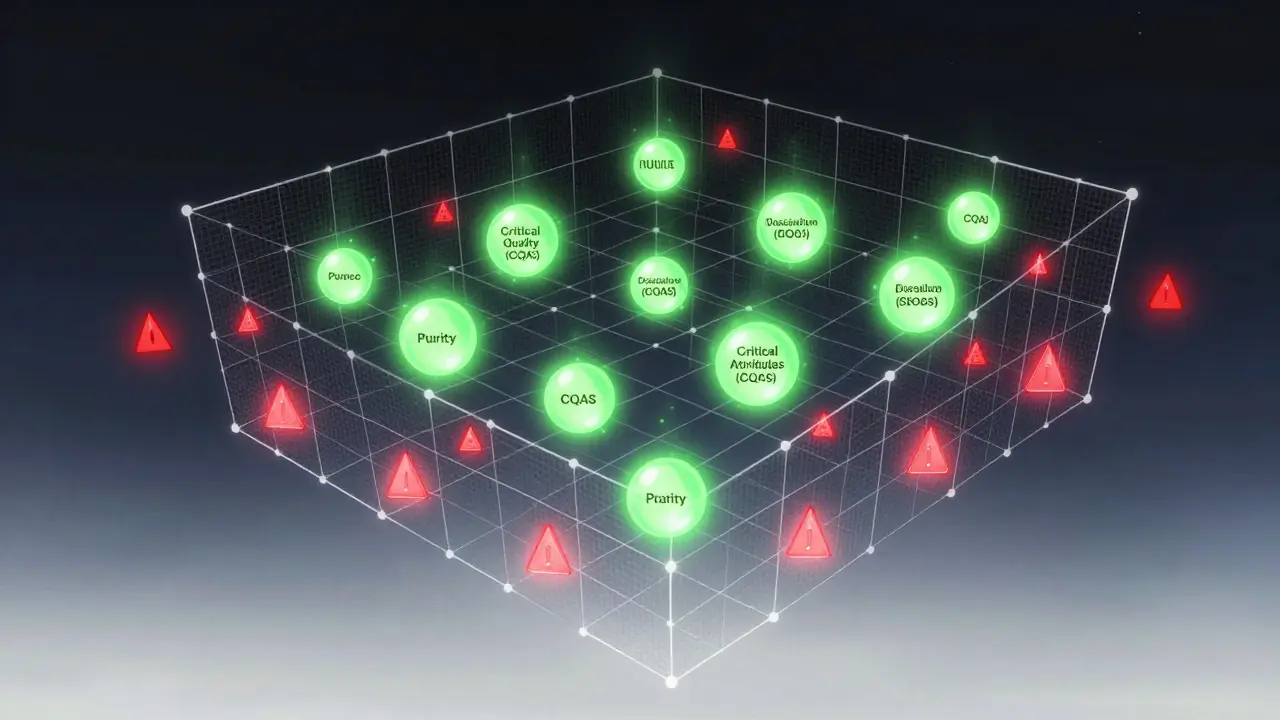
This is where QbD offers its biggest business advantage: the Design Space. A design space is the multidimensional combination of input variables and process parameters proven to deliver quality products. Here is the kicker: if you define your design space correctly and get it approved, you can move anywhere within those boundaries without filing for prior approval from the FDA.
Think about the logistics. In traditional manufacturing, changing a mixing speed might require a costly supplement submission and weeks of regulatory waiting. With an approved design space, that change is just routine operations management. The FDA accepts design spaces that demonstrate 95% confidence intervals for CQA compliance across 100+ simulated batches. This flexibility saves manufacturers an estimated $1.2 to $2.8 million per product annually in regulatory submissions and change management costs.
| Feature | Traditional Approach | QbD Approach |
|---|---|---|
| Process Control | Fixed "recipe" parameters | Scientifically justified ranges |
| Change Management | Requires prior regulatory approval | Flexible within Design Space |
| Approval Timeline | Average 13.9 months | Average 9.2 months |
| CRL Rate | Higher frequency | 31% fewer Complete Response Letters |
| Initial Cost | Lower upfront investment | 25-40% higher initial development cost |
Bioequivalence and Complex Generics
QbD is particularly crucial when you move beyond simple immediate-release tablets. For complex generics-like inhalers, transdermal patches, or modified-release systems-traditional bioequivalence studies are expensive and sometimes inconclusive. The European Medicines Agency (EMA) notes that 63% of QbD implementation failures stem from inadequate mechanistic understanding, especially for these complex products.
Modern approaches use advanced analytical techniques to characterize the Reference Listed Drug (RLD) deeply. By leveraging this data, you can reduce development time by 30%. The goal is to establish meaningful in vitro-in vivo correlations (IVIVC). If you can prove that your in vitro dissolution profile predicts clinical performance, you may avoid additional clinical trials. This is vital for 505(b)(2) applications and complex generics where clinical BE studies are difficult to execute.
Dr. Lawrence Yu, former Deputy Director of the FDA's Office of Pharmaceutical Quality, noted that QbD has reshaped generic development from a "copycat approach" to a "science-driven equivalence demonstration." This elevation in technical sophistication is now expected by 89% of global regulatory authorities for complex approvals.
Implementation Challenges and Costs
Let’s be real: QbD isn’t free. It requires significant upfront investment. You are looking at 25-40% higher initial development costs and timelines that extend by 4-8 months compared to traditional methods. Why? Because you need specialized expertise. Scientists require 80-120 hours of training in Quality Risk Management (ICH Q9) and Design of Experiments. You also need hardware. Implementing Process Analytical Technology (PAT) tools like near-infrared spectroscopy costs a minimum of $500,000. Software for multivariate analysis, such as MODDE Pro, adds another $15,000 per user per year.
However, the long-term savings are substantial. Dr. Elena Rodriguez of Hikma Pharmaceuticals reported that implementing QbD for generic esomeprazole reduced post-approval deviations from 14 to 2 per year, saving approximately $850,000 annually in quality investigations. The Parenteral Drug Association found that 87% of QbD-implementing manufacturers adopt PAT tools, reducing end-product testing requirements by 35-60%. You spend more money up front to save massive amounts on quality control, waste, and regulatory delays later.

Modern Tools and Continuous Manufacturing
The landscape is evolving toward continuous manufacturing (CM). The FDA’s Emerging Technology Program has processed 27 QbD-based continuous manufacturing applications with a 100% approval rate. CM synergizes perfectly with QbD because it allows for real-time monitoring and control. Teva’s 2022 case study on levothyroxine showed that adopting continuous manufacturing design spaces increased batch consistency by 28%.
New guidelines are pushing this further. The updated ICH Q2(R2) on validation of analytical procedures and the new Q14 guideline on analytical procedure development emphasize a lifecycle approach. While these require 30-50% more robustness data initially, they offer 40% faster validation for QbD-aligned submissions. If you are planning your development strategy for 2026 and beyond, aligning with these guidelines is non-negotiable.
Practical Steps for Adoption
If you are starting fresh, follow this structured pathway:
- Define the QTPP: Document desired characteristics based on the RLD. Aim for >95% similarity in key metrics.
- Conduct Risk Assessment: Use ICH Q9 principles to identify potential risks to quality.
- Identify CQAs and CPPs: Perform DoE studies to link process inputs to quality outputs.
- Establish Design Space: Define the multidimensional operating ranges with statistical confidence.
- Develop Control Strategy: Integrate PAT tools for real-time monitoring rather than relying solely on end-product testing.
Remember, QbD should be proportionate. Dr. James Polli warns against "over-engineering" simple generics. Spending $450,000 on excessive DoE studies for a well-established immediate-release product creates unnecessary burden. Reserve the heavy lifting for complex formulations where the risk of failure is high and the value of flexibility is greatest.
What is the main benefit of QbD for generic drug developers?
The primary benefit is regulatory flexibility through the "design space." Once approved, manufacturers can adjust process parameters within defined boundaries without seeking prior FDA approval, speeding up production changes and reducing regulatory submission costs by millions annually.
Is QbD required for all generic drugs?
While not explicitly mandated for every single simple generic, the FDA considers QbD elements essential for complex generics. Since 2017, it has been a strong regulatory expectation for all ANDAs, with data showing significantly higher approval rates for QbD-based submissions.
How does QbD impact bioequivalence studies?
QbD enhances bioequivalence by establishing robust in vitro-in vivo correlations (IVIVC). For complex generics, deep characterization of the Reference Listed Drug and rigorous process understanding can sometimes reduce the need for extensive clinical trials, relying instead on scientifically validated in vitro data.
What are Critical Quality Attributes (CQAs)?
CQAs are physical, chemical, biological, or microbiological properties that must be within an appropriate limit, range, or distribution to assure the desired product quality. Examples include dissolution rate, content uniformity, and impurity profiles.
Does QbD increase development costs?
Yes, initial development costs are 25-40% higher due to the need for specialized training, Design of Experiments (DoE), and advanced analytical tools like PAT. However, these costs are often offset by reduced post-approval deviations, faster approval timelines, and lower long-term quality control expenses.