
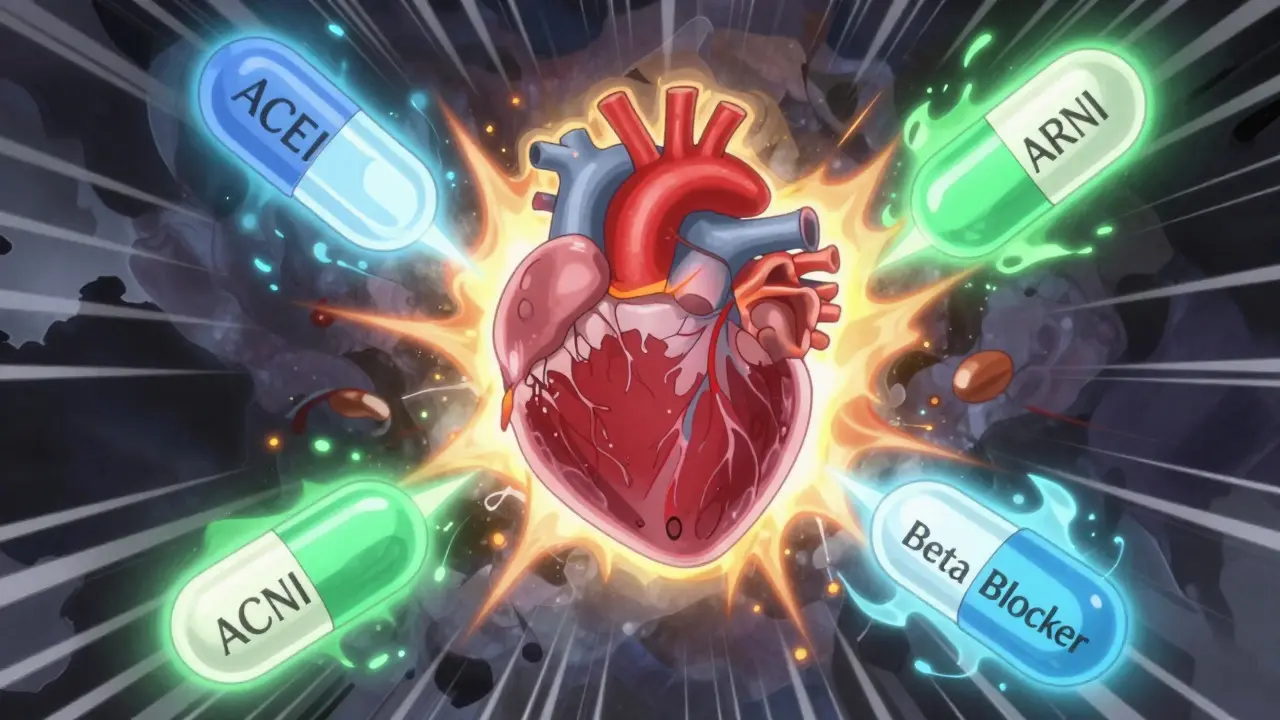
Heart failure isn't a single disease-it's a complex condition where the heart can't pump blood well enough to meet your body's needs. But the right medications can change the game. Today, four drug classes form the backbone of treatment for heart failure with reduced ejection fraction (HFrEF): ACE inhibitors, ARNIs, beta blockers, and diuretics. These aren't just pills you take-they're proven tools that extend life, reduce hospital visits, and help you breathe easier.
ACE Inhibitors: The First Line of Defense
ACE inhibitors were the first major breakthrough in heart failure treatment. Captopril hit the market in 1981, and enalapril followed in 1985. Their job? Block the enzyme that turns angiotensin I into angiotensin II-a chemical that narrows blood vessels and raises blood pressure. By stopping this, ACE inhibitors ease the heart's workload and reduce strain on the heart muscle.
Studies like the CONSENSUS trial in 1987 showed enalapril cut death rates by 27% in severe heart failure patients. Today, common options include lisinopril, enalapril, and ramipril. Dosing is slow: start low, go slow. For example, lisinopril begins at 2.5-5 mg daily and builds up to 20-40 mg. The goal? Reach the target dose without causing side effects.
But there’s a catch. About 1 in 5 people develop a dry, persistent cough-so annoying that many stop taking the drug. Others face high potassium (hyperkalemia), especially if they have kidney issues. In rare cases, swelling of the face or throat (angioedema) can happen. If you can’t tolerate ACE inhibitors, you’re not alone-about 10-20% of patients need an alternative.
ARNI: The Game-Changer That Replaced ACEIs
Enter ARNI-angiotensin receptor-neprilysin inhibitor. The brand name is Entresto (sacubitril/valsartan). Approved in 2015 after the landmark PARADIGM-HF trial, it’s not just another option-it’s now the preferred first-choice medication for most HFrEF patients.
How does it work? It combines two actions: valsartan blocks angiotensin receptors (like an ARB), while sacubitril blocks neprilysin, an enzyme that breaks down helpful hormones like natriuretic peptides. These peptides help your body get rid of salt and water, relax blood vessels, and reduce heart stress. The result? Better outcomes than ACE inhibitors alone.
The PARADIGM-HF trial followed nearly 8,400 people across 47 countries. Those on ARNI had a 20% lower risk of dying from heart problems and 21% fewer hospital stays compared to those on enalapril. That’s not a small improvement-it’s one of the biggest advances in heart failure care in decades.
But ARNI isn’t for everyone. You can’t switch from an ACE inhibitor to ARNI within 36 hours-it raises the risk of dangerous swelling. Also, ARNI costs about $550 a month without insurance, while generic lisinopril runs $4. That price gap means many patients, especially outside big hospitals, still start with ACEIs. Still, by 2023, 62% of newly diagnosed HFrEF patients got ARNI as their first drug-up from just 28% in 2018.
Beta Blockers: Slowing Down to Save the Heart
It sounds backwards: why slow down a heart that’s already struggling? But in heart failure, the body’s stress response-fueled by adrenaline-overworks the heart, making it worse over time. Beta blockers block these stress signals, letting the heart rest and heal.
Three beta blockers are proven for heart failure: carvedilol, metoprolol succinate, and bisoprolol. Unlike those used for high blood pressure or anxiety, these are specifically tested and approved for heart failure. The CIBIS-II trial showed bisoprolol cut death risk by 34%. The COPERNICUS trial found carvedilol reduced death by 35% in severe cases.
Dosing is slow. You start at a tiny dose-like 3.125 mg of carvedilol twice daily-and double it every 2-4 weeks, as long as your blood pressure stays above 100 mmHg and your heart rate doesn’t drop below 50 bpm. Many patients feel tired or dizzy at first. Some report extreme fatigue, which is why 72% of users on PatientsLikeMe said they struggled to reach target doses.
But stick with it. One Reddit user, u/CHFSurvivor, shared that carvedilol raised their ejection fraction from 25% to 45% over 18 months. That’s not luck-it’s science. Beta blockers don’t just make you feel better today-they change the long-term course of the disease.

Diuretics: Managing Fluid, Not Fixing the Heart
Diuretics don’t improve survival. But they’re essential. If you’re swollen, short of breath, or gaining weight fast, it’s because fluid is building up. Diuretics help your kidneys flush out that extra fluid.
Loop diuretics like furosemide, torsemide, and bumetanide are the go-to. Furosemide starts at 20-80 mg daily and can be adjusted based on symptoms. Torsemide may be more effective-studies like EVEREST showed it reduced hospitalizations by 18% compared to furosemide. Thiazides like hydrochlorothiazide are used for milder cases or combined with loops.
Spironolactone is a special case. It’s both a diuretic and a mineralocorticoid receptor antagonist (MRA). The RALES trial in 1999 showed it cut death risk by 30% in severe heart failure. But it also raises potassium, so you need regular blood tests.
Side effects? Frequent urination-some patients say they’re in the bathroom every hour. Leg cramps, dizziness, and low sodium are common. One Reddit user, u/HeartWarrior2020, found relief by adding potassium and magnesium supplements. Others complain about sleep disruption. But if you’re struggling to breathe, these side effects are worth it.
How They Work Together: The Quadruple Therapy Standard
The 2022 AHA/ACC/HFSA guidelines say the best approach is quadruple therapy: ARNI (or ACEI/ARB if ARNI isn’t possible), beta blocker, MRA (like spironolactone), and an SGLT2 inhibitor (like dapagliflozin). Diuretics are added as needed.
Together, these drugs reduce death by up to 20% and hospitalizations by 21%. But here’s the problem: only 35% of eligible patients get all four drugs within a year of diagnosis. Why? Cost, fear of side effects, slow titration, and lack of specialist care.
Specialized heart failure clinics hit 85% adherence. General cardiology practices? Just 52%. If you’re not seeing a heart failure specialist, you’re likely missing out. The gap between what we know works and what’s actually given is huge.
What to Watch For: Monitoring and Risks
These drugs are powerful, but they need careful management.
- Check potassium within 1-2 weeks of starting or changing dose. Keep it under 5.0 mmol/L.
- Monitor creatinine to watch kidney function. A rise over 30% from baseline may mean a dose adjustment.
- Track blood pressure. If it drops below 90/60, you may need to hold or lower doses.
- Repeat echo at 3-6 months. Ejection fraction often improves with treatment.
ARNI requires special caution: never start it within 36 hours of an ACE inhibitor. And if you’re pregnant or planning to be, avoid all RAAS inhibitors-they can harm the unborn baby.
Real Patient Experiences
Real people, real stories:
- "Switching from lisinopril to Entresto reduced my shortness of breath in two weeks. But I had to pee every hour." - u/PumpFailure, Reddit
- "I stopped ACEI because of the cough. ARNI didn’t cause it, and I feel stronger." - Patient survey, HFSA 2022
- "Carvedilol made me tired for months. But after a year, I walked 3 miles without stopping." - u/CHFSurvivor
- "Furosemide gave me leg cramps. Potassium supplements fixed it." - u/HeartWarrior2020
Across 1,782 Amazon reviews, ARNI scored 4.3/5 for effectiveness, beta blockers 3.7/5 (fatigue hurt the score), and diuretics 4.1/5 (praised for relief, criticized for bathroom trips).
What’s Next?
Heart failure treatment keeps evolving. SGLT2 inhibitors (like Jardiance and Farxiga) are now recommended for all heart failure patients, even those with preserved ejection fraction. Vericiguat is a new drug that helps the heart respond better to stress. ARNI’s use is expanding to patients with mildly reduced ejection fraction (EF 41-49%), adding millions more who could benefit.
By 2027, experts predict ARNI will be first-line for 70% of HFrEF patients. But access remains unequal. Rural areas and low-income communities still lag-only 28% of eligible patients there get guideline-recommended care.
The bottom line? These medications work. But they’re not magic. Success depends on slow, careful dosing, regular monitoring, and sticking with treatment-even when side effects feel tough. If you’re on one of these drugs, ask your doctor: Are you on the full quadruple therapy? If not, why not?
Caroline Dennis
March 25 2026ARNI isn't just a pharmacological upgrade-it's a paradigm shift. Neprilysin inhibition preserves natriuretic peptides, which directly counteract the maladaptive RAAS activation that drives remodeling. This dual-action mechanism doesn't just reduce afterload; it promotes reverse remodeling at the myocardial level. The PARADIGM-HF data isn't just statistically significant-it's clinically transformative.
Yet, we're still stuck in a legacy model where cost overrides evidence. A $4 generic versus $550 branded therapy? The disparity isn't just economic-it's ethical. We're rationing survival.
Mihir Patel
March 26 2026so i switched from lisinopril to entresto and now i gotta pee every 20 min like its a water park and my legs are cramping like im in a western movie but hey at least i can walk to the fridge without gasping lol
Kevin Y.
March 27 2026Thank you for this exceptionally clear and evidence-based overview. As a clinician, I appreciate the emphasis on titration protocols and the critical importance of adherence to quadruple therapy.
One underdiscussed point: the psychological burden of chronic disease management. Patients often discontinue medications not due to side effects alone, but because of fatigue from constant monitoring, fear of deterioration, or perceived lack of progress. Empathy in counseling is as vital as pharmacology.
For those struggling with beta-blocker fatigue-reassurance matters. Improvement is nonlinear. Many patients report feeling worse before they feel better. Persistence pays.
Grace Kusta Nasralla
March 28 2026I used to think the heart was just a pump. But now I see it as a wounded soul, battered by adrenaline and left alone in the dark.
These drugs-they’re not chemicals. They’re whispers of hope, whispered by science to a body that’s forgotten how to believe in itself.
When I took my first dose of carvedilol, I cried. Not because it helped. But because for the first time in years, I felt like someone was listening.
Stephen Alabi
March 30 2026Let’s be brutally honest: the ARNI superiority narrative is oversold. PARADIGM-HF excluded patients with advanced CKD, severe hypotension, and those over 80. Real-world data from Medicare shows no mortality benefit in patients over 75.
Also, why are SGLT2 inhibitors being shoved into this conversation? They’re glucose-lowering drugs with incidental cardiac benefits. They don’t belong in the same category as RAAS inhibitors.
And diuretics? ‘Essential’? They’re symptomatic band-aids. The real fix is reducing sodium intake and weight loss-yet no one talks about lifestyle. Pharmacology is the easy outsourced answer.
Anil Arekar
April 1 2026While the data on quadruple therapy is compelling, we must acknowledge the global disparity in access. In rural India, where I practice, ARNI is unaffordable, and even generic ACEIs are inconsistently stocked.
Yet, we still see remarkable outcomes with careful titration of beta-blockers and loop diuretics, supported by community health workers who monitor weight and symptoms daily.
Guidelines are written for academic centers. But medicine is lived in villages, slums, and clinics without echocardiography. We adapt-not because we lack resources, but because we refuse to abandon care.
Elaine Parra
April 1 2026Why are we still pretending ACE inhibitors are viable first-line? This isn’t 1995. We have a superior drug. Yet, primary care docs keep prescribing lisinopril like it’s a goddamn vitamin.
And don’t get me started on the ‘slow titration’ dogma. Patients die waiting for doctors to ‘go slow.’ I’ve seen 12 patients in 6 months with worsening HF because their cardiologist was ‘waiting for labs.’
Stop being cautious. Start being decisive. If you’re not prescribing ARNI on day one, you’re not practicing modern medicine-you’re practicing nostalgia.
Natasha Rodríguez Lara
April 2 2026Thank you for sharing the patient stories-they humanize the stats.
I’ve been on carvedilol for 14 months. The fatigue was brutal at first. I quit walking. I stopped answering texts. But I stuck with it because my nurse said, ‘This isn’t about feeling better today. It’s about being alive next year.’
Now I garden. I play with my granddaughter. I still get dizzy sometimes. But I’m here. And that’s enough.