

When you're pregnant, your body goes through a lot of changes - but not all of them are obvious. One condition that doesn't get enough attention is intrahepatic cholestasis of pregnancy (ICP), also called obstetric cholestasis. It’s not common - affecting about 1 to 2 out of every 1,000 pregnancies in the U.S. - but when it happens, it can be serious. The main sign? Intense itching, especially on the palms and soles, that gets worse at night. No rash. No visible bumps. Just relentless itching that doesn’t go away with lotions or antihistamines. That’s your body telling you something’s off with your liver.
What Exactly Is ICP?
ICP happens when pregnancy hormones - especially estrogen - interfere with how your liver moves bile out of your body. Bile helps digest food, and normally, it flows from your liver into your intestines. But in ICP, that flow slows down. Bile acids build up in your bloodstream instead. That’s what causes the itching. It’s not an allergy. It’s not dry skin. It’s a liver issue triggered by pregnancy.
The diagnosis is simple: a blood test for serum bile acids. Levels above 10 µmol/L confirm ICP. Severe cases? That’s when levels hit 40 µmol/L or higher. And if they climb past 100 µmol/L, the risk of stillbirth jumps from under 0.3% to over 3%. That’s why doctors don’t wait. If you have severe itching in the third trimester, get tested. Don’t brush it off as normal pregnancy discomfort.
Who’s at Risk?
Some women are more likely to get ICP. If you’ve had it before, your chance of getting it again in a future pregnancy is 60-70%. If your mom or sister had it, your risk goes up 12 to 15 times. Women of Latina descent - especially from Chile - have much higher rates, sometimes over 15%. Even in the UK, rates are around 0.7% to 1.5%, higher than in the U.S.
Multiple pregnancies - twins or triplets - raise your risk by 300-500%. IVF pregnancies also double the chance. And if you’ve had liver issues before, like gallstones or hepatitis, your liver might be more sensitive to the hormonal shifts of pregnancy.
How It’s Different from Other Liver Problems in Pregnancy
Not all liver problems during pregnancy are the same. Acute fatty liver of pregnancy (AFLP) and HELLP syndrome are more dangerous - they come with nausea, vomiting, high blood pressure, and abnormal blood tests. ICP doesn’t. It’s mostly itching and elevated bile acids. No high blood pressure. No swelling. No headaches. That’s why it’s easy to miss.
But here’s the catch: ICP is the only one of these conditions that mainly affects the baby. While moms usually feel fine otherwise (aside from the itching), babies are at risk. Preterm labor happens in 30-60% of ICP cases. Fetal distress is more common. Stillbirth risk rises sharply with bile acid levels. That’s why monitoring isn’t optional - it’s lifesaving.
How Doctors Monitor ICP
Once diagnosed, you’ll need frequent checkups. Most guidelines recommend twice-weekly non-stress tests starting at 32 to 34 weeks. These tests watch your baby’s heart rate and movement patterns. If the baby’s not reacting well, it could mean distress.
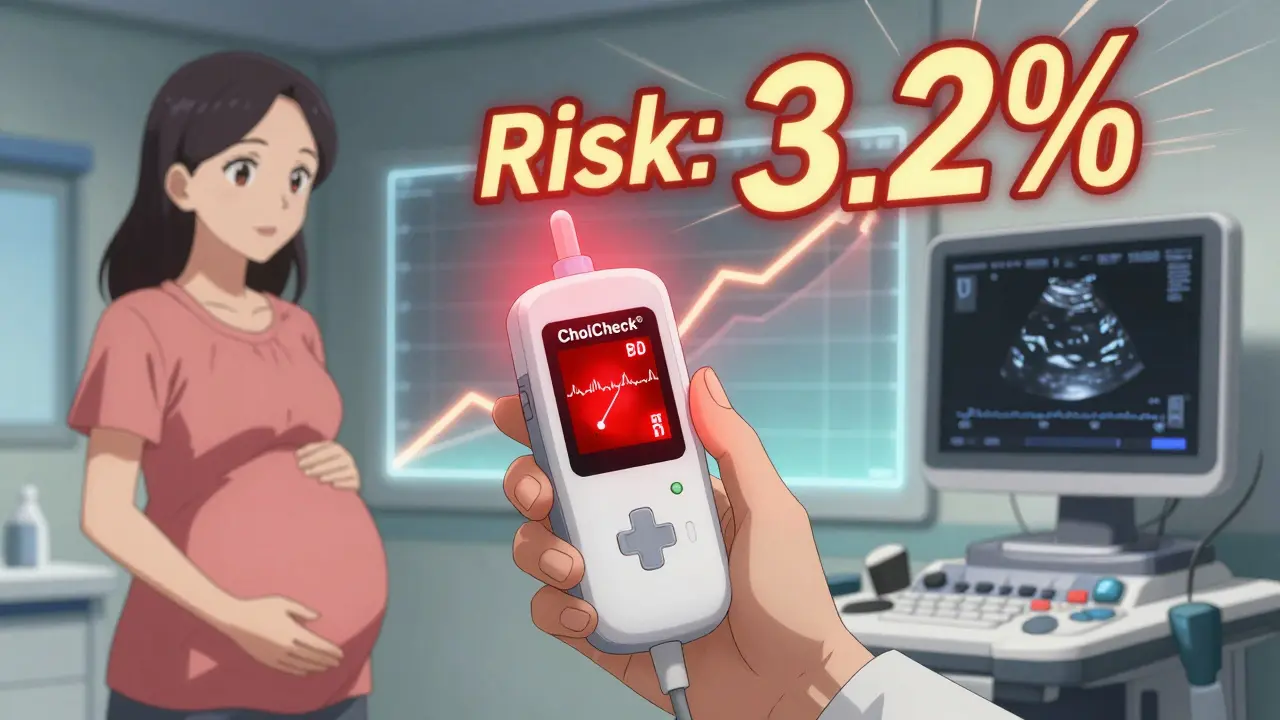
But the real key? Tracking your bile acid levels. They can spike fast. One study found that 30% of women go from mild to severe ICP in just two weeks. That’s why doctors check them every 1 to 2 weeks. Some hospitals now use rapid point-of-care tests like CholCheck®, which give results in 15 minutes instead of waiting days. That’s a game-changer for timely decisions.
First-Line Treatment: UDCA
The most common treatment is ursodeoxycholic acid (UDCA). It’s taken as a pill, usually 10 to 15 mg per kilogram of body weight each day. For a 70kg woman, that’s about 700 to 1,050 mg daily. UDCA helps bile flow better, lowers bile acid levels, and reduces itching by about 70%. Some studies suggest it may also lower the risk of preterm birth by 25%.
It’s safe for the baby. No major side effects. It’s been used for decades. The Royal College of Obstetricians and Gynaecologists (RCOG) and the American College of Obstetricians and Gynecologists (ACOG) both recommend it as first-line therapy.
But here’s the twist: a 2022 Cochrane Review found no clear proof that UDCA reduces stillbirths. That’s confusing. So why use it? Because it makes you feel better. And when you feel better, you sleep better, eat better, and stress less - all things that help your pregnancy. Plus, lowering bile acids is linked to better outcomes. Even if we can’t prove it reduces death rates, we know it helps.
Other Treatment Options
If UDCA doesn’t work or causes side effects (like diarrhea or upset stomach), there are alternatives.
- S-adenosyl methionine (SAMe): Taken as a supplement, 800 to 1,600 mg a day. Small studies show it reduces itching by 40-50%. But evidence is thin. Not widely used in the U.S.
- Cholestyramine: A powder that binds bile acids in the gut. It helps with itching, but it’s messy - chalky, bad taste. Worse, it can block vitamin K absorption, which increases bleeding risk after delivery. Used only if other options fail.
There’s no magic bullet. Treatment is about managing symptoms and reducing risk - not curing ICP. Because ICP goes away on its own after delivery. In 95% of cases, bile acid levels return to normal within days.
Delivery Timing Matters
This is where decisions get urgent. If your bile acids are below 40 µmol/L, delivery is usually planned at 37 to 38 weeks. If they’re above 100 µmol/L, delivery may be considered as early as 34 to 36 weeks. Why? Because stillbirth risk climbs steeply above 100. And it doesn’t wait.
But new data from 2023 suggests that with close monitoring and UDCA, even women with bile acids under 40 µmol/L can safely wait until 38 weeks. That means fewer unnecessary early deliveries. The 2024 International Consensus Statement will likely reflect this shift - moving away from rigid cutoffs toward personalized care based on how your bile acids change over time.

What Happens After Baby?
After delivery, ICP vanishes. But it leaves a mark. Women who’ve had ICP have a 3.2 times higher risk of developing liver problems later in life - including gallstones, chronic hepatitis, and even hepatitis C. That’s why follow-up care matters. Get your liver checked a few months postpartum. And tell your doctor about your ICP history if you ever have unexplained fatigue, jaundice, or abdominal pain down the road.
Why Early Detection Saves Lives
In places like Sweden and Finland, all pregnant women get bile acid screening in the third trimester. Since 2018, ICP-related stillbirths have dropped by 35%. In the U.S., only 42% of OB-GYNs screen unless symptoms appear. That means many cases are missed for 7 to 10 days - time when bile acids could be climbing.
If you’re itching badly at night, especially in your third trimester - don’t wait. Ask for a bile acid test. Bring up ICP. Most doctors haven’t heard of it unless they specialize in high-risk pregnancies. Be your own advocate.
Emotional Support Is Part of Treatment
ICP is exhausting. The itching keeps you awake. The worry about your baby weighs on you. Studies show women who get clear, detailed education about ICP have 22% lower anxiety and stick to treatment 18% better. Talk to your provider. Ask for pamphlets. Join a support group. Knowing what’s happening and what to expect helps more than you think.
What’s Next?
Researchers are testing new drugs. One called an autotaxin inhibitor is in Phase II trials. Early results show it cuts itching by 68% in just four weeks. It could be a game-changer - especially for women who don’t respond to UDCA.
But until then, the best tools we have are simple: test early, monitor closely, treat with UDCA, and deliver on time. ICP isn’t something you can ignore. But with the right care, most women go on to have healthy babies.

Gabrielle Conroy
February 25 2026I had ICP with my second kiddo and honestly? No one warned me. The itching was UNBEARABLE. Like, 3am scratching-til-I-bled levels. I thought it was dry skin, then allergies, then stress. Turns out? My liver was screaming. UDCA was a GAME CHANGER. I could finally sleep. Also, my OB didn’t even test me until I begged. PLEASE, pregnant peeps: if you’re itching like crazy at night, demand the bile acid test. It’s not ‘just pregnancy’ - it’s your liver begging for help. 🙏😭
kirti juneja
February 27 2026OMG this is so real. I’m from India and my mom had ICP back in the 90s - no testing, no UDCA, just ‘drink neem water and chill’. She almost lost my brother. Fast forward to me - 38 weeks, itching like a demon, went to the doc, bile acids at 87. Got UDCA stat. Baby came at 37.5 weeks, healthy as heck. But y’all - if you’re South Asian, your risk is HIGHER. Don’t wait. Don’t be shy. Your liver is doing the heavy lifting. Let it breathe. 🌿💖
Natanya Green
February 27 2026I just had to comment because I read this at 2am while scratching my palms like a cat with a tickle problem. I thought I was going crazy. Turns out? My liver was throwing a rave and I was the only one who knew. My OB said ‘it’s normal’ until I showed her this article. She ordered the test. Bile acids: 62. I cried. Then I took UDCA. Now I sleep. And I’m telling EVERY pregnant friend I know. This isn’t ‘just itching’ - it’s your body’s emergency alarm. 🔔🚨
Steven Pam
March 1 2026I’m a nurse and I’ve seen this too many times. Women get brushed off because ‘itching is normal’. But ICP? It’s silent. No rash. No fever. Just this relentless, soul-crushing itch. And the worst part? It doesn’t hurt mom - it hurts BABY. I’ve had moms cry in my arms because they didn’t know. Please, if you’re reading this and you’re pregnant - trust your gut. If it feels wrong, it is. Ask for the test. No shame. No delay. You’re not being dramatic. You’re being smart.
Timothy Haroutunian
March 2 2026Look. I get that this is important. But let’s be real - this whole ICP thing feels like another medical industry scare tactic. They push a drug, UDCA, that the Cochrane Review says doesn’t reduce stillbirths. So why are we treating it like gospel? Maybe the itching is just hormonal and the body’s fine. Maybe we’re overmedicalizing normal pregnancy. I’ve seen too many women get induced early because of anxiety, not data. We need to stop treating every symptom like a crisis. Let nature take its course. Not everything needs a pill or a 34-week C-section.
Shalini Gautam
March 4 2026As an Indian woman who had ICP twice, I’m so tired of Western medicine acting like they discovered this. We’ve known about liver issues in pregnancy for centuries - Ayurveda called it ‘Yonivyapad’. We used turmeric, neem, and warm sesame oil massages. UDCA? Sure, it helps. But don’t act like modern medicine has all the answers. We’ve been managing this for generations. The real issue? Doctors ignore traditional knowledge. And now we’re paying the price - with unnecessary drugs and early deliveries. Let’s blend wisdom, not just science.
Erin Pinheiro
March 5 2026I read this and I’m like… why is everyone so dramatic? I had itching during my last preggo and I just used coconut oil and chilled. No test. No meds. Baby was born at 41 weeks, 9lbs, perfect. I think we’ve turned pregnancy into a horror movie. ‘Oh no, the liver is acting up!’ It’s not a villain. It’s a WORKING organ. Maybe if we stopped panicking, our bodies would just… do their thing. Also, I think ‘bile acids’ sounds like a sci-fi villain. Who even says that? 😒
Michael FItzpatrick
March 6 2026This is one of the most vital posts I’ve read all year. ICP is the silent assassin of pregnancy. No one talks about it. No one screens for it. And yet - it’s the difference between a healthy baby and a devastating loss. I’m a dad. My wife had ICP. We didn’t know. We thought it was eczema. Then she started losing sleep. Then the anxiety set in. We got tested on day 7. Bile acids: 52. UDCA. Monitoring. Delivery at 37.5. Baby is thriving. But here’s the truth: if we’d waited another week, we might not have had this conversation. Because we wouldn’t be here. This isn’t about overmedicalization. It’s about listening to your body before it screams too loud. And if you’re reading this and you’re itching - don’t wait. Don’t be polite. Demand the test. Your baby’s life is worth more than your doctor’s schedule.