
Kidney Function Impact Calculator
Assess Your Kidney Function
Enter your lab results to see how creatine might be affecting your kidney function test results. This tool compares creatinine-based eGFR with cystatin C-based eGFR.
Your Results
Creatinine-Based eGFR
Estimated GFR: mL/min/1.73m²
Interpretation:
Cystatin C-Based eGFR
Estimated GFR: mL/min/1.73m²
Interpretation:
What This Means
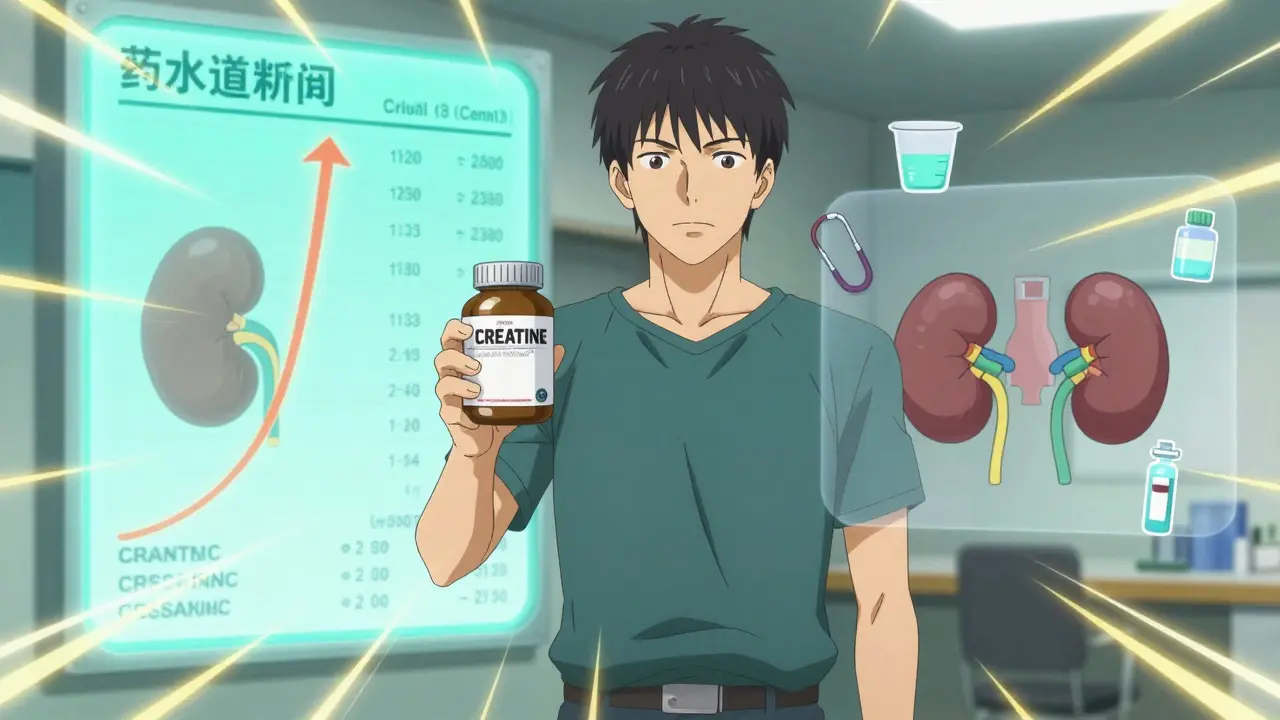
When you take creatine, your body turns it into creatinine - a waste product your kidneys filter out. That’s fine if your kidneys are healthy. But if you’re on kidney disease medications like ACE inhibitors, diuretics, or NSAIDs, that simple conversion can mess with your lab results in ways doctors might not expect. You could walk away from a routine blood test thinking you have kidney damage - when you don’t. And that’s not just a scare. It can lead to unnecessary tests, anxiety, and even changes in your treatment plan.
Why Creatine Throws Off Kidney Lab Tests
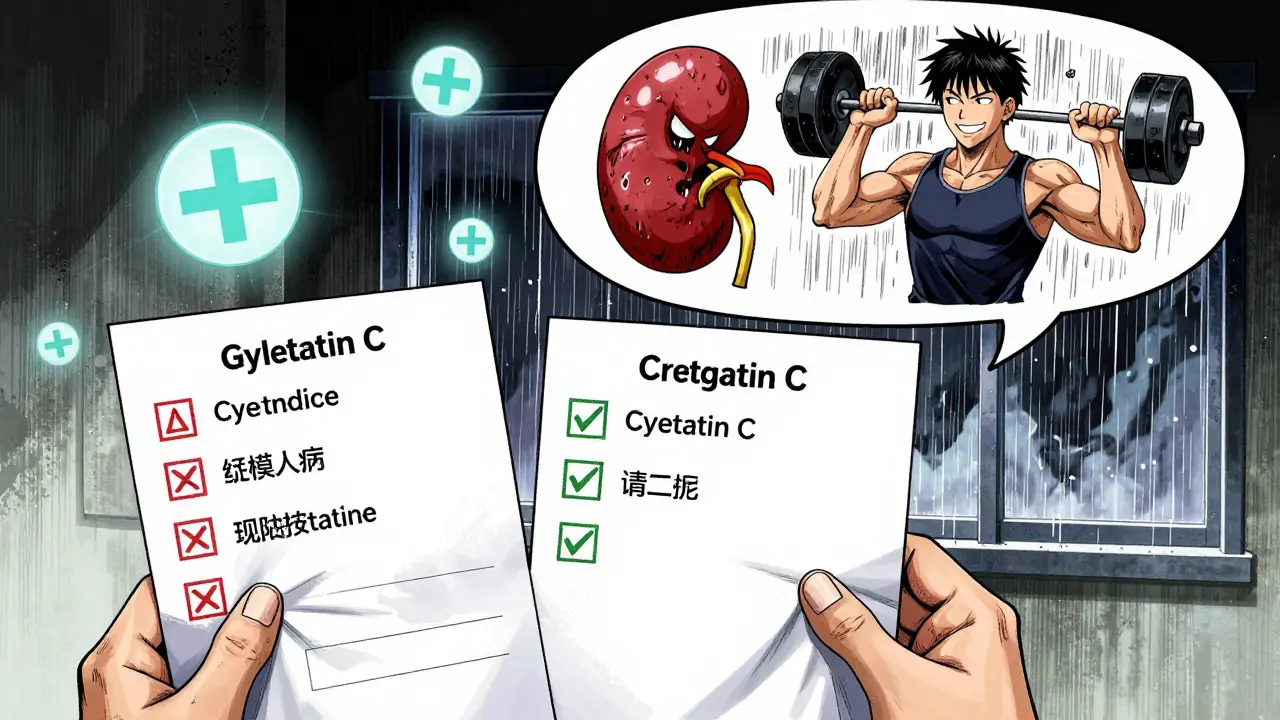
Creatine monohydrate, the most common form, gets absorbed by your muscles and then slowly breaks down into creatinine. That creatinine shows up in your blood. And here’s the problem: doctors use that number - serum creatinine - to calculate your eGFR, which tells them how well your kidneys are filtering. A normal eGFR is above 90. Below 60 for three months means chronic kidney disease. But creatine raises serum creatinine by 10% to 30% in healthy people. That’s not because your kidneys are failing. It’s because you’re dumping more creatinine into your system. A 2020 study in the Clinical Journal of the American Society of Nephrology found that creatine users with perfectly normal kidney function often had eGFR readings that looked like stage 2 kidney disease. When they stopped taking creatine, their eGFR jumped back up - not because their kidneys got better, but because the creatinine dropped.One Reddit user, a fitness student, got flagged for stage 2 CKD (eGFR 78) while taking 5 grams a day. He didn’t have symptoms. No swelling. No fatigue. His doctor ordered more tests. He stopped creatine for two weeks. His eGFR went to 95. No kidney damage. Just a misleading number.
What Happens When Creatine Meets Kidney Medications
If you’re on medication for kidney disease, your kidneys are already working harder. Some drugs - like NSAIDs (ibuprofen, naproxen), ACE inhibitors (lisinopril), or ARBs (losartan) - help protect your kidneys by lowering blood pressure and reducing protein loss. But they also change how your body handles waste. Creatine adds extra creatinine into the mix. That’s not dangerous by itself. But when your kidneys are already compromised, that extra load can make it harder to tell what’s going on. Are your creatinine levels high because of the creatine? Or because your kidney disease is getting worse? The two look identical on a lab report.There’s no evidence that creatine causes kidney damage in healthy people. A 2024 Mendelian randomization study in Renal Failure looked at genetic data from thousands of people and found no link between creatine levels and kidney function. But for someone with existing kidney disease? The risk isn’t about creatine causing harm - it’s about creatine hiding harm.
Case reports exist where people with no prior kidney issues developed acute tubular necrosis while taking 3 grams a day. But these are rare. One in thousands. The bigger issue? Doctors don’t always ask about supplements. A 2021 study in American Family Physician found 67% of primary care doctors never ask patients if they’re taking creatine - even when creatinine is high.
How to Know If Your Kidneys Are Really Failing
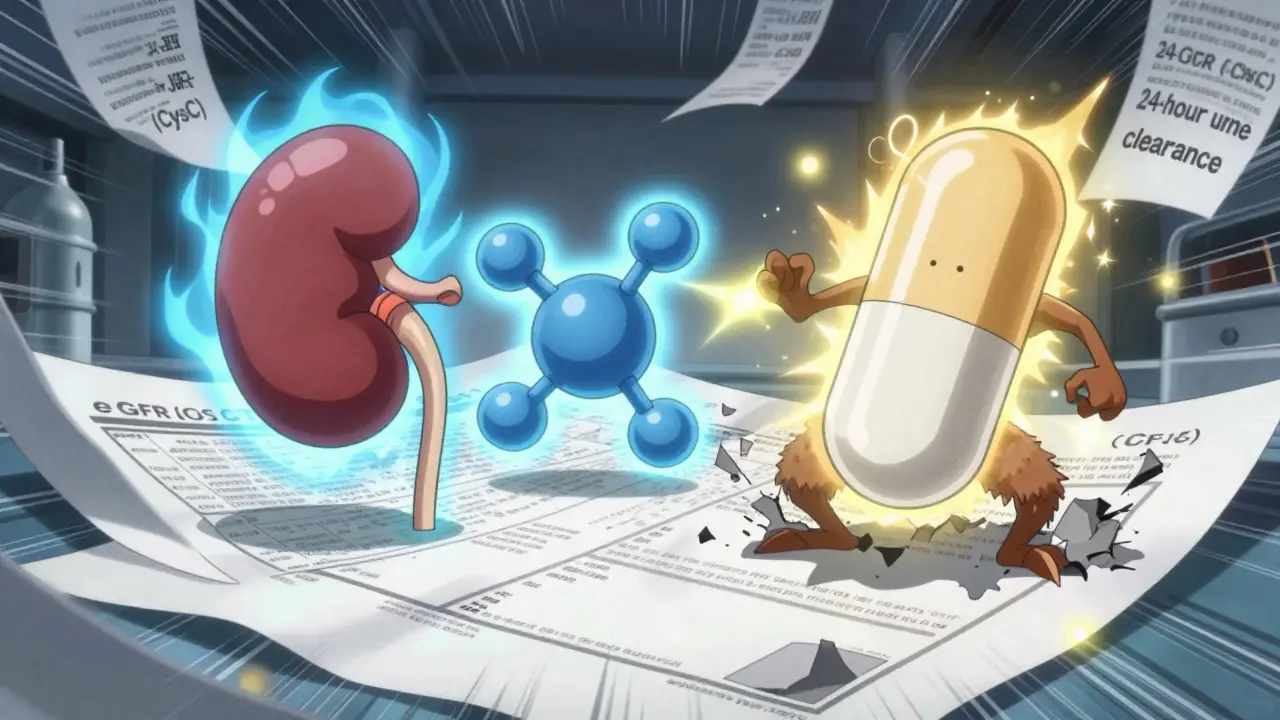
Don’t rely on serum creatinine alone if you’re taking creatine. That number is broken for you. You need better tools.- Cystatin C - This is your best friend. Unlike creatinine, cystatin C isn’t affected by creatine supplements. It’s a more accurate marker of kidney filtration. The CKD-EPI equation using cystatin C gives you a true eGFR. If your cystatin C-based eGFR is normal, your kidneys are fine - even if your creatinine is sky-high.
- 24-hour urine creatinine clearance - This measures how much creatinine your kidneys actually clear out over a full day. If your urine creatinine output stays steady while your blood creatinine rises, it’s the supplement, not your kidneys.
- Blood urea nitrogen (BUN) - Creatine doesn’t raise BUN. If your BUN is high along with creatinine, that’s a red flag. It suggests real kidney trouble.
- Urine protein - Healthy kidneys don’t leak protein. If your urine shows protein (proteinuria), that’s a sign of kidney damage, not creatine use.
Don’t panic if your creatinine is high. Look at the whole picture. If cystatin C and urine protein are normal, and you feel fine, you’re probably okay. But if multiple markers are off - especially protein or BUN - then it’s time to talk to a nephrologist.
What You Should Do Before and While Taking Creatine
If you have kidney disease or are on kidney medications, don’t skip creatine without a plan. Here’s how to do it safely:- Get baseline labs - Before starting creatine, ask for a full kidney panel: serum creatinine, cystatin C, BUN, urine protein, and eGFR (both creatinine-based and cystatin C-based). Keep a copy.
- Start low - Skip the loading phase. Go straight to 3 grams a day. No need to flood your system.
- Monitor every 3 months - Repeat the same labs. Compare to your baseline. If cystatin C stays flat and your eGFR (CysC) doesn’t drop, you’re good.
- Tell every doctor - Write it on your medication list. Say it out loud. “I take 3 grams of creatine daily.” Don’t assume they know. Most don’t.
- Stop if things change - If your cystatin C rises, or your BUN climbs, or you start swelling or feeling tired, pause creatine and get retested.
The National Kidney Foundation says creatine is safe for healthy people. But for those with kidney disease? They say: “Use with caution and proper monitoring.” That’s not a warning. It’s a roadmap.
What Your Doctor Should Be Doing
Most doctors aren’t trained to handle this. But they should be.- Ask about supplements - every time. Not just prescription drugs. Creatine is the #1 supplement used by adults under 45.
- Order cystatin C when creatinine is high - especially in athletes or gym-goers.
- Know the difference between creatine-induced elevation and real kidney disease - one is harmless, the other is serious.
- Don’t refer someone to a nephrologist just because creatinine is high. Look at cystatin C first.
There’s a growing push to adjust eGFR formulas to account for creatine use. Early research from the University of Toronto suggests multiplying the creatinine-based eGFR by 0.9 for creatine users. That’s not official yet - but it’s coming.
The Bottom Line
Creatine doesn’t break your kidneys. But it can trick your labs into thinking it did. If you’re on kidney disease meds, you’re already walking a tightrope. Don’t let a supplement make the fall worse - or worse, make you think you’re falling when you’re not.Take creatine if you want to. Just know how to read the numbers. Get cystatin C tested. Talk to your doctor. Keep records. You’re not risking your kidneys - you’re protecting your peace of mind.
Nick Flake
February 3 2026Bro, this is the kind of post that makes me believe in Reddit again 🙏
Creatine isn’t the villain - bad lab interpretation is. I’ve seen so many athletes get panic-diagnosed with CKD because their doc didn’t ask about supplements. It’s like blaming the thermometer for a fever.
Also, cystatin C is the unsung hero of nephrology. If your doc doesn’t know it, they’re operating in 2005.
Time to educate the masses. This isn’t just fitness - it’s medical literacy.
Gary Mitts
February 5 2026So basically, creatine is the fake news of kidney labs.
larry keenan
February 6 2026While the clinical implications are well-articulated, the underlying issue remains systemic: diagnostic algorithms have not evolved to accommodate widespread supplementation. The creatinine-based eGFR equation, developed in an era when creatine was niche, is now statistically biased in active populations. Without recalibration or adjunct biomarkers like cystatin C, false positives will persist. This is not an individual oversight - it’s a structural failure in clinical biochemistry education.
clarissa sulio
February 7 2026My brother got flagged for kidney disease because he was taking creatine. He didn’t even know what eGFR meant. Took him three months and a second opinion to get it cleared. Doctors need to stop treating supplements like illegal drugs. Just ask.
Matt W
February 8 2026Y’all are overcomplicating this.
Take creatine. Get cystatin C. If that’s good, you’re fine.
Don’t let a number scare you. Your body doesn’t lie - your lab report does.
Bridget Molokomme
February 9 2026Wow. So if I take creatine and my creatinine is high, I’m just… a victim of bad science?
And my doctor’s a dinosaur?
Also, why am I paying for blood tests if they’re just gonna misread them?
Also also, can I sue my PCP for emotional distress?
Solomon Ahonsi
February 9 2026This is why I stopped trusting doctors. They don’t even know what’s in their own textbooks. I took creatine for 3 years. My creatinine was always 1.4. My doc told me to stop lifting and eat tofu. I got a cystatin C test on my own. It was 0.7. My kidneys are fine. He didn’t even know what cystatin C was. I had to Google it and show him the paper.
Now he’s ‘researching it.’ Bro, it’s 2024.
Vatsal Srivastava
February 9 2026Why are we even talking about this? Creatine is for weak men who need to feel strong. Real strength comes from discipline not chemicals. Also cystatin C is a rich person’s test. Most people can’t afford it. This whole post is elitist nonsense
jay patel
February 10 2026Let me tell you something - I’m a gym guy, 42, diabetic, on lisinopril, and I’ve been on 5g creatine daily for 7 years. I got my cystatin C done last year - 0.68. My eGFR (CysC) was 92. My creatinine? 1.52. My doctor almost referred me to a nephrologist. I printed this whole thread and handed it to him. He said ‘I’ll update my notes.’
But here’s the thing - I’ve been doing this for years. I don’t panic. I monitor. I know my numbers. I’m not scared of creatine. I’m scared of doctors who don’t know their job.
So if you’re on meds, don’t quit creatine. Quit the ignorance. Get cystatin C. Ask for it. Like, demand it. You’re not being difficult - you’re being smart.
Chinmoy Kumar
February 11 2026i read this and i was like wow this is so important but also so simple why is this not taught in med school? i am from india and here many people take creatine but no one knows about cystatin c or even what eGFR means. my cousin got scared last year because his creatinine was high and he stopped working out for 6 months. he was fine all along. we need more awareness. maybe we can make a simple poster in hindi and telugu? this is life changing info
Becky M.
February 12 2026My aunt has stage 3 CKD and takes ACE inhibitors. She started creatine for muscle loss. Her creatinine went up. Her doctor wanted to reduce her meds. I made her get cystatin C - it was normal. Her BUN was normal. Proteinuria? Zero. She kept taking creatine. She’s stronger now. Doctors need to stop treating supplements like they’re poison. They’re just… data noise.
George Firican
February 12 2026There’s a quiet revolution happening in clinical nephrology - one that doesn’t involve drugs or dialysis, but data. We’ve spent decades reducing kidney function to a single number, a relic of the pre-genomic era. Creatine didn’t break the system - it exposed it. The fact that we still rely on serum creatinine as a primary biomarker in an age of proteomics and AI-driven diagnostics is not just outdated - it’s negligent. Cystatin C isn’t a luxury; it’s the ethical minimum. The real tragedy isn’t that people are misdiagnosed - it’s that we’ve normalized it. We’ve turned medical uncertainty into a bureaucratic ritual. And until we stop treating labs like oracle bones and start treating them like instruments, we’re not healing people. We’re just guessing.
Monica Slypig
February 13 2026USA has the best doctors in the world so why are we even having this conversation? If your creatinine is high you have kidney disease. End of story. Creatine is for losers who can't build muscle naturally. Also why are you even on meds if you're taking supplements? Just stop being lazy and eat real food.
Ansley Mayson
February 15 2026So let me get this straight - someone took a supplement, got a lab result, and now we’re blaming the doctor? What’s next? Blaming the scale for being wrong when you eat cake?
Also, if you’re on kidney meds, why are you taking creatine? That’s like putting a turbocharger on a broken engine. You’re not being smart. You’re being reckless.
Sandeep Kumar
February 16 2026India makes better creatine than the US and you still worry about labs? You people are weak. Take creatine. Don’t cry about numbers. Real men don’t check cystatin C. They check their gains. If your kidneys fail you’re not meant to lift. Simple.