
Medication Safety Checker for Kidney Disease
Check if Your Medication Is Safe
Enter your eGFR value and select a medication to see if your current dose is safe for your kidney function.
Warning: Potential Risk
Your current dose may be unsafe for your kidney function.
Why This Matters
When your kidneys are not functioning properly, medications can accumulate to toxic levels. This is especially dangerous with medications that are primarily cleared by the kidneys.
Important Note
This tool provides general guidance only. Always consult your healthcare provider for personalized medical advice and dose adjustments.
When your kidneys aren’t working right, even common medicines can turn dangerous. It’s not about taking too many pills-it’s about your body not being able to clear them. For someone with chronic kidney disease (CKD), a standard dose of ibuprofen, metformin, or even an antibiotic can build up to toxic levels. This isn’t rare. In fact, medication accumulation is one of the most preventable causes of sudden kidney damage in older adults and people with CKD.
Why Your Kidneys Matter for Medicines
Your kidneys don’t just make urine. They filter about 30% of all medications you take. When they’re healthy, they flush out waste and excess drugs. But when kidney function drops-say, below 60 mL/min/1.73m² (stage 3 CKD)-that filter starts clogging. Drugs stick around longer. Their concentration rises. And suddenly, what was a safe dose becomes a poison.It’s not just about how much you take. It’s about how fast your body gets rid of it. Some drugs are cleared almost entirely by the kidneys. Others are broken down by the liver but still rely on kidneys to remove the leftover pieces. When kidney function declines, both types can pile up. That’s why a person with stage 4 CKD might need a quarter of the normal dose of a drug that’s perfectly safe for someone with healthy kidneys.
Top Medications That Turn Dangerous
Not all drugs are created equal when it comes to kidney risk. Some are far more dangerous than others. Here are the biggest offenders:
- NSAIDs (ibuprofen, naproxen, diclofenac): These are the most common cause of drug-induced kidney injury. They block chemicals that keep blood flowing to the kidneys. In someone with CKD, this can cause a sudden, severe drop in kidney function. Studies show the risk triples when eGFR is below 60. Many people don’t realize over-the-counter painkillers can land them in the hospital.
- Metformin: Used by millions for type 2 diabetes, metformin is usually safe-but not if your kidneys are failing. When eGFR drops below 30, the drug can cause lactic acidosis, a life-threatening buildup of acid in the blood. But here’s the good news: if you stop it at the right time (eGFR < 30), the risk is nearly zero. A Cochrane review of 20,000 patients found no cases of lactic acidosis when guidelines were followed.
- Sulfonylureas (chlorpropamide, glyburide): These diabetes drugs cause low blood sugar. In CKD, their half-lives balloon. Chlorpropamide can last over 200 hours instead of 34. Glyburide’s active metabolite sticks around so long, it can cause hypoglycemia for 3 days straight. Glipizide, by contrast, is safer because it’s cleared by the liver, not the kidneys.
- Trimethoprim (and co-trimoxazole): This antibiotic is often prescribed for UTIs. But in CKD patients taking ACE inhibitors or ARBs, it can spike potassium levels by 1.5 mmol/L in just 48 hours. That’s enough to trigger dangerous heart rhythms.
- Aciclovir: Used for shingles and cold sores, this antiviral can form crystals in the kidney tubules, especially when eGFR is below 50. This leads to crystal nephropathy-kidney damage from blocked tubes. Mental confusion and seizures can follow.
- DOACs (apixaban, rivaroxaban): These blood thinners are popular because they don’t need regular blood tests. But apixaban is 50% cleared by the kidneys. In stage 4 CKD, bleeding risk jumps 40% compared to healthy kidneys. Warfarin, which is cleared by the liver, is often safer in these cases.
- Tacrolimus and cyclosporine: These are life-saving for transplant patients. But they’re extremely narrow in their safe range. Just 20-30% above the therapeutic level can cause kidney scarring. Chronic use leads to fibrosis in 25-30% of transplant recipients.
How Doctors Miss the Signs
It’s not always the patient’s fault. Many doctors don’t check kidney function before prescribing. A JAMA Internal Medicine study found that in 35% of primary care visits, doctors rely on serum creatinine alone-ignoring eGFR entirely. That’s like judging a car’s fuel efficiency by looking at the gas tank, not the engine.
Another common mistake: giving standard doses to patients with stage 3 or 4 CKD. The American Society of Health-System Pharmacists found a 42% error rate in dosing renally cleared drugs when eGFR is below 60. That means nearly half the time, someone with CKD gets a dose that’s too high.
Drug interactions make it worse. Taking NSAIDs with an ACE inhibitor? That combination raises the risk of acute kidney injury fivefold. Combining trimethoprim with an ARB? That’s a recipe for hyperkalemia. These aren’t edge cases-they’re routine mistakes.
What You Can Do to Stay Safe
If you have CKD, here’s what actually works:
- Know your eGFR. Don’t just rely on “creatinine normal.” Ask for your eGFR number. If it’s below 60, you’re in stage 3 or worse. That’s the red flag.
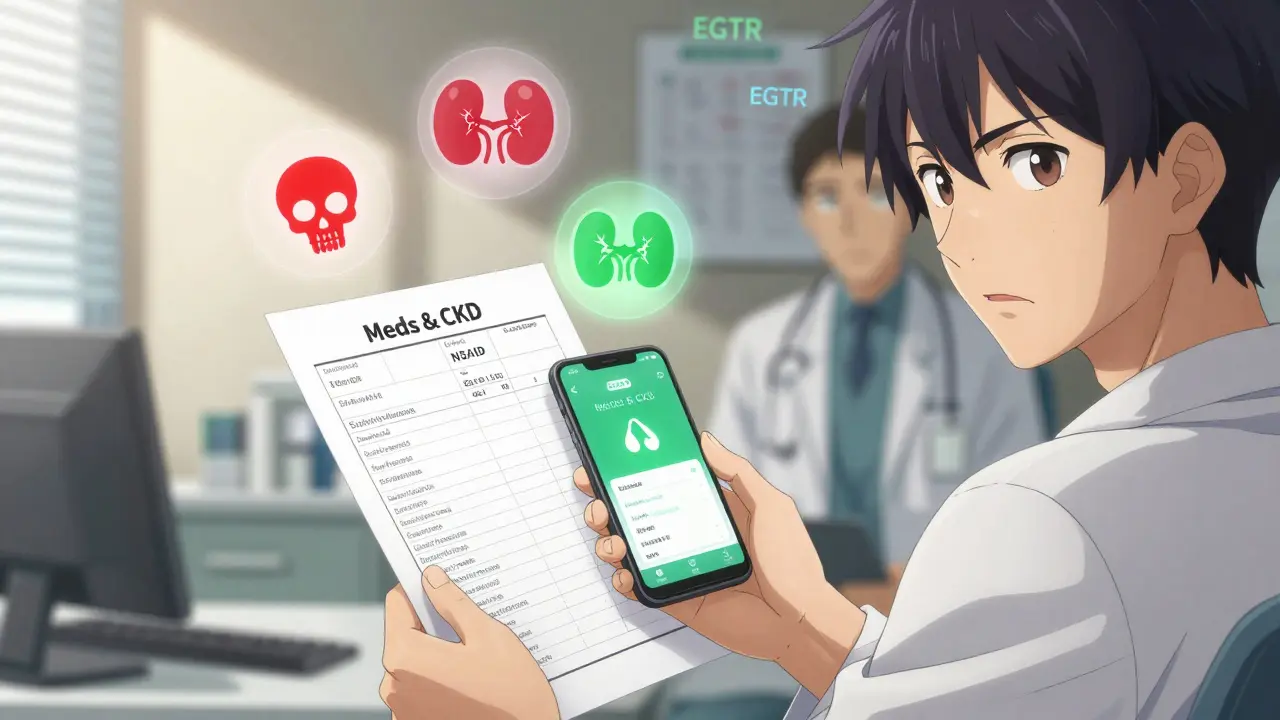
- Review every medication. Don’t assume your doctor knows your kidney status. Bring a full list of everything you take-prescriptions, OTCs, supplements. Ask: “Is this safe for my kidneys? Do I need a lower dose?”
- Avoid NSAIDs entirely. If you have CKD, use acetaminophen for pain instead. It doesn’t harm the kidneys. If you need stronger pain relief, talk to your doctor about alternatives.
- Use a kidney-safe medication app. Apps like Meds & CKD (from Healthmap Solutions) scan your meds and flag risks based on your eGFR. One study showed 82% of users had better conversations with their doctors after using it.
- Watch for warning signs. Sudden fatigue, confusion, swelling in your legs, or irregular heartbeat? These could mean drug toxicity. Don’t wait. Call your doctor.
Real Stories, Real Consequences
A Reddit user named ‘KidneyWarrior2022’ shared how a simple ibuprofen prescription nearly killed them. They had stage 3 CKD with an eGFR of 45. Their doctor gave them 400 mg of ibuprofen three times a day for back pain. Within 48 hours, their creatinine jumped from 1.8 to 3.2. They were hospitalized for five days with acute kidney injury.
Another patient on the American Kidney Fund forum took glyburide for diabetes. Their dose hadn’t changed in years. One morning, they passed out from low blood sugar. They woke up in the ER-hypoglycemia from a drug that should’ve been switched years ago.
These aren’t outliers. A 2022 survey of 1,200 CKD patients found 78% received at least one medication without proper dose adjustment. Over 40% had adverse events that required emergency care.

The Future Is Smarter Dosing
Thankfully, things are changing. The FDA now requires all new drugs to include renal dosing instructions. Pharmaceutical companies face fines up to $2.5 million for missing this info. The European Medicines Agency tracked over 12,000 cases of drug-induced kidney injury in 2022-nearly half were from incorrect dosing.
New tools are emerging. KidneyIntelX, approved by the FDA in 2023, uses machine learning to predict individual toxicity risks with 89% accuracy. Stanford researchers are testing pharmacogenomic dosing-tailoring doses based on your genes and kidney function. Early results show a 63% drop in adverse events.
Soon, your electronic health record will auto-flag risky prescriptions. Dr. Richard Lafayette of Stanford predicts that within five years, 75% of dosing errors in CKD patients will be caught before the prescription is even filled.
Bottom Line: Your Kidneys Can’t Take the Pressure
Kidney disease doesn’t just affect your body’s ability to make urine. It changes how every drug you take behaves. What’s safe for one person can be deadly for another. The good news? Almost all of these risks are preventable.
You don’t need to be a medical expert. You just need to know your eGFR, question every prescription, and avoid NSAIDs. Talk to your pharmacist. Use a kidney-safe app. Keep a written list of your meds. And never assume your doctor knows your kidney status unless you tell them.
Medication accumulation isn’t a mystery. It’s a mistake-and one we can stop.
Can I still take ibuprofen if I have kidney disease?
No. If you have chronic kidney disease (CKD), especially stage 3 or worse (eGFR below 60), you should avoid ibuprofen and other NSAIDs completely. They reduce blood flow to the kidneys and can cause sudden, severe kidney injury. Use acetaminophen (Tylenol) instead for pain relief, and always check with your doctor before taking any new painkiller.
How do I know if my medication dose is right for my kidneys?
Ask for your eGFR number-it’s the best measure of kidney function. If it’s below 60 mL/min/1.73m², your doctor should review all your medications. Look up your drugs in a reliable renal dosing tool like the University of Florida’s Renal Dosage Handbook or the Meds & CKD app. If a drug’s label says “adjust dose for renal impairment,” don’t assume the standard dose is safe. Always confirm with your pharmacist or nephrologist.
Is metformin safe for people with kidney disease?
Metformin is safe for many people with CKD, but only if used correctly. Dose reduction is needed when eGFR drops below 45, and it should be stopped entirely if eGFR falls below 30. A Cochrane review of 20,000 patients found no cases of lactic acidosis when these guidelines were followed. Never ignore your eGFR when taking metformin-it’s the key to staying safe.
What should I do if I’m on multiple medications?
If you take 10 or more medications, you’re at high risk for harmful interactions and accumulation. Ask your doctor or pharmacist for a full medication review every 6 months. Use a free app like Meds & CKD to scan your list for kidney risks. Bring a printed list to every appointment-even your primary care doctor might not know your full medication history. Many adverse events happen because no one sees the whole picture.
Are there any new tools to help avoid kidney damage from drugs?
Yes. KidneyIntelX, approved by the FDA in 2023, uses AI to predict your personal risk of drug toxicity based on your kidney function, age, and other meds. It’s already being used in some hospitals. Apps like Meds & CKD help patients track risks in real time. And by 2026, most electronic health records will automatically block unsafe prescriptions for CKD patients. These tools are changing how care is delivered-and they’re free or low-cost for patients.

Joanna Brancewicz
January 9 2026NSAIDs are a silent killer in CKD patients. I’ve seen three elderly patients in my clinic alone get AKI from ibuprofen. Always check eGFR before prescribing. Even OTC meds need renal dosing flags.
It’s not just about the drug-it’s about the system failing the patient.
Evan Smith
January 10 2026So let me get this straight-we’re telling people with kidney disease they can’t take Advil… but their doctor still gives it to them? And we’re surprised they end up in the ER?
Classic. Just classic. I bet the pill bottle says ‘safe for most adults’ and nobody reads the fine print. Or maybe they just don’t care.
Meanwhile, my grandma’s on 17 meds and her pharmacist doesn’t even know her name.
Lois Li
January 11 2026This is so important. I’m a nurse and I’ve had patients come in confused because their doctor said ‘your creatinine is fine’ but didn’t mention eGFR.
Most people don’t know the difference. We need better patient education-simple, clear, no jargon.
And pharmacies should be required to print kidney risk warnings on every prescription label. Not optional. Mandatory.
Also, thank you for mentioning Meds & CKD. I’ve started recommending it to every CKD patient I see. It’s a game-changer.
Ken Porter
January 12 2026Why are we even talking about this? America’s healthcare system is broken. You want to avoid kidney damage? Don’t get sick. Don’t need meds. Move to a country that doesn’t treat people like walking wallets.
Also, metformin is fine if you’re not lazy. Just don’t be stupid.
swati Thounaojam
January 12 2026My dad had CKD and took glyburide for years. No one told us to check dose. He passed out once. We thought it was just old age.
Now I check every med with my nephrologist. This post saved my family.
Luke Crump
January 13 2026They say medication accumulation is preventable… but what if the system is designed to fail us?
What if the real disease isn’t CKD-it’s capitalism?
Pharma profits from dosing errors. Doctors are overworked. Patients are invisible.
We’re not fixing kidneys-we’re fixing stock prices.
And you call this ‘preventable’? No. It’s inevitable. Until we burn the whole thing down.
Manish Kumar
January 14 2026You know, in India, we don’t have the luxury of fancy apps like Meds & CKD. My uncle in Pune takes metformin, lisinopril, and ibuprofen together because the local pharmacist said ‘it’s fine.’ He’s 72, eGFR 38, and still walks to the market every morning. He doesn’t know what ‘renal clearance’ means. But he knows pain. And he knows his son is away in Dubai. So he takes what’s given. No one asks. No one checks. We don’t have electronic records. We have hope. And prayer.
Maybe the real solution isn’t AI or FDA guidelines. Maybe it’s just someone sitting with the patient. Listening. Not judging. Not correcting. Just being there.
Because sometimes, the most dangerous drug isn’t ibuprofen-it’s silence.
Aubrey Mallory
January 16 2026Who approved this post? This is the most vital public health message I’ve seen in years. Every single point is backed by data. No fluff. No marketing. Just truth.
Why isn’t this mandatory reading for all primary care residents?
Why aren’t hospitals fined for not checking eGFR before prescribing?
And why do we still let OTC painkillers sit next to candy in pharmacies like they’re harmless?
This isn’t just education-it’s a moral imperative. I’m sharing this with every family member I have. And I’m printing it out for my doctor.
Dave Old-Wolf
January 17 2026My mom had stage 4 CKD and was on trimethoprim for a UTI. She got hyperkalemia and ended up on a ventilator. We didn’t know the combo with her ARB was deadly.
After that, I started keeping a notebook of all her meds and dosages. I call her pharmacist every time something new is added.
It’s exhausting. But it’s better than burying someone because no one asked, ‘Is this safe for her kidneys?’
Thanks for listing the alternatives. Glipizide over glyburide? That’s gold.
Prakash Sharma
January 17 2026Western medicine thinks it knows everything. But in India, we’ve been using turmeric, neem, and garlic for kidney health for centuries. Why are we listening to FDA guidelines instead of our own traditions?
Also, why are we giving people so many pills? One pill, one problem. That’s the real issue.
Stop overmedicating. Stop trusting Big Pharma. Go back to nature.
Donny Airlangga
January 17 2026I’ve been on dialysis for 8 years. I take 12 medications. I read every label. I cross-check with my nephrologist. I still get scared every time a new script comes in.
This post made me feel seen.
Thank you for writing it. I wish I’d had this when I was first diagnosed.
Molly Silvernale
January 18 2026Medication accumulation isn’t just a medical issue-it’s a poetic tragedy.
Our bodies, once elegant machines, now clogged with the ghosts of prescriptions meant to heal…
Each pill a whispered promise, each dose a silent betrayal.
The kidneys, those quiet poets of filtration, drown in the ink of corporate labels and hurried scribbles.
And we, the patients, are the footnotes-forgotten in the margins of a system that forgot to ask: ‘Are you still alive?’
So I ask you now: Who will read this when the machines stop humming?
Who will remember the names of the drugs that killed us?
Not the FDA.
Not the doctors.
But us.
Us, who still breathe.
And still dare to care.