

Hypoglycemia Medication Risk Checker
Check if your diabetes medications increase hypoglycemia risk in older adults. Based on guidelines from the American Diabetes Association and American Geriatrics Society.
Results will appear here based on your selections.
Recommendations
Why Hypoglycemia Is More Dangerous for Older Adults
Low blood sugar isn’t just uncomfortable-it can be life-threatening, especially for older adults with diabetes. While a young person might feel shaky or sweaty when their glucose drops, an 80-year-old might just seem confused, sluggish, or off-balance. These subtle signs are easy to miss, and by the time someone notices, the person could already be in a medical emergency.
According to the American Diabetes Association (2024), adults over 65 experience hypoglycemia 2.3 times more often than younger adults. The real danger isn’t just the low number on the meter-it’s what happens next. Each episode raises the risk of falls by 40%, hip fractures by 25%, and heart problems by 30%. In one study, older adults who had a severe low blood sugar episode were 2.5 times more likely to die within five years than those who didn’t.
Part of the problem is biology. As people age, their bodies don’t respond to low glucose the same way. The hormones that should kick in to raise blood sugar-like epinephrine and glucagon-become weaker. Up to half of older adults lose these natural warning signals. That’s called hypoglycemia unawareness. They don’t feel the warning signs until their glucose is dangerously low, often below 50 mg/dL.
Which Diabetes Medications Carry the Highest Risk?
Not all diabetes drugs are created equal when it comes to hypoglycemia risk. The biggest culprits are insulin and sulfonylureas, especially older ones like glyburide. Studies show glyburide increases the chance of severe low blood sugar by 50% compared to newer alternatives like glipizide. That’s why the American Geriatrics Society Beers Criteria lists glyburide as a potentially inappropriate medication for seniors.
Insulin is another major trigger. Many older adults are prescribed long-acting insulin to control overnight sugars, but if they skip a meal, get sick, or become less active, that insulin keeps working-and their blood sugar keeps dropping. One caregiver shared how her father’s insulin dose of 40 units caused weekly lows. After cutting it in half, the lows stopped and his A1c stayed at a safe 7.8%.
Sulfonylureas like glimepiride and tolbutamide also carry high risk, especially in people with kidney problems. When kidneys don’t work well-which is common in older adults-these drugs stick around longer in the body, increasing the chance of a low. In fact, seniors with chronic kidney disease are 2.7 times more likely to have a severe hypoglycemic event than those with normal kidney function.
Thankfully, there are safer options. GLP-1 receptor agonists (like semaglutide), SGLT2 inhibitors (like empagliflozin), and DPP-4 inhibitors (like sitagliptin) rarely cause low blood sugar. They’re often better choices for older adults, especially if they’re not on insulin.
Hidden Triggers You Might Not Notice
Hypoglycemia doesn’t always come from taking too much medicine. Sometimes it’s a chain of small, everyday things that add up:
- Skipping meals or eating less because of poor appetite or nausea
- Drinking alcohol without food, especially in the evening
- Starting a new medication that interacts with diabetes drugs
- Getting sick with an infection or flu, which changes how the body uses glucose
- Being less active after a fall or hospital stay
- Living alone and forgetting to eat
Many older adults with dementia or depression don’t recognize they’re low-or they forget how to treat it. One Reddit user described his 78-year-old mother with Alzheimer’s: “She’d sit in her chair, staring blankly, and we’d find her blood sugar at 38 mg/dL. She didn’t cry out. She didn’t call for help. She just went quiet.”
Even something as simple as a new pair of shoes can be a trigger. If an older adult walks more than usual-maybe because they’re trying to get back to normal after a hospital stay-they can burn through glucose faster than their meds account for.
What a Good Prevention Plan Looks Like
A strong hypoglycemia prevention plan isn’t just about checking blood sugar. It’s a team effort involving the patient, family, and doctor. Here’s what works:
- Set realistic blood sugar goals. The ADA recommends different targets based on health status. A healthy 70-year-old might aim for an A1c under 7%. Someone with heart disease, dementia, or limited life expectancy should aim for under 8.5%. Tight control isn’t worth the risk.
- Review all medications every 3-6 months. Ask your doctor: “Is this drug still necessary? Is there a safer alternative?” Many seniors are on five or more medications. Each one adds risk.
- Use continuous glucose monitoring (CGM). Devices like the Dexcom G7 or FreeStyle Libre 3 show real-time trends and alert you before a low happens. Even if you’re not on insulin, CGM can catch dangerous drops. Studies show CGM reduces hypoglycemia by 40%.
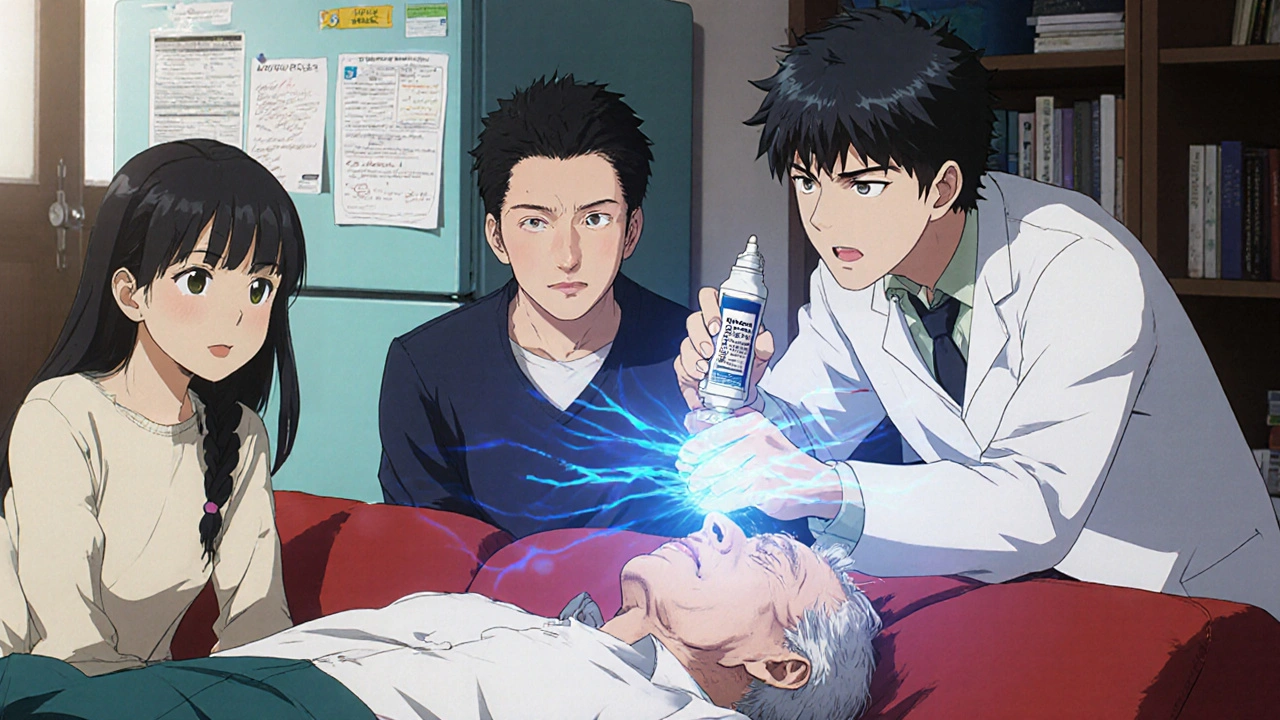
- Teach caregivers how to use glucagon. The new nasal glucagon (Baqsimi) is easy to use-no injection needed. Just spray it into the nose. It works in seconds. Keep it in the kitchen, not the medicine cabinet.
- Make a written action plan. Write down: “If blood sugar is below 70 mg/dL, give 15g fast-acting sugar (juice, glucose tabs). Wait 15 minutes. Check again. If still low, repeat. If confused or unconscious, use glucagon.” Post it on the fridge.
The Pottstown Primary Care Intervention showed that just three clinic visits focused on risk assessment and medication changes cut the number of seniors at high risk for hypoglycemia by 46% in six months. No fancy tech. Just smart, simple changes.
When to Say No to Tight Control
Many older adults and their families believe the lower the A1c, the better. That mindset can be deadly. A1c targets shouldn’t be one-size-fits-all. For someone who’s frail, has multiple chronic conditions, or lives in a care home, aiming for an A1c below 7% is dangerous. The goal should be avoiding lows, not chasing perfect numbers.
One 84-year-old woman with heart failure and mild dementia had an A1c of 8.2%. Her doctor wanted to lower it. But she’d had three severe lows in six months, including one that landed her in the ER after a fall. Her family asked: “Is it worth risking her life for a 0.5% drop in A1c?” The answer was no. They switched her to a safer medication and stopped insulin. Her A1c stayed at 8.1%. She didn’t have another low for 18 months.
The American Diabetes Association now says: “Minimize hypoglycemia risk over achieving tight control.” That’s the new standard. It’s not giving up-it’s choosing safety.
What Families and Caregivers Can Do
If you’re caring for an older adult with diabetes, you’re on the front lines. Here’s what you can do right now:
- Keep glucose tabs or juice boxes in every room-bedside, bathroom, car, purse.
- Check blood sugar before bed if they’re on insulin or sulfonylureas.
- Ask the doctor: “Could this medicine be causing lows?”
- Learn how to use nasal glucagon. Practice with the trainer device.
- Watch for subtle signs: confusion, irritability, slurred speech, unsteadiness.
- Use the TRIM-HYPO survey to talk about how often lows happen and how they affect daily life. It helps doctors see the real impact.
One caregiver said, “I used to think my dad’s ‘bad days’ were just old age. Now I know they were low blood sugar. We keep glucagon in the freezer. It saved his life.”

Why So Many Seniors Still Go Undiagnosed
Despite the risks, hypoglycemia in older adults is still underdiagnosed. Why? Because it doesn’t always look like hypoglycemia. Emergency rooms record only the worst cases-those that lead to hospital visits. But most lows happen at home. They’re mild, brief, and unreported.
Studies estimate that 70-80% of severe hypoglycemic events are missed in claims data. And Level 1 and 2 lows-those below 70 mg/dL-are almost never counted. That means doctors don’t see the full picture. A senior might come in for dizziness, and the doctor blames it on aging, not low sugar.
Medicare’s current rules make it worse. CGM is covered only for people on insulin. But many older adults on sulfonylureas are just as vulnerable. They’re left without the tools to prevent lows.
What’s Next for Hypoglycemia Prevention
There’s progress. The FDA approved the first dual-hormone artificial pancreas system in 2023 for clinical trials in older adults. It delivers both insulin and glucagon automatically. But it won’t be widely available until 2026 or later.
In the meantime, the focus is shifting from A1c to “time in range.” The ADA now recommends that older adults spend at least 50% of the day (12 hours) between 70 and 180 mg/dL-and less than 1% of the day below 54 mg/dL. That’s a practical, measurable goal.
Primary care doctors are also being trained to screen for hypoglycemia risk during routine visits. Tools like the TRIM-HYPO survey help quantify how often lows happen and how much they affect daily life. That makes it easier to justify changing medications or adding CGM.
Final Thoughts: Safety Over Perfection
Hypoglycemia in older adults isn’t just a medical issue-it’s a human one. It steals independence. It causes falls. It leads to hospital stays. It ends lives. The good news? Most of these events are preventable.
You don’t need fancy tech or perfect blood sugar numbers. You need awareness. You need a plan. You need to talk to your doctor about the real risks of your medications. And you need to keep glucagon in the house.
For older adults with diabetes, the goal isn’t to be perfect. It’s to be safe. And that’s a goal worth fighting for.
Matthew Higgins
November 30 2025I had a neighbor who went into a coma from a low sugar episode and no one knew until his cat started meowing at the door. They found him slumped in his chair, cold as ice. He was on glyburide. No one told him it was dangerous for seniors. Just another pill in the rotation.
Mary Kate Powers
December 2 2025This is so important. My grandma had three falls in a year because of hidden lows. We started using CGM and now she’s been stable for 14 months. It’s not about A1c numbers-it’s about keeping her upright and alert. Everyone needs to hear this.
Sohini Majumder
December 2 2025OMG, I just read this and I’m crying?? Like, I didn’t even know this was a thing?? My uncle was on insulin and he’d just… zone out?? We thought he was being lazy. Turns out he was dying slowly. This is the most important thing I’ve read all year. I’m forwarding this to EVERYONE.
Sara Shumaker
December 2 2025It’s fascinating how medicine still clings to the A1c-as-god paradigm. We treat aging like a bug to be fixed, not a process to be honored. The real tragedy isn’t the low blood sugar-it’s the systemic refusal to see elderly patients as whole human beings with dignity, not just metabolic equations. We’re not optimizing for life-we’re optimizing for charts.
Scott Collard
December 3 2025CGM should be mandatory for anyone over 65 on any glucose-lowering med. Period. Insurance companies are literally gambling with lives by only covering it for insulin users. This isn’t healthcare-it’s cost-cutting disguised as policy.
Brandy Johnson
December 5 2025This article is dangerously misleading. In America, we coddle the elderly to the point of enabling dependency. If they can’t manage their own blood sugar, they shouldn’t be living alone. Glucagon in the freezer? That’s a Band-Aid on a broken system. The real solution is institutional care.
stephen idiado
December 6 2025Hypoglycemia unawareness is a pharmacokinetic failure of polypharmacy in geriatric populations. The real issue is lack of metabolic resilience due to mitochondrial decay. We need biomarkers, not Band-Aids.
Joy Aniekwe
December 8 2025Oh wow. So the solution to elderly people nearly dying from their own medicine is… to give them more tech? How about we stop prescribing deadly drugs to people who can’t swallow pills without choking? Maybe the real problem is doctors who think ‘more meds’ = ‘better care’.
tushar makwana
December 9 2025My dad used to get really quiet after lunch. We thought he was tired. Turns out he was low. We started keeping juice in his pocket. Now he smiles more. It’s not about medicine. It’s about noticing. Thank you for saying this.
Geoff Heredia
December 11 2025Wait-this is all a lie. The FDA and Big Pharma are pushing CGM because they want to sell devices. They don’t care about seniors. They care about profit. And why is no one talking about the fact that insulin was originally made from pig pancreases? Who’s really controlling this?
Jennifer Wang
December 11 2025The American Diabetes Association’s updated guidelines on hypoglycemia risk mitigation in geriatric populations represent a paradigmatic shift toward patient-centered outcomes. The adoption of time-in-range metrics, coupled with medication de-escalation protocols, demonstrates evidence-based evolution in clinical practice.
Monica Lindsey
December 13 2025If your parent can’t manage their diabetes, maybe they shouldn’t be allowed to live alone. This isn’t compassion-it’s enabling. Glucagon in the freezer? That’s not prevention. That’s damage control for bad parenting.
Peter Axelberg
December 14 2025I’ve been a caregiver for my mom for six years. She’s 82, on metformin and a tiny bit of glipizide. We check her sugar before bed. We keep glucose tabs in the car, the bathroom, her purse. We don’t chase perfect numbers. We chase her being able to watch her grandkids play soccer without passing out. That’s the goal. Simple. Human. Real.
Matthew Higgins
December 14 2025I just saw a nurse say this in a comment: ‘If they can’t manage their meds, they shouldn’t live alone.’ Bro. That’s not a solution. That’s a surrender. My aunt lives alone. She’s got dementia. We put her on a CGM, got her a daily meal delivery, and trained the mailman to check in. She’s been low once in 18 months. That’s not failure. That’s love.