

C. diff Risk Assessment Calculator
When you take an antibiotic, you expect it to kill the bad bacteria making you sick. But sometimes, it also wipes out the good bacteria in your gut-and that’s when trouble starts. Antibiotic-induced diarrhea isn’t just a mild side effect. For about 1 in 5 people who get diarrhea after antibiotics, it’s caused by Clostridioides difficile, or C. diff, a dangerous infection that can turn life-threatening in hours.
It’s not rare. In the U.S. alone, over half a million cases happen every year. Around 30,000 people die within 30 days of diagnosis. And it’s not just hospitals-more than a quarter of cases now start in the community, in people who never set foot in a clinic. The truth? Most cases are preventable. But too many people don’t know how.
What Exactly Is C. diff?
C. diff is a spore-forming bacterium that lives harmlessly in some people’s guts. But when antibiotics wipe out the normal gut flora, C. diff takes over. It doesn’t just cause diarrhea-it releases two powerful toxins that eat away at the colon lining. That’s what leads to severe cramping, fever, bloody stools, and in worst cases, toxic megacolon or sepsis.
Not all antibiotic-related diarrhea is C. diff. In fact, 66% of cases aren’t. But if you’ve been on antibiotics in the past 30 days and now have unformed stools, you need to get tested. The problem? Many doctors still mistake it for a virus or IBS. A Reddit thread from 2023 showed nearly 4 in 10 patients were misdiagnosed at first.
Which Antibiotics Are Most Likely to Cause It?
Some antibiotics are far more dangerous than others. The biggest culprits are:
- Fluoroquinolones (like ciprofloxacin and levofloxacin)
- Third- and fourth-generation cephalosporins (like ceftriaxone and cefepime)
- Clindamycin
- Carbapenems (like meropenem)
Even a short course-just 3 to 5 days-can be enough. That’s why doctors are now told to avoid these drugs unless absolutely necessary. If you’re prescribed one of these, ask: "Is there a narrower-spectrum option?" or "Can this be shortened?"
How Is It Diagnosed?
Testing isn’t simple. You need unformed stool-no laxatives in the last 48 hours. Labs usually start with a glutamate dehydrogenase (GDH) screen. If that’s positive, they check for toxins with an enzyme immunoassay or use a nucleic acid amplification test (NAAT) to find C. diff DNA.
But here’s the catch: NAATs are super sensitive. They can detect C. diff even when it’s not causing disease. That means you might test positive but not have an active infection. Doctors now use a two-step process to avoid overtreating. If you’re not sick, you don’t need antibiotics.
What Are the Treatment Options?
Treatment depends on how bad it is. For mild cases, the old standby-metronidazole-is no longer first choice. Studies show it fails in 30-40% of cases now. The CDC says it’s becoming resistant. So here’s what’s used today:
- Vancomycin: 125mg four times a day for 10 days. Costs about $1,650. Works well, but recurrence happens in 20% of cases.
- Fidaxomicin: 200mg twice a day for 10 days. Costs $3,350. Fewer recurrences-only 13% vs 22% with vancomycin. But most hospitals don’t stock it because of the price.
For severe cases-white blood cell count over 15,000 or creatinine over 1.5-doctors still use vancomycin or fidaxomicin. If you’re crashing-low blood pressure, bloated belly, no bowel movements-you get high-dose oral vancomycin (500mg four times daily) plus IV metronidazole. Sometimes, rectal vancomycin is even given if your gut is paralyzed.
And here’s something patients rarely hear: Don’t take loperamide (Imodium) or other anti-diarrheals. They trap the toxins inside your colon. The Cleveland Clinic says they can make things worse-sometimes deadly.
What If It Comes Back?
One in five people get C. diff again after treatment. Two recurrences? That’s a pattern. Three or more? You’re in the high-risk group.
For the first recurrence, doctors might repeat the same antibiotic. But after that, they switch tactics:
- Vancomycin taper: 125mg four times daily for 10-14 days, then twice daily for 7 days, then once daily for 7 days, then every 2-3 days for 2-8 weeks. This slowly rebuilds your gut defenses.
- Fidaxomicin + rifaximin: Used together to prevent relapse.
But the real game-changer is fecal microbiota transplantation (FMT). It’s not sci-fi-it’s FDA-approved. Rebyota and Vowst are now available. They deliver healthy gut bacteria from a screened donor. Success rates? 85-90%. One patient on HealthUnlocked wrote: “After 7 recurrences over 18 months, one FMT cleared me permanently. I wish I hadn’t waited so long.”
There’s also bezlotoxumab (Zinplava), a monoclonal antibody that blocks C. diff toxin B. Given as a single IV infusion during antibiotic treatment, it cuts recurrence risk by 10%. But it’s expensive and only for high-risk patients.

How Do You Prevent It?
Prevention is simpler than treatment-and far more effective.
1. Use antibiotics only when needed. The CDC says 30-50% of antibiotic prescriptions in hospitals are unnecessary. If you have a cold, sore throat, or mild sinus infection, antibiotics won’t help. Ask your doctor: “Is this bacterial? Do I really need it?”
2. Wash your hands with soap and water. Alcohol-based hand sanitizers don’t kill C. diff spores. Only soap and water do. This is why healthcare workers who wash properly reduce transmission by up to 50%.
3. Clean surfaces with bleach-based disinfectants. Standard cleaners? Useless. C. diff spores live for months on doorknobs, bedrails, toilets. EPA List K disinfectants are the only ones that kill them.
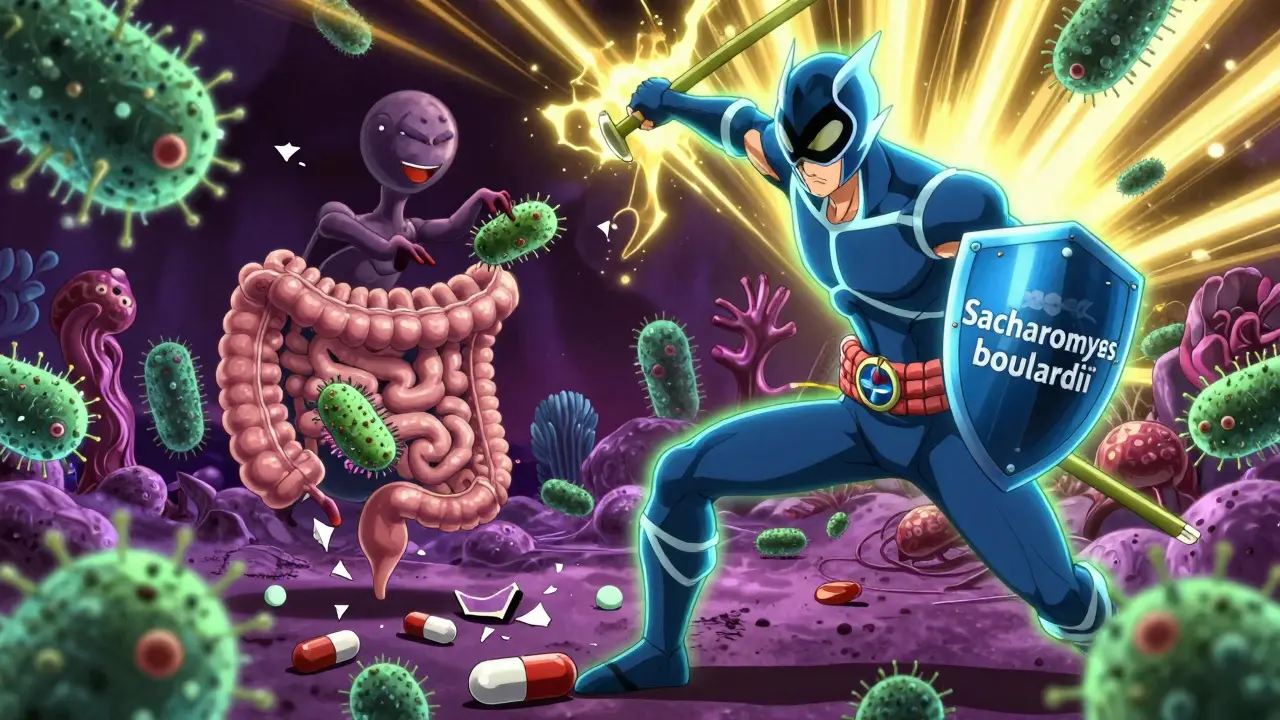
4. Probiotics? Maybe-but don’t count on them. Some studies show Saccharomyces boulardii or Lactobacillus rhamnosus GG can cut risk by 60%. But the IDSA doesn’t recommend them routinely. Evidence is mixed. If you take them, do it while on antibiotics-but don’t expect miracles.
What Happens After You Recover?
Diarrhea might stop in 3 days. But recovery isn’t over. Many patients report brain fog, fatigue, and digestive issues for weeks-even months. One study of over 1,200 patients found:
- 45% had brain fog
- 37% felt exhausted long after diarrhea ended
- 82% had to avoid dairy, spicy foods, or caffeine during recovery
Give your gut time. Eat bland, fiber-rich foods. Yogurt with live cultures may help. Avoid sugar and processed carbs-they feed bad bacteria. Stay hydrated. And if symptoms return, don’t wait. Test again.
Why This Matters More Than You Think
C. diff isn’t just your problem. It’s a public health emergency. The CDC classifies it as an "urgent threat." It costs the U.S. system $4.8 billion a year. Hospitals with antibiotic stewardship programs cut C. diff rates by 26% between 2011 and 2017. That’s not magic-it’s policy. Better prescribing. Better cleaning. Better training.
And the future is changing fast. New drugs like ridinilazole show promise in trials-better than vancomycin at keeping C. diff from coming back. Point-of-care tests are being developed so you get results in hours, not days. Microbiome-targeted therapies will soon be standard.
But until then, the best defense is knowledge. Know your antibiotics. Know your risks. Know when to push back. And if you’ve had diarrhea after antibiotics, don’t ignore it. Get tested. Your gut-and your life-depend on it.
Can you get C. diff without taking antibiotics?
Yes. While antibiotics are the biggest trigger, about 25% of C. diff cases happen in people who haven’t taken them recently. This is called community-associated C. diff. It’s often linked to close contact with infected people, contaminated surfaces, or exposure in nursing homes. Older adults, especially those with weakened immune systems, are at higher risk even without recent antibiotic use.
Is C. diff contagious?
Extremely. C. diff spreads through spores in feces. If someone with C. diff doesn’t wash their hands after using the bathroom, they can leave spores on doorknobs, phones, toilets, or bedding. Others touch those surfaces and then touch their mouth. That’s how it spreads. Spores survive for months on surfaces and resist normal cleaning. That’s why soap and water, not hand sanitizer, are required for hand hygiene.
Why is metronidazole no longer recommended as first-line treatment?
Because it’s failing too often. Studies show its failure rate has jumped from 5-15% in the past to 30-40% today. It’s less effective at clearing the infection and doesn’t reduce recurrence like vancomycin or fidaxomicin. The CDC and IDSA updated their guidelines in 2017 to remove metronidazole as first-line due to rising resistance and poor outcomes. It’s now only used if the other drugs aren’t available.
Can probiotics prevent C. diff?
Some strains, like Saccharomyces boulardii and Lactobacillus rhamnosus GG, have shown in studies to reduce C. diff risk by up to 60% when taken during antibiotic treatment. But the evidence isn’t consistent across all populations. The Infectious Diseases Society of America doesn’t recommend them routinely because results vary too much. If you want to try them, choose a reputable brand and take them daily while on antibiotics-but don’t rely on them alone.
How long does it take to recover from C. diff?
Most people start feeling better within 3 to 5 days of starting the right antibiotic. But full recovery can take weeks. Diarrhea may stop, but fatigue, brain fog, and digestive sensitivity can linger for months. This is because the gut microbiome takes time to rebuild. Some people need dietary changes, probiotics, or even FMT to get back to normal. Don’t rush back to your old eating habits-your gut is still healing.
Is FMT safe and available everywhere?
FMT is very safe when done with properly screened donor stool. FDA-approved products like Rebyota and Vowst are now available in most major hospitals. But access is still limited in rural areas and smaller clinics. It’s not a first-line treatment-it’s reserved for people with multiple recurrences after antibiotics have failed. If you’ve had three or more episodes, ask your doctor about FMT. It’s one of the most effective options we have.


Akshaya Gandra _ Student - EastCaryMS
January 6 2026i just got off antibiotics for a sinus thing and now i got this weird loose stool thing going on lol
thought it was just my diet but now im scared
should i go to the doc or wait it out?
Uzoamaka Nwankpa
January 6 2026They say antibiotics are necessary but half the time they’re just prescribing them like candy. My cousin got C. diff after a 3-day course for a sore throat. No fever, no nothing. Just diarrhea that wouldn’t quit. Now she’s on probiotics and scared to even take Tylenol with antibiotics.
Hospitals don’t care until you’re in the ER screaming in pain. Then they test. Too late.
And don’t even get me started on how they charge $3000 for a 10-day pill course. This is profit-driven medicine.
Siobhan Goggin
January 7 2026Thank you for writing this. I’ve been through three rounds of C. diff and it’s the most terrifying thing I’ve ever lived through. The brain fog lasted six months. I thought I was going crazy.
But FMT changed everything. I’m not exaggerating - I felt like myself again within two weeks. No more panic attacks every time I ate something new.
If you’ve had more than one recurrence - please, please don’t wait. Ask for FMT. It’s not magic. It’s science.
Vikram Sujay
January 7 2026While the clinical details presented are accurate and well-sourced, I find myself reflecting on the broader epistemological implications of antibiotic stewardship in modern healthcare.
The reduction of complex biological systems - such as the human microbiome - to mere vectors of pathogenicity reflects a mechanistic worldview that prioritizes intervention over ecological balance.
When we treat gut flora as expendable collateral damage, we are not merely treating an infection - we are eroding the co-evolved symbiosis that has sustained human physiology for millennia.
The emergence of community-acquired C. diff suggests that our public health infrastructure has failed to internalize the lesson: antibiotics are not benign tools. They are ecological bombs.
Until medicine embraces microbiome restoration as a primary therapeutic objective - rather than a last-resort afterthought - we will continue to treat symptoms while accelerating systemic collapse.
Perhaps the most radical act of prevention is not taking the pill at all.
Jay Tejada
January 7 2026So let me get this straight - we’ve got a $3,000 pill that works better than the $1,600 one, but hospitals won’t stock it because it’s ‘too expensive’?
Meanwhile, the guy who wrote this post probably got his meds for free from a VA clinic.
Meanwhile, I’m paying $400 out of pocket for vancomycin because my insurance says ‘not preferred’.
And you want me to ‘ask my doctor for a narrower-spectrum option’? Bro, my doctor doesn’t even know what ‘fidaxomicin’ sounds like.
Also, I took Imodium once. Didn’t die. But now I’m paranoid every time I poop.
Shanna Sung
January 9 2026They’re hiding the truth - C. diff isn’t from antibiotics, it’s from the government’s fluoridated water supply and the GMO corn in your yogurt
They don’t want you to know that Rebyota is actually a bioweapon disguised as a fecal transplant
My neighbor’s dog got C. diff after eating a flea collar - that’s the real source
And why is no one talking about the 5G towers near the hospital? They weaken your gut lining
They gave me metronidazole and now I can’t drink alcohol - coincidence? I think not
They’re using this to push vaccines. It’s all connected
Mandy Kowitz
January 10 2026Wow. Someone actually took the time to write this without saying ‘just take probiotics’.
Imagine that. A post that doesn’t end with ‘I did a juice cleanse and it fixed everything’.
Also, I’m so tired of people saying ‘just wash your hands’ like that’s the only solution. You think your grandma’s soap and water is gonna stop a spore that survives on your toilet seat for 6 months?
Also, why is no one talking about how the CDC is funded by Big Pharma? Who’s writing these guidelines again?
And why is fidaxomicin so expensive? Because someone’s got a yacht to buy.
Cassie Tynan
January 11 2026Okay but the real villain here isn’t the antibiotic - it’s the 15-minute doctor visit where you’re handed a script like a coupon.
You don’t get to ask questions. You don’t get to say ‘I’ve got a cold, not a bacterial infection.’ You get a pill and a smile.
And then you get diarrhea. And then you get scared. And then you Google it and find this post and realize - you were right to doubt them.
So here’s my takeaway: If your doctor prescribes an antibiotic without asking you about your last two bowel movements - walk out.
And if you’re reading this and you’ve had C. diff - you’re not broken. You’re just surviving a system that treats your gut like trash.