
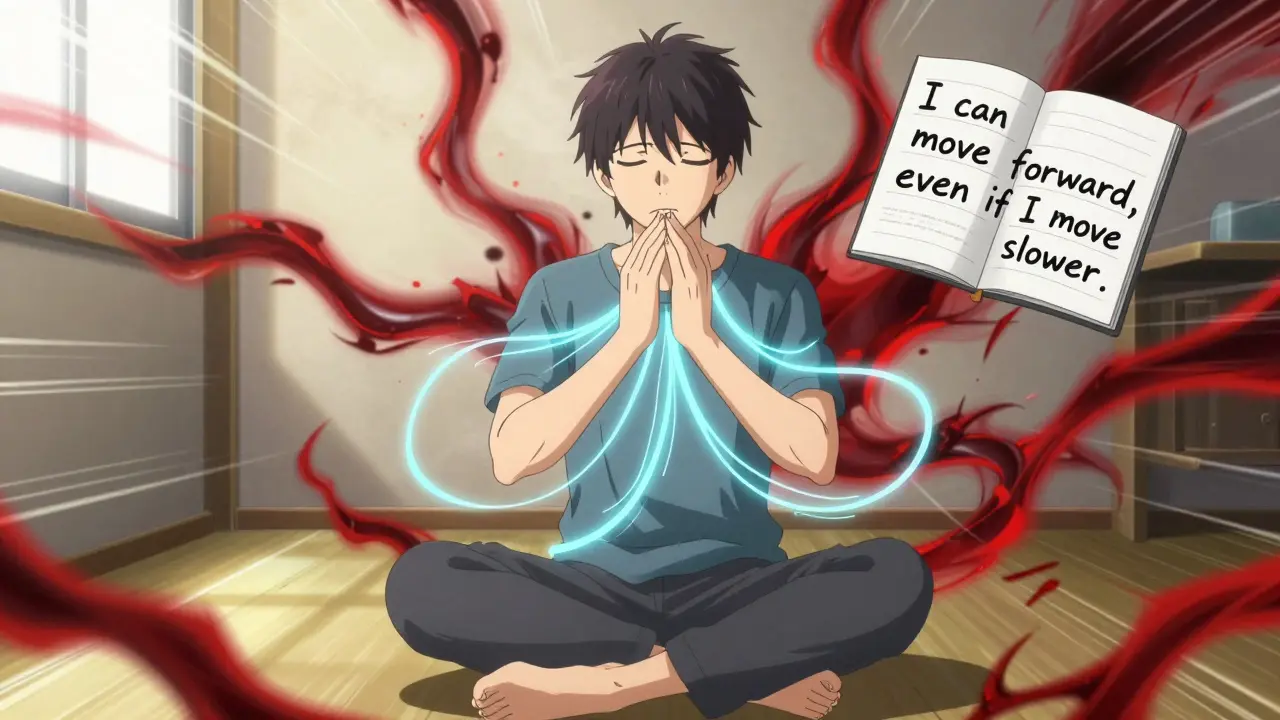
Chronic pain isn’t just a physical sensation-it’s a full-body experience that rewires how you think, feel, and move. If you’ve been living with pain for months or years, you’ve probably tried medications, physical therapy, or even injections. But what if the key to feeling better isn’t just in your back, knee, or neck-but in your mind?
What CBT for Chronic Pain Actually Does
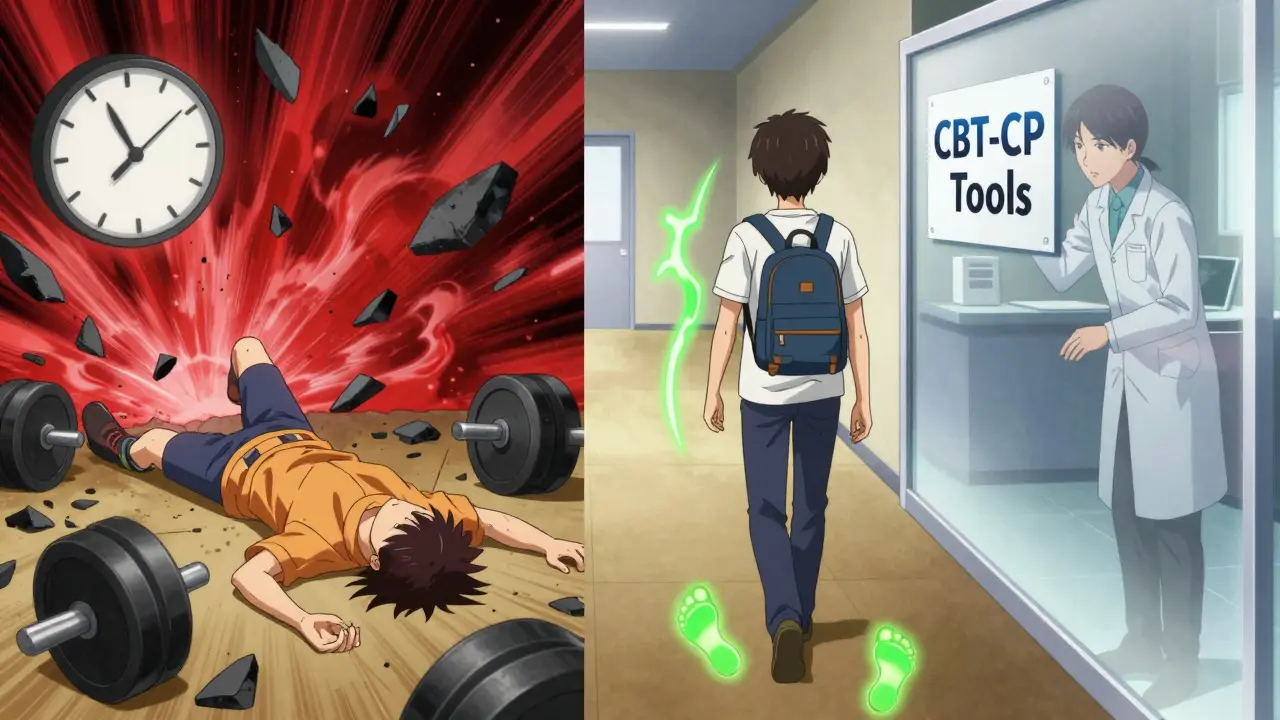
Cognitive Behavioral Therapy for chronic pain, or CBT-CP, isn’t about pretending your pain isn’t real. It’s about changing how you respond to it. Developed in the 1970s by pain psychologists like Dennis Turk and Robert Kerns, CBT-CP is built on one simple idea: your thoughts and behaviors can make pain worse-or better.Most people with long-term pain fall into traps like catastrophizing-thinking, “This will never get better,” or “I’m broken.” They avoid movement because they fear it’ll hurt more. They rest too much, then push too hard when they feel okay, leading to painful boom-bust cycles. CBT-CP helps you recognize these patterns and replace them with smarter habits.
It’s not magic. It’s science. A 2023 review of 13 studies with over 1,600 participants found that CBT-CP consistently improves mood, sleep, and daily function-even when pain levels don’t drop dramatically. That’s the real win: you don’t need to be pain-free to live well.
How CBT-CP Works: The Core Tools
A typical CBT-CP program runs for 8 to 16 weekly sessions, each lasting about an hour. You’ll work with a trained therapist-either in person or online-and use practical tools designed for real life.- Pain neuroscience education: You learn how pain signals work in the nervous system. Chronic pain isn’t always a sign of damage-it’s often your nerves becoming oversensitive. Understanding this reduces fear.
- Activity pacing: Instead of doing everything when you feel good and crashing afterward, you learn to spread tasks evenly. Walking 10 minutes twice a day beats 30 minutes once and then being stuck in bed for two days.
- Cognitive restructuring: You identify thoughts like “I can’t do anything anymore” and replace them with more balanced ones: “I can do less today, but I’m still moving forward.”
- Relaxation techniques: Breathing exercises, progressive muscle relaxation, and mindfulness help calm your nervous system, which can reduce pain intensity over time.
- Behavioral activation: You rebuild activities you’ve given up-not because the pain is gone, but because you’ve learned to manage it while doing them.
The U.S. Department of Veterans Affairs uses a standardized 10- to 12-session protocol with workbooks and homework. Studies show patients who complete at least 80% of sessions are more than twice as likely to see real improvement.
CBT vs. Other Pain Treatments
What makes CBT-CP different from pills, physiotherapy, or acupuncture?Medications like opioids don’t fix the problem-they just mask it. And they come with serious risks: addiction, tolerance, and side effects. A 2024 trial called STAMP found that 36% of chronic pain patients on opioids reduced their daily dose after CBT-CP, compared to just 17% in the usual care group.
Physical therapy helps with strength and mobility, but it doesn’t address fear, anxiety, or negative thinking. CBT-CP does. One study showed that combining CBT-CP with physiotherapy led to 40% greater functional improvement than physiotherapy alone.
What about mindfulness or yoga? A 2024 study directly compared CBT-CP with mindfulness-based therapy in 254 patients. Both worked equally well for pain and function. So if you prefer quiet meditation over thought journals, either can help. But CBT-CP has more structure, more data, and more support from clinical guidelines.
Here’s how they stack up:
| Treatment | Reduces Pain Intensity | Improves Mood | Reduces Opioid Use | Requires Daily Practice |
|---|---|---|---|---|
| CBT-CP | Modest (25% of studies show improvement) | Strong (6 out of 8 studies showed major reduction in depression) | Yes (36% reduction in opioid use in STAMP trial) | Yes |
| Opioids | Yes (short-term) | No (often worsens depression) | No (increases dependence) | No |
| Physical Therapy | Modest | Minimal | No | Yes |
| Mindfulness-Based Therapy | Similar to CBT-CP | Strong | Yes | Yes |
Who Benefits Most-and Who Doesn’t
CBT-CP works best for people whose pain has become tangled with stress, fear, or depression. If you’ve been told “it’s all in your head,” that’s not true-but your brain is definitely playing a role in keeping the pain going.Strong candidates include:
- People with chronic low back pain, fibromyalgia, or arthritis
- Those with depression or anxiety alongside pain
- Patients who’ve tried meds but want to reduce or stop opioids
- Anyone tired of boom-bust cycles and wanting to regain control
It’s less effective for:
- Neuropathic pain (like diabetic nerve pain) without a clear behavioral component
- People who don’t believe thoughts can affect physical pain
- Those in severe flare-ups who can’t focus on exercises
A 2023 study by Markus Knoche even found no benefit in a small group of men and women with chronic pain-but that’s an outlier. Most research, including guidelines from the American Psychological Association, still strongly supports CBT-CP as a first-line treatment.
Real People, Real Results
In the STAMP trial, one participant said: “Learning to pace activities prevented my boom-bust cycles.” Another wrote: “I stopped waiting for the pain to disappear before I lived my life.”Reddit users in r/ChronicPain shared similar stories. Over 60% of comments about CBT-CP were positive. Common themes:
- “I finally have tools I can use every day.”
- “I reduced my pain meds without feeling worse.”
- “I stopped feeling like a victim of my pain.”
But it’s not perfect. About 30% of negative comments said: “It felt like they were blaming me for my pain,” or “It didn’t help when I was in a flare.” That’s why good therapists don’t push positivity-they teach acceptance and adaptation.
Getting Started: Barriers and Solutions
The biggest problem? Access. Only 68% of U.S. insurance plans cover enough CBT sessions. Medicare only pays for 10 per year-but most programs need 12 to 16. Private insurers vary: UnitedHealthcare covers 12, Aetna covers 8.Therapists are scarce. Only 15% of people who could benefit from CBT-CP actually get it.
But things are changing:
- Video CBT (vCBT): A 2021 study showed online CBT works just as well as in-person. You can do it from your couch.
- Digital apps: FDA-cleared apps like PainCare and CBT-i Coach now offer structured CBT modules for pain.
- Co-located care: Some clinics now have pain psychologists working right next to your physio or doctor. No extra travel. No confusion.
Here’s how to start:
- Ask your doctor for a referral to a pain psychologist or licensed therapist trained in CBT-CP.
- Check your insurance: Call and ask, “Do you cover Cognitive Behavioral Therapy for chronic pain? How many sessions?”
- If therapy isn’t available, try a reputable digital CBT app like PainCare or the VA’s free CBT-CP program online.
- Start small. Even one session can help you see pain differently.
The Bigger Picture
Chronic pain is one of the biggest health challenges of our time. Over 80% of people with chronic low back pain say current treatments don’t work well. CBT-CP isn’t a cure-but it’s one of the few tools that helps you live fully despite the pain.It’s not about fixing your body. It’s about reclaiming your life. You don’t need to be pain-free to be powerful. You just need the right tools-and the courage to use them.
The future of pain care is moving away from pills and toward personalized, whole-person approaches. CBT-CP is already leading that shift-and it’s working for thousands of people right now.
Is CBT for chronic pain just talking about my feelings?
No. CBT for chronic pain is not about venting or exploring emotions. It’s a structured, skill-based therapy focused on changing how you think about pain, how you move, and how you respond to flare-ups. You’ll learn practical tools like pacing, relaxation, and thought restructuring-not just talk about how you feel.
Will CBT make my pain go away completely?
Not always. CBT-CP rarely eliminates pain entirely. But it often reduces how much pain controls your life. Studies show most people experience better sleep, less anxiety, and more ability to do daily activities-even if their pain score doesn’t drop by much. The goal isn’t to be pain-free. It’s to be life-full.
How long does it take to see results from CBT for chronic pain?
Most people start noticing changes in mood and activity levels after 4 to 6 sessions. Improvements in pain-related fear and sleep often show up within 8 weeks. But lasting change takes time-full programs usually last 10 to 16 weeks. Consistency matters more than speed. Completing at least 80% of sessions doubles your chance of success.
Can I do CBT for chronic pain on my own?
Yes, but with limits. There are FDA-cleared apps and online programs based on CBT-CP protocols (like the VA’s free program). These can help with basic skills like pacing and thought records. But working with a trained therapist improves outcomes significantly-especially if you’re dealing with depression, trauma, or complex pain. A therapist helps you adjust tools to your specific struggles.
Does insurance cover CBT for chronic pain?
Sometimes. Medicare covers up to 10 sessions per year, which isn’t enough for full treatment. Private insurers vary: UnitedHealthcare covers 12 sessions, Aetna covers 8. Many plans require a diagnosis of chronic pain and a referral from a doctor. Always call your insurer and ask: “Do you cover Cognitive Behavioral Therapy for chronic pain? How many sessions are allowed?”
Is CBT better than opioids for chronic pain?
CBT isn’t a replacement for opioids in every case-but it’s safer and more sustainable. A 2024 trial found that 36% of patients using CBT reduced their daily opioid use, compared to just 17% in usual care. CBT avoids addiction, tolerance, and side effects. It also helps you rebuild your life, not just numb your pain. For long-term management, CBT is the clear winner.
If you’ve been told your pain is “all in your head,” remember: your brain is part of your body. And when your brain learns new ways to respond, your whole body can heal differently. CBT-CP doesn’t promise a miracle. But it gives you back the power to move forward-even with pain.
Neil Ellis
January 21 2026Man, this hit different. I used to think pain was just something you suffered through like a tough guy-until I tried pacing. Now I walk 10 minutes twice a day like it’s my job, and guess what? I actually have energy left for my dog, my garden, and not just staring at the ceiling. CBT didn’t erase the pain, but it gave me back my life. No magic, just muscle memory for your mind.
Liberty C
January 23 2026How predictable. Another article that treats chronic pain like a cognitive glitch you can ‘restructure’ your way out of. The real issue? The medical-industrial complex has run out of profitable interventions, so now they’re selling mindfulness as a cure-all while ignoring systemic neglect. This isn’t empowerment-it’s gaslighting disguised as science.
Daphne Mallari - Tolentino
January 23 2026While I appreciate the attempt to demystify CBT-CP, the article’s reliance on ‘studies’ and ‘reviews’ without contextualizing methodological limitations is concerning. The effect sizes reported are modest at best, and the selection bias in participant recruitment-particularly in VA-based trials-renders generalizability dubious. Furthermore, the conflation of functional improvement with pain reduction obscures a critical distinction in outcome metrics that ought to be rigorously maintained in clinical discourse.
Rob Sims
January 25 2026Oh wow. So if I’m in agony and my therapist says ‘just reframe your thoughts,’ I’m supposed to feel better? Cool. So what do you tell someone who’s been bedridden for three years because their spine is literally collapsing? ‘Try breathing deeper, hun’? This isn’t therapy-it’s victim-blaming with a PowerPoint.
Kenji Gaerlan
January 25 2026cbt for pain? sounds like a fancy way to say ‘stop being so sensitive’
Jasmine Bryant
January 27 2026Does anyone know if the VA’s CBT-CP app still works on iOS 15? I tried downloading it last week and it crashed every time. I’m not tech-savvy so I don’t know if it’s me or the app. Anyone else have this issue?
Brenda King
January 27 2026I’ve been doing CBT for my fibro for 6 months now. I used to think I was broken because I couldn’t keep up with my kids. Now I know I’m just wired differently. I don’t push through pain anymore-I adjust. I nap when I need to. I say no. I celebrate tiny wins. It’s not about being positive. It’s about being real. And honestly? It’s the first time I’ve felt like I’m not fighting myself.
Chiraghuddin Qureshi
January 28 2026From India, where pain meds are hard to get and therapists are a luxury 🤷♂️ But I found a free YouTube CBT series by a Aussie physio. Changed my life. Not magic, but real. You don’t need a clinic to start small. Just breathe. Move slow. Be kind to your body. 🙏
Malik Ronquillo
January 30 2026CBT is great until you’re in a flare and your brain is screaming ‘I’M DYING’ and you’re supposed to ‘restructure’ that? Nah. I tried it. Felt like my pain was being called a choice. I’m not lazy. I’m not broken. I’m just in hell and nobody gets it
Alec Amiri
January 31 2026Look, I get it. You want to feel better. But don’t let anyone tell you CBT is the answer if you’re still on morphine and your spine is fused. This isn’t a self-help podcast. This is real life. If you’re not in pain, you don’t get to say ‘just change your thoughts.’ That’s not wisdom. That’s privilege wrapped in a workbook.
Oren Prettyman
February 1 2026It is imperative to underscore that the empirical foundation upon which CBT-CP is predicated remains subject to considerable heterogeneity across clinical trials, particularly with regard to the operationalization of pain intensity as a dependent variable. Furthermore, the longitudinal durability of functional improvements-while statistically significant in several meta-analyses-often fails to achieve clinical significance when measured against baseline disability indices. The apparent efficacy may, therefore, be confounded by placebo effects and regression to the mean, especially in cohorts with high baseline psychological comorbidity. One must therefore approach the promotion of CBT-CP as a first-line intervention with extreme caution, lest it supplant more biologically grounded modalities in the absence of robust, replicated, and generalizable outcomes.