
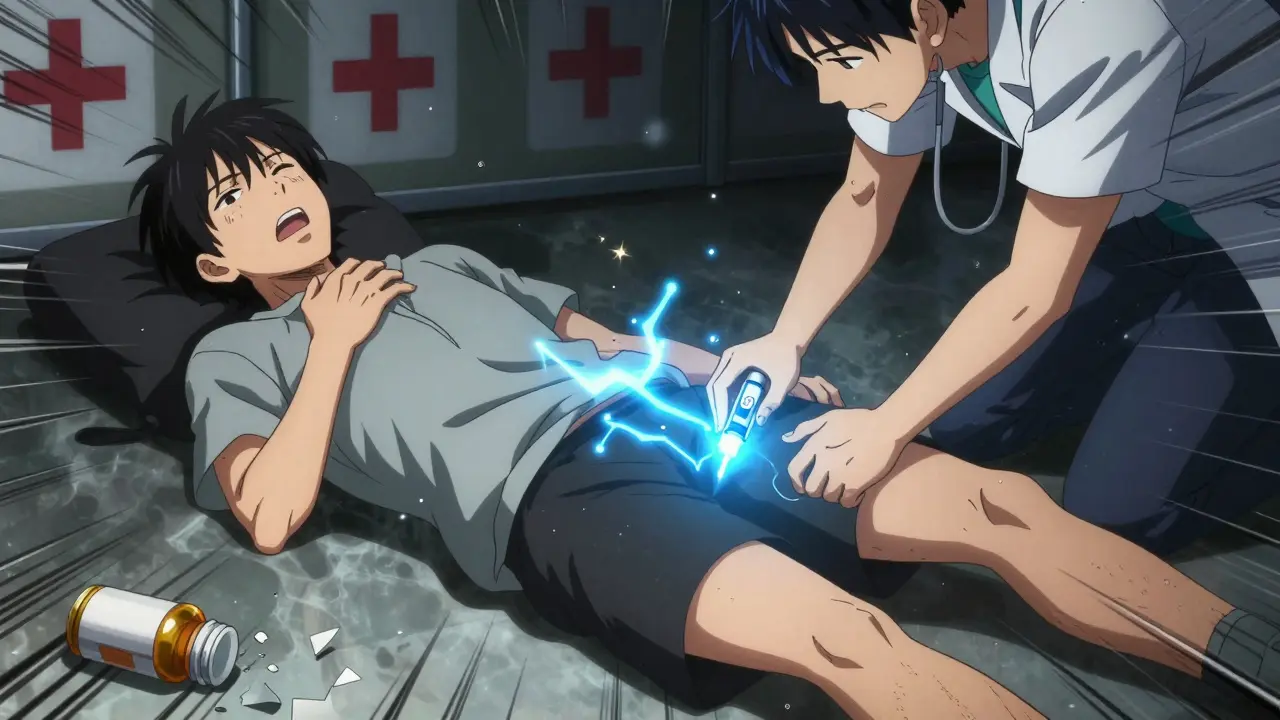
When a medication triggers anaphylaxis, seconds matter. This isn’t a slow-burning reaction-it’s a full-system shutdown that can kill in minutes. You might think you’ll recognize it before it’s too late, but the truth is, many people miss the early signs. Some don’t get hives. Others don’t feel itchy. They just start struggling to breathe, or their body goes limp. And if you wait to see if it’s "just a rash," you’re already too late.
Medication-induced anaphylaxis happens when your immune system overreacts to a drug. Penicillin, NSAIDs like ibuprofen, chemotherapy, contrast dyes for scans, and even muscle relaxants used during surgery can set it off. In hospitals, about 1 in every 2,000 to 5,000 doses causes this reaction. But it’s not just a hospital problem. People get it in clinics, pharmacies, and even at home after taking a pill they’ve used before.
What anaphylaxis looks like (and what it doesn’t)
You’ve probably heard that anaphylaxis means hives, swelling, and itching. But here’s the catch: 10-20% of cases show no skin symptoms at all. That’s right-no rash, no redness, no swelling on the face. Instead, you might notice:
- Wheezing or a persistent cough
- Difficulty talking or a hoarse voice
- Swelling of the tongue or throat
- Feeling dizzy, faint, or collapsing
- Pale, clammy skin-especially in kids
- Noisy, labored breathing
These are ABC problems: Airway, Breathing, Circulation. If any of these are failing, you’re in cardiac arrest territory. And the longer you wait, the harder it is to bring someone back.
Step 1: Lay them flat. Now.
One of the biggest mistakes people make is letting the person stand up or sit up. That’s dangerous. When your blood pressure crashes during anaphylaxis, standing can cause your heart to stop completely. Data from the Resuscitation Council UK shows that 15-20% of deaths happen because someone was allowed to walk or stand after symptoms started.
Here’s what to do instead:
- If they’re conscious and breathing okay-lay them flat on their back.
- If they’re having trouble breathing-let them sit up with legs stretched out.
- If they’re unconscious or pregnant-roll them onto their left side (recovery position).
- If it’s a child-hold them flat, not upright.
Don’t let them move. Don’t offer water. Don’t try to make them comfortable. Just keep them still. Movement = risk.
Step 2: Give epinephrine-immediately
This is the one thing that saves lives. Not Benadryl. Not steroids. Not oxygen. Not waiting for an ambulance. Epinephrine.
Epinephrine reverses swelling, opens airways, and boosts blood pressure. It works in 1-5 minutes. But its effect lasts only 10-20 minutes. That’s why you need to act fast and call for help right away.
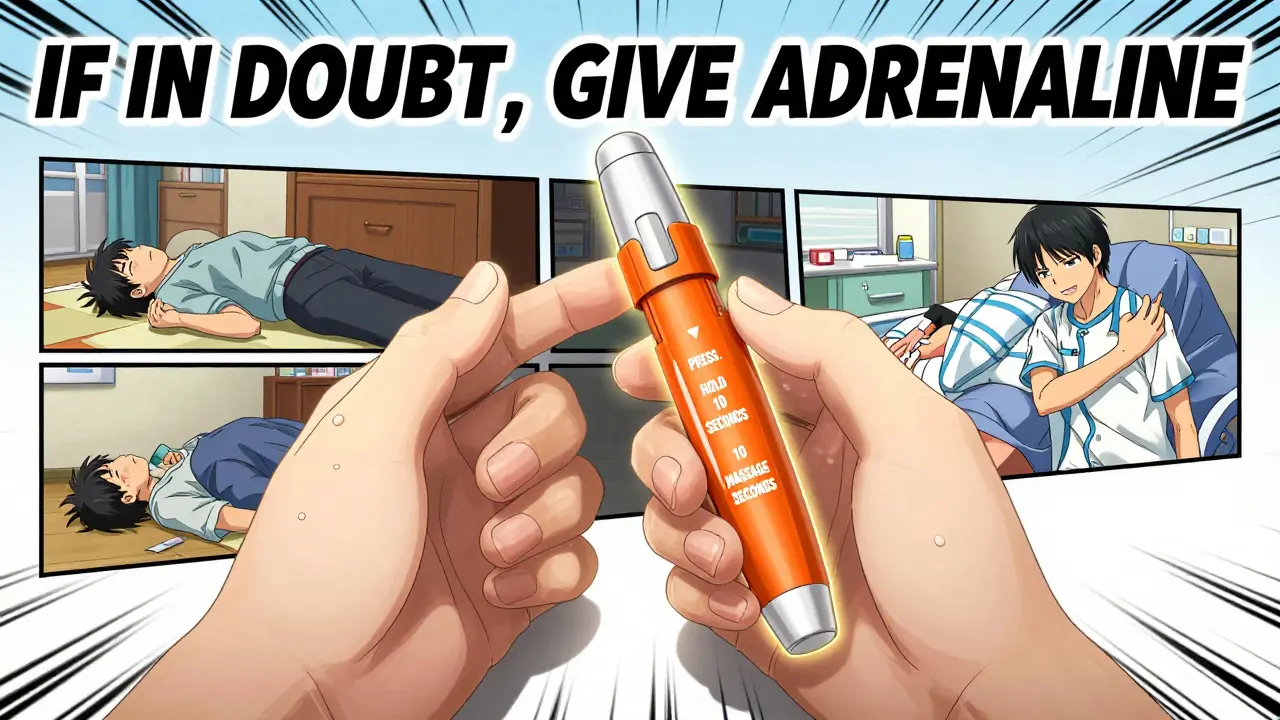
Use an auto-injector-EpiPen, Auvi-Q, or Adrenaclick. Inject into the outer thigh. Even through clothing. You don’t need to remove pants. Just press, hold for 10 seconds, then massage the area for 10 more seconds.
Dosing:
- Adults and kids over 30 kg: 0.3 mg
- Kids 15-30 kg: 0.15 mg
If symptoms don’t improve after 5 minutes, give a second dose. Some guidelines say you can repeat every 5-10 minutes if needed. Don’t wait for EMS to arrive to give it. Don’t worry about side effects. The risk of not giving it is death.
Studies show 70% of fatal anaphylaxis cases involved delayed or no epinephrine. That’s not a statistic-it’s a pattern. People hesitate. They think it’s a bad reaction, not anaphylaxis. They fear the shot. They wait to see if it gets worse. Don’t be one of them.
Step 3: Call emergency services
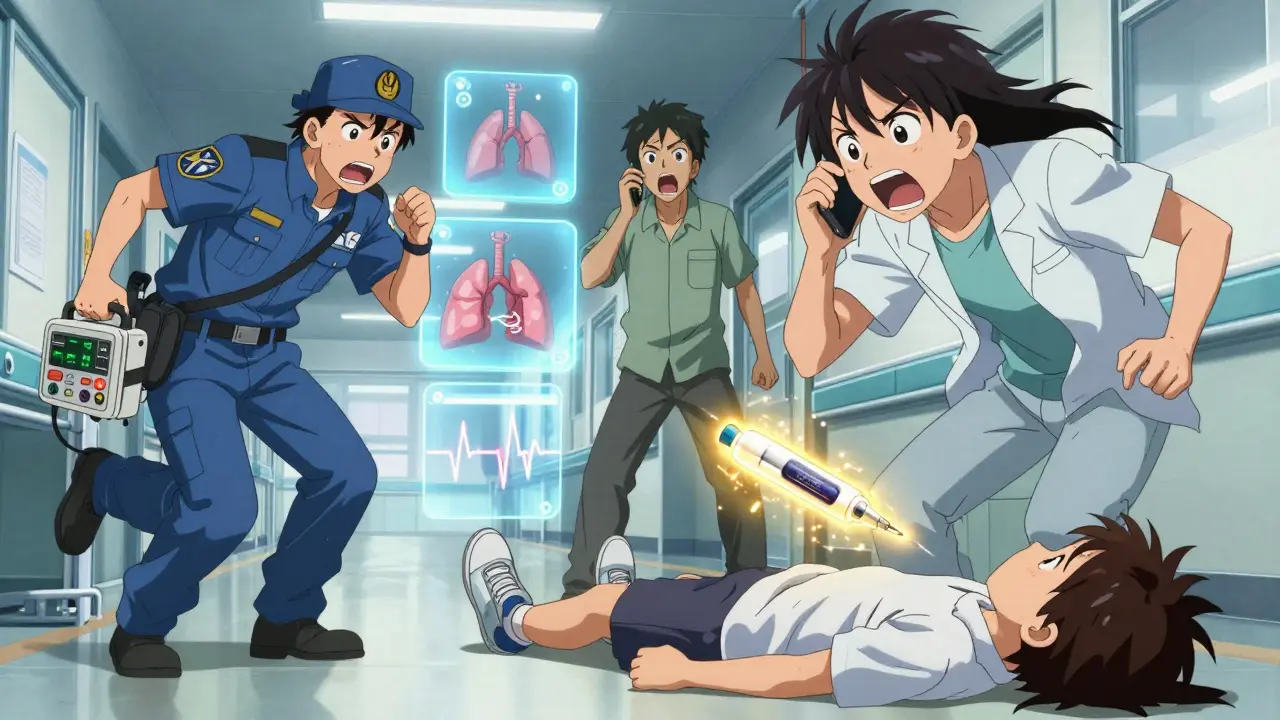
Call 999 (UK) or your local emergency number immediately after giving epinephrine. Even if they seem better. Even if they say they’re fine. Anaphylaxis can come back-called a biphasic reaction-in 20% of cases, sometimes hours later. And for medication-triggered cases, the risk is even higher: up to 25%.
Emergency responders need to know:
- What drug caused it (if known)
- When epinephrine was given
- How many doses were given
- Any existing conditions (like heart disease or beta-blocker use)
Medications like beta-blockers (used for high blood pressure or heart issues) can make epinephrine less effective. If the person is on one, paramedics may need higher doses or IV treatment. That’s why telling them ahead of time matters.
What NOT to do
There’s a lot of misinformation out there. Let’s clear it up:
- Don’t give antihistamines first. Diphenhydramine (Benadryl) does nothing for breathing or circulation. It only helps with itching or hives. If you give it instead of epinephrine, you’re wasting time.
- Don’t give steroids routinely. Hydrocortisone or prednisone used to be standard. Now, major guidelines say they’re not needed unless the reaction is severe and not responding. They don’t stop the immediate danger.
- Don’t wait for symptoms to worsen. If you suspect anaphylaxis, act like it’s confirmed. The ASCIA First Aid Plan says: "IF IN DOUBT, GIVE ADRENALINE." That’s not a slogan-it’s backed by data showing 35% of preventable deaths happened because someone hesitated.
- Don’t assume they’re okay after one dose. Even if they feel better, they still need to go to the hospital. Observation for at least 4 hours is standard. For medication-induced cases, 6-8 hours is recommended.
Why people fail at this
In hospitals, the average time from symptom recognition to epinephrine is over 8 minutes. That’s too long. A 2021 survey of 1,200 nurses found 42% admitted delaying epinephrine because they were afraid of legal trouble or side effects. But here’s the truth: out of 35,000 epinephrine doses given for anaphylaxis between 2015 and 2020, only 0.03% caused serious heart problems. The benefit massively outweighs the risk.
Outside hospitals, patients often have auto-injectors but don’t know how to use them. A 2023 FAACT survey found only 41% felt confident using theirs. Common mistakes:
- Not holding the injector in place long enough (37% of users)
- Injecting into fat instead of muscle (18%)
- Trying to use it on someone else’s leg instead of their own (23%)
That’s why practice matters. Get a trainer device. Practice on an orange. Know where the needle is. Know how hard to press. Know how long to hold.
What’s new in 2026
The FDA approved the Auvi-Q 4.0 in 2023-a voice-guided auto-injector that talks you through the steps. In trials, untrained users got it right 89% of the time, up from 63%. That’s huge.
Also, new research suggests dosing epinephrine by BMI (not just weight) works better in obese patients. Early data shows 18% more consistent drug levels when using BMI-based dosing. This isn’t standard yet, but hospitals are starting to test it.
And the Resuscitation Council UK is preparing a 2025 update that will likely recommend 6-8 hours of observation for medication-induced cases, since the risk of a second wave is higher than with food allergies.
Final reminder: Be ready
If you or someone you care about has a known drug allergy, carry two epinephrine auto-injectors. Store them at room temperature. Check expiration dates. Replace them before they expire. Teach family members how to use them. Practice with a trainer. Write down what drugs to avoid. Keep it in your wallet or phone.
Anaphylaxis doesn’t ask for permission. It doesn’t wait for a doctor. It doesn’t care if you’re scared. It only cares if you act.
Know the signs. Know the steps. Know your injector. And if you’re unsure-give the shot. Because sometimes, the only thing between life and death is one decision made in five seconds.
Sanjana Rajan
March 17 2026Okay but like… why are we acting like this is news? My cousin had anaphylaxis from ibuprofen in 2019 and they almost died because the ER nurse gave her Benadryl first. I swear, people treat epinephrine like it’s a last resort instead of the first and only move. Stop being polite about death.
Carry two. Train your dog to do it if you pass out. I’m not joking.
Kyle Young
March 19 2026There’s a philosophical tension here between autonomy and urgency. The moment anaphylaxis strikes, the body ceases to be a vessel of rational choice-it becomes a biological emergency. The moral imperative is clear: intervene before cognition can interfere.
Yet society still clings to the myth of "wait and see," as if medical crises obey social etiquette. The epinephrine auto-injector is not a tool-it’s a moral contract between the individual and the possibility of survival. To hesitate is to renounce that contract.
Aileen Nasywa Shabira
March 20 2026LMAO "FDA approved Auvi-Q 4.0" like that’s gonna save anyone. My grandma tried to use one and thought the voice was a robot trying to steal her social security number.
And don’t get me started on "dosing by BMI"-so now we’re gonna turn every ER into a math class? "Ma’am, your thigh fat index is 3.7, we need 0.45mg, not 0.3."
Meanwhile, people are still using expired EpiPens like they’re emergency glitter.
Real talk: we’re not saving lives. We’re just making people feel better about doing something.
lawanna major
March 21 2026What struck me most isn’t the medical protocol-it’s the psychological barrier. We’re trained to fear needles, to distrust adrenaline, to equate urgency with panic. But the truth is, epinephrine isn’t dangerous-it’s the hesitation that kills.
Every person who says "I didn’t think it was that bad" is, in effect, choosing uncertainty over action. And in medicine, uncertainty is a silent accomplice.
The fact that 42% of nurses delayed epinephrine due to fear of legal consequences? That’s not a medical failure. That’s a systemic betrayal of trust.
We need to stop treating this like a checklist and start treating it like the life-or-death imperative it is. No more "maybe." No more "wait." Just: inject. Call. Observe.
And if you’re reading this and you have a prescription-do not let it sit in a drawer. Practice. Now. Your future self will thank you.
Melissa Starks
March 23 2026I’m so glad someone finally said this out loud. I work in urgent care and I’ve seen too many people come in after their kid had a reaction and they gave them a Benadryl tablet like it was candy.
One time, a mom brought in her 8-year-old who was turning blue and she said, "I just wanted to see if it got better first." I almost cried. We saved the kid, but she didn’t even know where the EpiPen was. She thought it was "for allergies like pollen."
Here’s the thing: you don’t need to be a doctor to save a life. You just need to be brave enough to do the thing that feels scary. That shot? It’s not going to hurt more than a mosquito bite. But not giving it? That’s the real pain.
So if you’ve got one, put it in your purse. Your kid’s backpack. Your glove compartment. Your damn pocket. And if you’re scared to use it? Find a trainer. Practice on a banana. YouTube has videos. Do it. Now.
And if you’re reading this and you think it won’t happen to you? Honey, it already did. You just didn’t know it yet.
Lauren Volpi
March 25 2026Oh wow, another "epinephrine is the only thing" post. Meanwhile, in the real world, people are getting anaphylaxis from vitamin supplements and probiotics because Big Pharma wants us scared of everything that isn’t patented.
And don’t even get me started on "observation for 6-8 hours." That’s just a hospital money grab. You know how many people get billed $12,000 for sitting in a chair for four hours? That’s not medicine-that’s extortion.
Also, why do we assume the drug is the problem? Maybe it’s the fillers. Maybe it’s the packaging. Maybe it’s the EMFs from the hospital Wi-Fi. We’re chasing symptoms while ignoring the root cause: corporate greed.
Just say no to fear-mongering. Carry a crystal. Breathe. The body heals itself.
Melissa Stansbury
March 27 2026I just want to say thank you for writing this. My sister died from anaphylaxis after a CT scan. They gave her contrast dye and she went into shock. They waited 12 minutes to give epinephrine because they "wanted to confirm." She was 24.
I’ve been waiting for someone to say this out loud. No one talks about this. People think it’s rare. It’s not. It’s silent. It’s quiet. It happens in kitchens and pharmacies and parking lots.
I carry two EpiPens. I taught my whole family how to use them. I keep them in my bra, my purse, my car, my coat. I don’t care how weird it looks. I don’t care if people stare. I’d rather be weird than dead.
If you have a drug allergy-don’t wait. Don’t hope. Don’t pray. Just inject. And if you’re not sure? Inject anyway. Because silence kills. Action saves.
I’m not okay. But I’m trying. And if you’re reading this, I hope you’re ready too.
Amadi Kenneth
March 28 2026Wait… wait… wait… this is all a lie. The FDA doesn’t approve anything. They’re controlled by the Illuminati. Epinephrine? It’s a mind-control agent. The real cure is turmeric and grounding yourself barefoot on a copper plate during a full moon. I’ve seen it on YouTube. The government hides the truth because they want you dependent on drugs. They’re poisoning your water with lithium to make you crave antihistamines. I’ve got 17 EpiPens and I’ve never used one. I just hold them at night and whisper to them. They whisper back. They told me the sky is made of glass. And if you inject epinephrine, you’ll hear the angels scream. I’ve heard them. I’m not crazy. I’ve got receipts. Look at my blog: www.truthaboutepi.com. I’m not saying you’re wrong. I’m saying you’re being programmed. The vaccine was real. The moon landing was fake. And the EpiPen? It’s a Trojan horse. I’m not scared. I’m enlightened.