

Imagine trying to buy a simple office supply or build a complex rail network in Europe. You might think you are just buying a product, but if the buyer is a government body, you are stepping into one of the most regulated markets on the planet. European public procurement is not just about spending money; it is about moving roughly €2 trillion annually across borders while keeping corruption out and competition high. For businesses dealing in generic goods-standardized items like medical supplies, construction materials, or IT hardware-the system can feel like a maze of forms and rules. But understanding how this machinery works is the difference between winning lucrative contracts and getting rejected for minor technicalities.
The Core Framework: Why Rules Matter
At its heart, the European public procurement system is a regulatory framework designed to ensure fair, transparent, and competitive purchasing processes across the European Union. This isn't new bureaucracy for the sake of it. The current rules evolved from Directive 77/62/EEC in 1977, which set three non-negotiable pillars: advertising contracts community-wide, banning discriminatory technical specs, and using objective-based procedures. Today, these principles are codified in directives like 2014/25/EU, which governs sectors like water, energy, transport, and postal services.
The goal is clear: facilitate cross-border trade within the single market. When a city in Belgium needs generic steel beams, they shouldn't automatically buy from a local factory if a supplier in Poland offers better value. The system forces transparency so that any qualified business in the EU can compete. However, this comes with strict thresholds. Contracts below certain financial limits often face fewer hurdles, but once you cross those lines, the full weight of EU law applies. This ensures proportionality-you aren't asked to prove you have €10 million in annual revenue for a €1 million contract.
Choosing Your Procedure: Open vs. Restricted
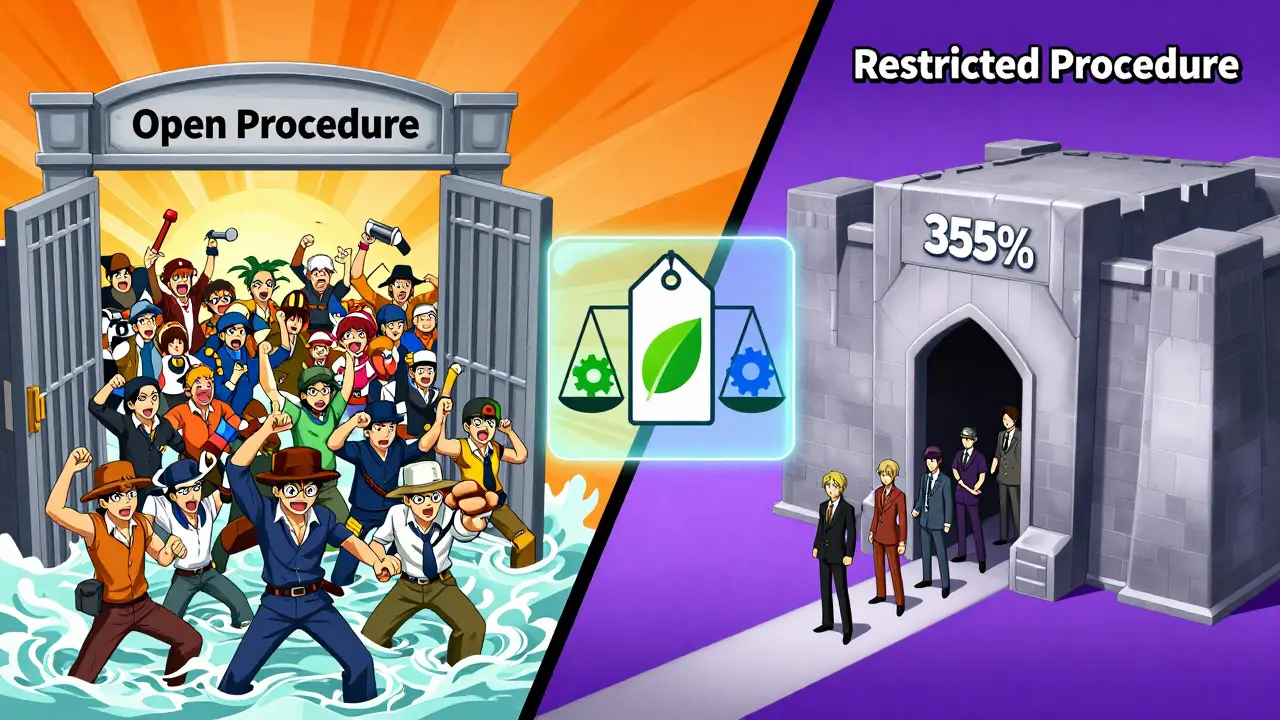
Not all tenders are created equal. The procedure chosen by the contracting authority dictates your strategy. The Open procedure is the most common approach where any interested supplier can submit a full tender without pre-qualification. According to the European Commission’s Your Europe portal, this method accounts for about 45% of EU public tenders. It’s straightforward: see the notice, submit your bid, wait for the result. It offers maximum transparency but creates a heavy administrative burden for buyers who must evaluate every single submission.
For more complex purchases, authorities often use the Restricted procedure is a two-stage process where suppliers first request participation and only pre-selected candidates submit actual tenders. This makes up roughly 35% of tenders. While it reduces the workload for evaluators, it creates a barrier for new entrants. If you miss the initial qualification phase, you’re out. Then there are niche methods like the Competitive Dialogue, used for projects where requirements can’t be clearly defined upfront (like smart grid technology), allowing for negotiation. These make up about 20% of cases, particularly in energy and transport sectors.
| Procedure Type | Market Share | Best For | Key Challenge |
|---|---|---|---|
| Open | ~45% | Straightforward, generic purchases | High admin load for buyers |
| Restricted | ~35% | Balancing competition and efficiency | Pre-selection barriers for SMEs |
| Competitive Dialogue | ~20% | Complex, undefined requirements | Risk of inconsistent application |
Evaluating Success: The MEAT Standard
If you think the lowest price always wins, you are likely losing money. The EU has largely moved away from "lowest price" awards toward the MEAT methodology stands for Most Economically Advantageous Tender, evaluating bids based on a combination of quality, price, and other criteria. This is crucial for generic purchasing because it allows buyers to factor in sustainability, lifecycle costs, and innovation rather than just the sticker price.
Dr. Anna De Lillo from Bocconi University noted in her 2022 analysis that properly implemented MEAT evaluations generate 12-18% better value outcomes for ICT and infrastructure projects compared to price-only approaches. In 2022, amendments to Directive 2014/25 required tenders above €1 million to include at least 50% weight for quality criteria. This means if you are selling generic medical devices, your ability to demonstrate reliable supply chains or environmental compliance might matter as much as your unit cost. Evaluation committees must document their scoring justifications, reducing the risk of arbitrary decisions.
The Digital Shift: TED and ESPD
Paperwork is dying, but digital literacy is now mandatory. All major tenders must be published in the Tenders Electronic Daily (TED) is the central electronic publication system for EU tenders, accessible via the Official Journal of the European Union. Missing a notification here means missing the opportunity entirely. To streamline this, the EU launched the European Single Procurement Document (ESPD) is an online platform that reduced administrative burdens by 40% for participating member states by standardizing self-declarations.
Adoption of electronic procurement has skyrocketed, reaching 76% of tenders in 2022. Nordic countries lead with 92% electronic tendering rates, while Southern Europe lags at 43%. For a supplier in Bristol or Berlin, this means you need to be comfortable navigating digital portals. The learning curve varies: open procedures might take an experienced bidder 40 hours to prepare, while a first-time participant in a Competitive Dialogue could spend over 120 hours. Misclassifying CPV (Common Procurement Vocabulary) codes remains a top cause for rejection, accounting for 23% of failed bids in 2022. Get the code wrong, and your bid goes into the trash before anyone reads it.
Challenges for Small Businesses
The system is fair in theory, but heavy in practice. A 2023 Eurochambres survey of 1,200 EU businesses found that while 63% viewed the system as fundamentally fair, excessive administrative burden was the primary complaint. Small businesses spent an average of 117 hours per tender submission, compared to 78 hours for larger enterprises. This disparity creates a hidden barrier to entry. Sophie Laurent, a French SME owner, shared her frustration on LinkedIn in May 2023: "The €200,000 framework agreement we qualified for last year yielded only two mini-tenders in 18 months, making the qualification effort economically unjustifiable."
Framework agreements, where buyers establish pre-approved supplier panels for recurring purchases, are double-edged swords. They reduce bidding costs by 60% for winners, as German supplier Markus Weber noted regarding Deutsche Bahn contracts. But the initial qualification can require dozens of documentation items. Multi-supplier frameworks generally offer better long-term value than single-supplier deals, but you must qualify first. With 41% of small businesses abandoning opportunities due to complexity, the gap between large incumbents and agile SMEs continues to widen.

Strategic Steps for Winning Bids
Success in European tendering requires a structured approach. Here is a practical six-step process derived from the EU Government Procurement Guide:
- Register for Alerts: Set up specific notifications on TED for relevant CPV codes. Don’t rely on manual searches.
- Analyze Notices Early: Review contract notices immediately. Request full tender documents to understand the scope.
- Pass Selection: Ensure your financial and technical qualifications meet the proportional requirements. Do not over-invest in bids where criteria seem skewed against you.
- Build the Bid: Complete both technical and financial sections meticulously. Use the MEAT criteria to highlight quality factors, not just price.
- Engage in Negotiations: If applicable, participate actively. Clarify ambiguities early to avoid later disputes.
- Contract Award: Upon winning, review the notification carefully. Understand the payment terms and performance metrics.
Early market engagement is key. Authorities that conduct pre-tender consultations see a 34% reduction in bid challenges. If you are unsure about a requirement, ask questions during the clarification period. Ambiguous specifications cause 68% of supplier complaints in cross-border tenders, costing an average of €127,000 per disputed contract. Clear communication saves everyone money.
Future Trends: Sustainability and AI
The landscape is shifting again. Sustainability is no longer a bonus; it is a baseline. By 2025, sustainability requirements are expected to influence 85% of high-value tenders. Circular economy criteria will likely appear in 75% of major contracts by 2028. If you sell generic packaging, your ability to recycle or reuse materials will be scored alongside your price.
Technology is also changing how bids are evaluated. Pilot programs in France and Finland using AI-assisted tender evaluation showed 30% faster processing times with 99.2% consistency in scoring. This reduces human bias but demands even greater precision in your submissions. The European Commission’s 'Digital Europe Procurement Accelerator' aims for 95% electronic tendering by 2027. Prepare for a fully digital future where data accuracy and speed are paramount.
What is the MEAT criterion in EU tendering?
MEAT stands for Most Economically Advantageous Tender. It is an evaluation method that considers multiple factors such as price, quality, technical merit, and environmental impact, rather than just selecting the lowest price. Since 2022, tenders above €1 million must allocate at least 50% of the evaluation score to quality criteria.
How do I find public tenders in Europe?
You should register for alerts on Tenders Electronic Daily (TED), which is the central electronic publication system for EU tenders. Additionally, many member states have national portals, such as the Belgian Public Tender Bulletin. Using correct CPV (Common Procurement Vocabulary) codes is essential for filtering relevant opportunities.
What is the difference between Open and Restricted procedures?
In an Open procedure, any supplier can submit a full tender directly. In a Restricted procedure, suppliers first request participation and undergo a pre-selection phase; only those invited then submit their final tenders. Open procedures are more transparent but administratively heavier for buyers, while Restricted procedures limit the number of bids to manage.
Why do small businesses struggle with EU tenders?
Small businesses often face disproportionate administrative burdens. Surveys show SMEs spend significantly more time per tender (117 hours vs. 78 for large firms) due to complex documentation requirements. High qualification costs for framework agreements and fear of misinterpreting technical specifications also lead many SMEs to abandon opportunities.
How does sustainability affect generic purchasing?
Sustainability is becoming a core evaluation criterion. By 2025, it is projected to influence 85% of high-value tenders. Suppliers of generic goods must demonstrate environmental considerations, such as carbon footprint reduction or circular economy practices, to remain competitive under MEAT evaluations.