

Sterile manufacturing isn't just another step in drug production-it's the difference between life and death for patients receiving injectables. Unlike pills or creams, injectable drugs go straight into the bloodstream, bypassing the skin, stomach, and immune system that normally protect us. That means even one microorganism in a vial can trigger sepsis, organ failure, or death. The stakes are that high. And the rules? They’re strict for a reason.
Why Sterility Isn't Optional
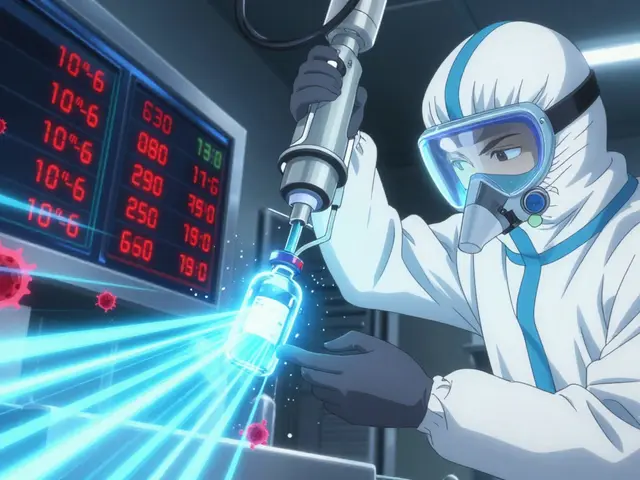
The history of sterile manufacturing is written in tragedy. In the 1920s, contaminated insulin killed patients. In 1955, a faulty polio vaccine caused paralysis in hundreds. Then in 2012, a compounding pharmacy in Massachusetts distributed fungal-contaminated steroids, leading to 751 infections and 64 deaths. These weren’t accidents. They were failures of process. The FDA, WHO, and EU responded with regulations that don’t allow room for error. Today, the standard is a Sterility Assurance Level (SAL) of 10^-6-meaning only one in a million units can be contaminated. That’s not a target. It’s the minimum.Two Paths to Sterility: Terminal vs. Aseptic
There are two ways to make sterile injectables: terminal sterilization and aseptic fill-finish. Each has its place, but they’re not interchangeable.Terminal sterilization means you make the product, seal it in its container, then kill everything inside using heat or radiation. Steam at 121°C for 15-20 minutes is the gold standard. It’s reliable, validated, and cheaper. But here’s the catch: only 30-40% of injectables can survive that kind of punishment. Biologics-like monoclonal antibodies, vaccines, and gene therapies-break down under high heat. They’re too delicate. So for these, you need aseptic processing.
Aseptic fill-finish is like performing surgery in a cleanroom. Every step, from filling vials to capping them, happens without sterilizing the final product. Instead, you sterilize everything else-the equipment, the air, the gloves, the containers-and keep the environment sterile throughout. This method dominates the market today. Over 40% of new drug approvals in 2023 required aseptic processing, according to PharmaSource Global. And it’s growing fast, driven by biologics, which now make up 32% of all new injectables.
What Makes a Cleanroom Work
Not all cleanrooms are created equal. For aseptic filling, you need ISO 5 (Class 100) conditions. That means fewer than 3,520 particles larger than 0.5 micrometers per cubic meter of air. Compare that to a typical office, which has over 10 million particles per cubic meter. The difference isn’t just clean-it’s alien.To get there, you need:
- Unidirectional airflow at 0.3-0.5 meters per second to sweep contaminants away
- Pressure differentials of 10-15 Pascals between rooms to keep dirty air out
- Air changes of 20-60 times per hour
- Temperature held at 20-24°C and humidity at 45-55% RH
Even the air you breathe matters. Workers wear full-body gowns, masks, and double gloves. They go through air showers and spend hours training before they even touch a vial. And they’re monitored constantly. Particle counters run 24/7. Air samplers catch microbes. If you hit more than 1 colony-forming unit (CFU) per cubic meter in an ISO 5 zone, the system triggers an alert. At 5 CFU, you shut down.
Equipment and Technology: Isolators vs. RABS
The debate between isolators and Restricted Access Barrier Systems (RABS) is ongoing. Both aim to separate people from the product. But they do it differently.Isolators are sealed, glove-box-like systems. Operators work through gloves built into the walls. No one enters the ISO 5 zone. This reduces contamination risk by 100-1,000 times compared to open cleanrooms, according to Dr. James Akers of the BioPharmaceutical Technology Center Institute. But isolators cost 40% more to install and maintain.
RABS are semi-enclosed. They have transparent walls and glove ports, but operators still enter the room. When operated correctly, they can match isolator performance. The Parenteral Drug Association’s Technical Report No. 13 (2022) says so. But the margin for error is razor-thin. A torn glove, a sudden movement, or a poorly timed door opening can ruin a batch.
In 2023, a top pharma company lost $450,000 in one batch because of a glove defect in their RABS system. That’s why training isn’t optional-it’s life insurance for your product.
Water, Containers, and the Hidden Threats
Sterility isn’t just about air. It’s about every material that touches the drug.Water for Injection (WFI) must be purer than distilled water. It must have endotoxin levels below 0.25 EU/mL. That’s stricter than drinking water standards by a factor of 100. WFI is made by distillation or reverse osmosis and stored in hot, sanitized tanks.
Containers-vials, syringes, ampoules-must be depyrogenated. Pyrogens are fever-causing toxins from dead bacteria. Even if you kill all microbes, their toxins remain. So containers go through a dry heat cycle at 250°C for 30 minutes or longer. That’s the equivalent of an Fh value of 1,365 minutes. No shortcuts.
Bioburden in raw materials is another silent killer. Non-sterile ingredients must have fewer than 10 CFU per gram. That means every batch of sugar, buffer, or solvent gets tested. And if it fails? The whole batch gets scrapped.
Media Fills and the Gold Standard Test
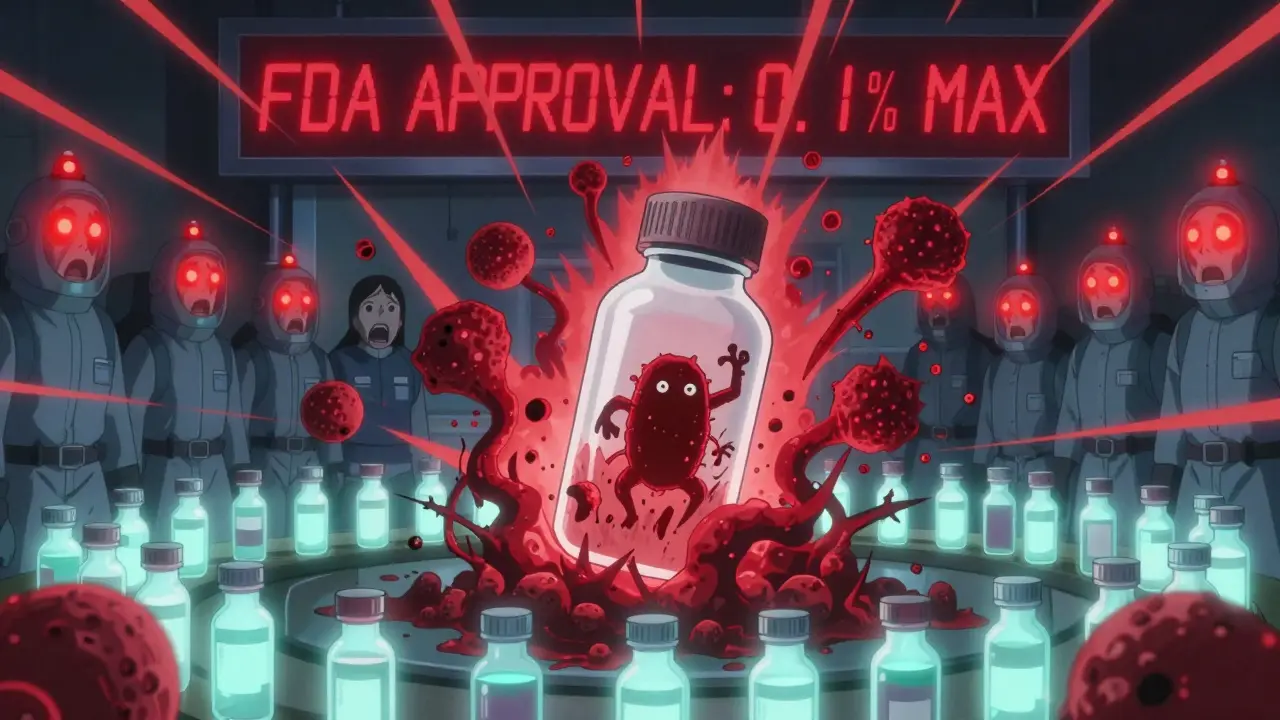
You can’t test every vial for sterility-that would destroy the whole batch. So how do you know it’s safe? You simulate it.Media fill tests are the industry’s most critical validation. Instead of filling with drug solution, you fill with nutrient broth. Then you incubate the vials for 14 days. If any grow bacteria, the process failed. The FDA requires 5,000-10,000 units per media fill simulation. If more than 0.1% of units show growth, you don’t get approval. That’s one contaminated vial out of every 1,000. And you can’t afford even one.
One facility reported three media fill failures in a single quarter. Each cost over $150,000 in lost product and revalidation. The root cause? Inadequate gowning procedures and untrained staff.

Costs and the Business of Sterility
Sterile manufacturing isn’t cheap. A small-scale facility with 5,000-10,000 liters of annual capacity costs $50-100 million to build. Aseptic processing runs 2-3 times more expensive than terminal sterilization. Oakwood Labs estimates $120,000-$150,000 per batch for aseptic vs. $50,000 for terminal. But if your drug is a monoclonal antibody? You have no choice.Contract manufacturers (CDMOs) now handle 55% of sterile injectable production. Companies like Lonza, Catalent, and Thermo Fisher have the capital and expertise most drugmakers can’t afford. But even they’re under pressure. The EU’s revised Annex 1 (2022) demands continuous environmental monitoring, not periodic checks. That means sensors running 24/7, not weekly inspections. Upgrading to meet this standard costs $15-25 million per facility.
What Goes Wrong-and How to Fix It
FDA inspection data from 2022 shows that 68% of sterile manufacturing deficiencies came from aseptic technique failures. Only 12% were linked to terminal sterilization. Common issues:- Inadequate environmental monitoring (37% of citations)
- Media fill failures (28%)
- Poor personnel training (22%)
One company cut its defect rate from 0.2% to 0.05% by switching to automated visual inspection-but it cost $2.5 million. Another reduced deviations by 45% and sped up batch release by 30% with real-time monitoring systems.
The message? You can’t cut corners. Every step-from gowning to filling to testing-must be documented, monitored, and validated. A single missed log, a delayed sensor calibration, or an untrained technician can cost millions.
The Future of Sterile Manufacturing
The market is booming. Sterile injectables hit $225 billion in 2023 and are projected to reach $350 billion by 2028. Biologics are the engine. And with them come new demands:- Continuous manufacturing is replacing batch processing. It reduces contamination risk by minimizing human handling.
- Closed processing systems are now in 65% of new facilities. No open transfers. No exposed vials.
- AI-driven inspections are coming. The FDA’s 2024-2026 plan uses machine learning to predict contamination risks before they happen.
- Rapid microbiological methods will cut testing time from 14 days to 24 hours. No more waiting weeks for results.
Automation is the future. Robotic filling systems are expected to grow 40% by 2027. But they don’t replace training-they raise the bar. You need engineers who understand both microbiology and robotics.
What’s the difference between terminal sterilization and aseptic processing?
Terminal sterilization kills microbes after the product is sealed, using heat or radiation. It’s reliable but only works for heat-stable drugs. Aseptic processing keeps everything sterile during production without sterilizing the final product. It’s used for sensitive biologics but requires extreme environmental controls and constant monitoring.
Why is ISO 5 so important in sterile manufacturing?
ISO 5 is the cleanest classification for aseptic filling zones. It allows fewer than 3,520 particles ≥0.5μm per cubic meter of air. This level minimizes contamination risk during the most vulnerable step-filling vials. Anything less increases the chance of introducing microbes into sterile products.
What is a media fill test and why is it required?
A media fill test simulates the entire aseptic filling process using nutrient broth instead of the actual drug. The filled vials are incubated for 14 days to detect microbial growth. It’s required to prove that the process can consistently produce sterile products without contamination. The FDA requires 5,000-10,000 units per simulation to validate the process.
Why can’t all injectables be terminally sterilized?
Many injectables, especially biologics like monoclonal antibodies, proteins, and vaccines, are too sensitive to heat or radiation. High temperatures or gamma rays break down their structure, destroying effectiveness. These products must be made using aseptic processing to preserve their integrity.
How do regulatory agencies enforce sterile manufacturing standards?
Regulators like the FDA and EMA conduct inspections, review documentation, and audit validation data. They require proof of environmental monitoring, media fill results, personnel training records, and equipment calibration logs. Failure to meet standards leads to warning letters, import bans, or shutdowns. In 2022, the FDA issued 1,872 inspection citations for sterile manufacturing issues-up from 1,245 in 2019.
At the end of the day, sterile manufacturing for injectables isn’t about compliance-it’s about trust. Patients trust that what’s injected into them is safe. Regulators trust that manufacturers are doing everything right. And manufacturers? They trust their processes, their people, and their systems. When any link in that chain breaks, lives are at risk. There’s no room for compromise.
Chelsea Deflyss
February 8 2026so like... i read this whole thing and honestly? i thought sterile meant "no germs" but apparently it's like... a whole military operation. like imagine your IV bag has more security than a nuke silo. wow.
also typo: "depyrogenated" lol i had to google that. my brain hurt.
Brandon Osborne
February 10 2026THIS IS WHY AMERICA IS LOSING THE PHARMA RACE.
They’re spending $15 MILLION to upgrade sensors while China’s cranking out biologics in garages with duct tape and prayer. You want to know why drug prices are insane? Because we’re running a 1950s NASA mission to make a simple injection.
And don’t even get me started on "media fills"-like, we’re feeding broth to vials like it’s a baby’s bottle? This isn’t science. It’s theater. And we’re all paying for the tickets.
Marie Fontaine
February 11 2026OMG this is so cool!! 🤩 I work in a lab and we do media fills every quarter and it’s like a sci-fi movie-everyone in bunny suits, air showers, the whole thing.
But seriously-people don’t realize how much love goes into this. Like, someone spent 8 hours training just to put a cap on a vial. That’s dedication. 🙌
Lyle Whyatt
February 13 2026Let me tell you something about isolators versus RABS-it’s not just about cost, it’s about philosophy. Isolators are like a spaceship: sealed, controlled, no human interference. RABS? More like a surgical theater with a window. You can see the chaos. And honestly? The chaos is what kills batches.
I’ve been in both. I’ve seen gloves tear. I’ve seen a technician sneeze into a fill line. I’ve watched a $200,000 batch vanish because someone didn’t wash their hands *twice*.
The industry talks about "margin for error" like it’s a math problem. But it’s not. It’s a human problem. And humans? We’re messy. We’re tired. We’re distracted. And when you’re working 12-hour shifts in a 20°C room with double gloves on? You start forgetting why you’re even there.
So yes, isolators cost more. But they don’t rely on us. And maybe… just maybe… that’s the point.
Tatiana Barbosa
February 15 2026The SAL of 10^-6? That’s not a target-it’s a prayer.
But here’s the kicker: the real innovation isn’t in the cleanroom. It’s in the people. The ones who catch the microbe in the air sampler. The ones who spot the 0.1°C dip in temp. The ones who refuse to let a batch go because "it looked fine."
Biologics are fragile. The tech is insane. But the real MVP? The technician who stayed an extra hour to revalidate the gowning protocol after a media fill failure. That’s the stuff that saves lives. Not the sensors. Not the robots. The humans.
Ken Cooper
February 16 2026ok so i just read this and i’m like… wait, so if you sneeze in the cleanroom, the whole batch is trash?
and they test water to be cleaner than your tap? and they heat vials at 250c for 30 mins just to kill dead bacteria?
holy cow. i thought my job was stressful.
also… "depyrogenated"? that’s a word? lol. i’m telling my coworkers. they’re gonna lose it.
MANI V
February 17 2026This is why the West is collapsing.
Instead of building efficient systems, we’re building cathedrals to sterility. $15 million to monitor air? You could build a hospital in India for that.
And yet-no one dares to simplify. No one dares to innovate. We’re so afraid of one dead patient that we’ve turned medicine into a cult.
There’s a reason developing nations make better vaccines. They don’t have time for this nonsense.
Tasha Lake
February 19 2026ISO 5 is wild. Like, 3,520 particles per cubic meter? My apartment has more than that just from my cat walking around.
And the fact that they incubate broth for 14 days? That’s longer than my last relationship. But yeah-better safe than dead. I’ll take the 14 days.
Tom Forwood
February 20 2026I’m from Australia and we’ve got this weird thing where we just… trust the system.
But after reading this? I’m not trusting it anymore. I’m *respecting* it.
My cousin got a contaminated IV after surgery. She almost died. This isn’t abstract. This is someone’s mom. Someone’s kid.
So yeah-$15 million? Worth it. Gowning protocols? Worth it. 14-day incubations? Worth it.
Just… don’t cut corners. Ever.
John McDonald
February 21 2026The real story isn’t the tech-it’s the turnover.
Most sterile manufacturing techs leave within 3 years. Burnout. Low pay. High stress.
We spend millions on isolators, but we don’t pay our people enough to stay.
And then we wonder why media fills fail.
It’s not the air. It’s the people. And if we keep treating them like cogs, we’ll keep losing batches.
Andrew Jackson
February 22 2026The FDA’s obsession with 10^-6 is a socialist overreach.
Why must we bow to regulatory dogma? Why can’t we innovate? Why must we spend $100 million to make a vial that could be made for $50 if we just trusted the market?
This is not safety. This is control. And it’s killing American competitiveness.
Joseph Charles Colin
February 23 2026Terminal sterilization: 30-40% of injectables. Aseptic: 60-70%. But here’s what no one says: the real bottleneck isn’t the cleanroom-it’s the supply chain for WFI.
Distillation tanks. Reverse osmosis membranes. Pyrogen-free tubing. Every component has to be validated. And most suppliers? They’re not even certified.
So when you hear about a batch failure? It’s rarely the operator. It’s a $200 valve from a vendor who skipped the endotoxin test.
Fix the supply chain before you fix the cleanroom.
John Sonnenberg
February 24 2026I just want to say… this is the most terrifying thing I’ve ever read.
One sneeze. One torn glove. One uncalibrated sensor. And someone’s child dies.
And we’re still talking about cost. And efficiency. And ROI.
What the hell is wrong with us?
This isn’t a business case. This is a moral imperative.
And if you’re not crying right now… you’re not paying attention.