
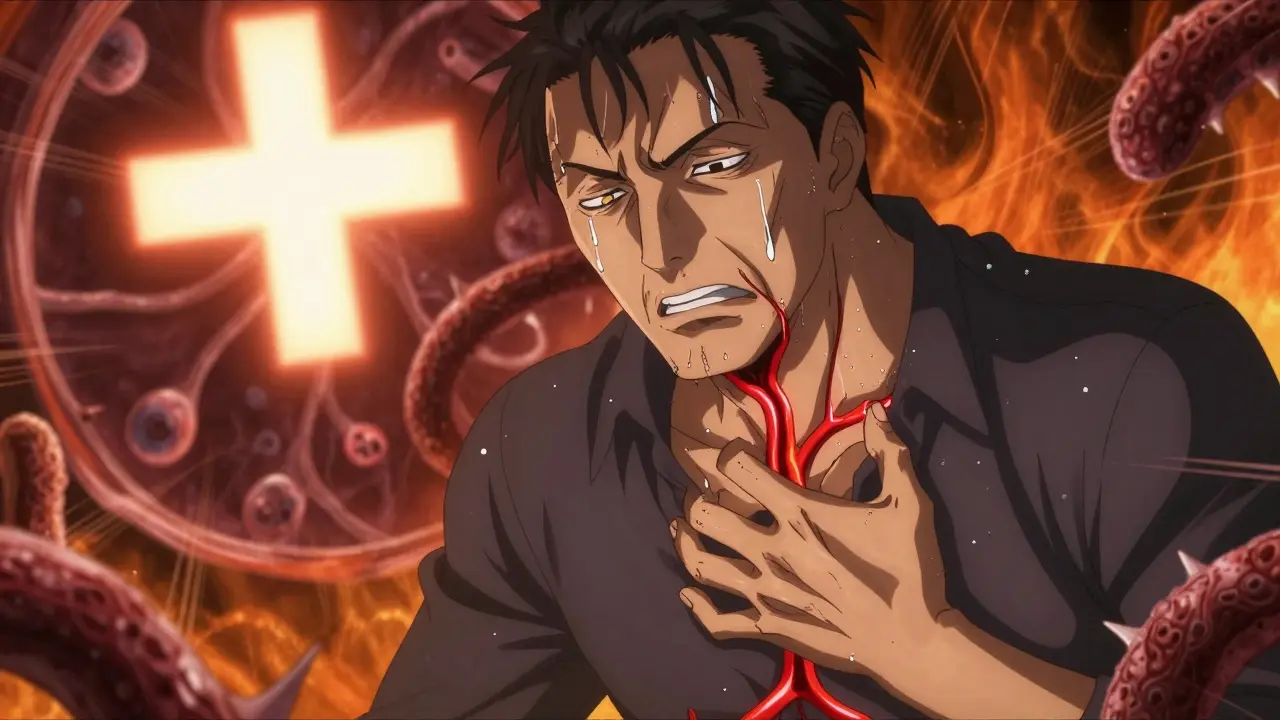
If you’ve had heartburn for years-maybe even decades-you might think it’s just part of life. But chronic GERD isn’t just uncomfortable. It’s a silent driver behind one of the most dangerous cancers of the digestive tract: esophageal cancer. And the scary part? Most people don’t realize they’re at risk until it’s too late.
How GERD Turns Into Cancer
Your esophagus isn’t built to handle stomach acid. Every time acid backs up, it irritates the lining. Over time, your body tries to protect itself by changing the cells. Instead of the normal flat cells, they start looking like stomach lining. That’s called Barrett’s esophagus. It’s not cancer. But it’s the only known precursor to esophageal adenocarcinoma, the most common type of esophageal cancer in the U.S.According to a major 2023 study from the NIH, people with long-term GERD have more than triple the risk of developing esophageal cancer compared to those without it. The risk jumps even higher if you have symptoms weekly-up to seven times greater. And here’s the twist: you don’t need to have severe symptoms. Even mild, daily reflux for five or more years can set this process in motion.
Most people with GERD never develop Barrett’s esophagus. Only about 5 to 20 out of every 100 long-term GERD patients will. And of those, only about 1 in 200 will go on to get cancer each year. But because GERD affects nearly 1 in 5 adults in the U.S., that small percentage adds up to thousands of cases annually.
Who’s Most at Risk?
Not everyone with GERD is equally likely to develop cancer. Certain factors stack the deck. The biggest ones:- Male sex: Men are 3 to 4 times more likely than women to get esophageal adenocarcinoma.
- Age over 50: 90% of cases happen in people over 55. New or worsening reflux after 50 is a major red flag.
- White, non-Hispanic ethnicity: White Americans have three times the risk of Black Americans for this type of cancer.
- Obesity: A BMI over 30 doubles or triples your risk. Fat around the abdomen pushes stomach contents upward.
- Smoking: Current or former smokers face 2 to 3 times higher risk.
- Family history: If a close relative had esophageal cancer, your risk goes up.
Combine three or more of these, and your risk isn’t just higher-it’s dangerously elevated. White men over 50 with 10 or more years of reflux, even if it’s mild, are in the highest-risk group. Yet, only 13% of people in this group get screened as recommended.
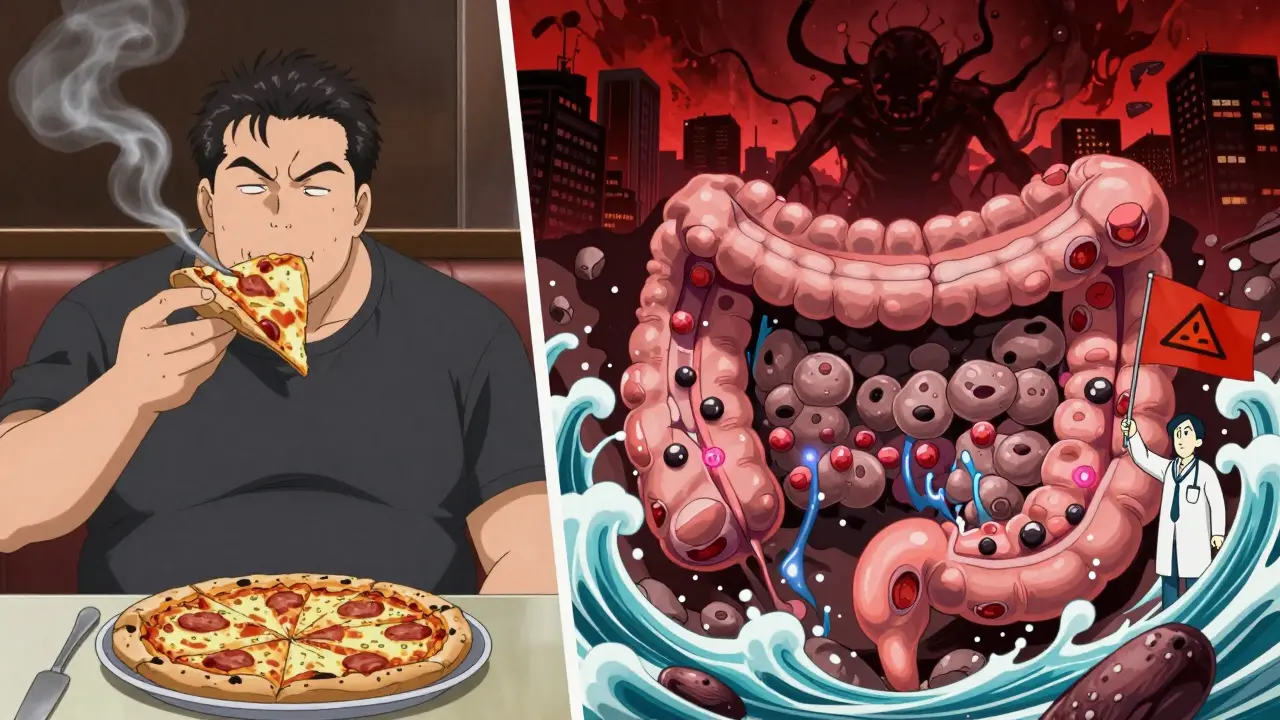
Red Flags That Mean You Need a Doctor Now
Most esophageal cancers are found too late-because the early signs are mistaken for something else. If you’ve had GERD for years and notice any of these, don’t wait:- Dysphagia: Food feels stuck in your chest or throat. It starts with solids, then moves to liquids. This happens in 80% of diagnosed cases.
- Unexplained weight loss: Losing more than 10 pounds in six months without trying is a major warning sign. It shows up in 60-70% of cases.
- Food impaction: Food gets stuck so badly you need to drink water or even go to the ER. This occurs in 30-40% of patients.
- Chronic hoarseness or cough: If you’ve had a persistent hoarse voice or cough for more than two weeks-with no cold or allergies-it could be acid irritating your vocal cords.
- Heartburn that won’t quit: If you’re having heartburn more than twice a week for five or more years, you’re in the danger zone.
These aren’t just annoying symptoms. They’re your body’s way of screaming for help. The American Cancer Society says 75% of esophageal cancers are found at advanced stages because people ignore these signs-or their doctors do.
What You Can Do to Lower Your Risk
The good news? You can interrupt this process. And the earlier you act, the better.Quitting smoking cuts your cancer risk by half within 10 years. Cutting alcohol to one drink a day for women, two for men, lowers risk by 25-30%. Losing 5-10% of your body weight reduces GERD symptoms by 40% in obese people.
But the most powerful tool? Medication and screening. Taking proton pump inhibitors (PPIs) like omeprazole consistently for five or more years reduces cancer risk by 70% in people with Barrett’s esophagus. That’s not a guess-it’s from clinical data.
Screening isn’t for everyone. But if you’re a white male over 50 with chronic GERD (5+ years) and two other risk factors-like obesity or smoking-you should get an upper endoscopy. That’s the only way to see if Barrett’s esophagus is present.
New tools are making screening easier. The Cytosponge-a pill you swallow with a string attached-collects cells from your esophagus without needing a scope. It’s 80% accurate at detecting Barrett’s and is being rolled out in the UK and parts of the U.S. But it’s not everywhere yet. Endoscopy is still the gold standard.

Why Most People Miss the Warning Signs
We’ve been told for decades that heartburn is normal. That it’s just from spicy food or stress. But the truth is, your esophagus is not meant to be bathed in acid. Every time you ignore it, you’re letting damage build up.Doctors are starting to use risk calculators like BE MAPPED, which scores your chance of developing Barrett’s based on age, sex, BMI, smoking, GERD length, family history, and race. It’s 85% accurate. But even the best tool won’t help if you don’t use it.
The rise in esophageal adenocarcinoma since the 1970s tracks directly with the rise in obesity. In 1980, 15% of U.S. adults were obese. Now it’s 42%. That’s not a coincidence. More weight = more pressure on the stomach = more acid reflux = more cancer risk.
And the survival rate? It’s brutal. Only 21% of people with esophageal cancer survive five years after diagnosis. But if caught early-before it spreads-the survival rate jumps to 50-60%. That’s the difference between a death sentence and a second chance.
What to Do Next
If you’ve had GERD for five years or more, especially if you’re a man over 50 or have other risk factors:- Write down your symptoms. How often? How bad? Any trouble swallowing?
- Track your weight. Have you lost pounds without trying?
- Make an appointment with a gastroenterologist. Don’t wait for symptoms to get worse.
- Ask: “Should I be screened for Barrett’s esophagus?”
- If you smoke, quit. If you’re overweight, start losing weight. Even 10 pounds helps.
- If you’re on PPIs, don’t stop them without talking to your doctor. Consistent use saves lives.
GERD doesn’t have to lead to cancer. But ignoring it does. The science is clear. The tools exist. The only thing missing is action.
Ron Williams
December 16 2025Been dealing with heartburn since my 30s. Thought it was just spicy food and stress. Turns out I’m a walking risk factor: white, male, 58, BMI 31, smoked for 20 years. Scary how normal it all felt until I read this.
Got my endoscopy scheduled next week. Fingers crossed it’s nothing.
Thanks for laying it out like this.
Kitty Price
December 17 2025Same. I’ve been on PPIs for 7 years. My doctor said ‘just keep taking it’ but never mentioned Barrett’s or screening. 😔
Now I’m scared I waited too long. Gonna call my GI tomorrow.
Thanks for the nudge 💙
Randolph Rickman
December 19 2025Let me tell you something - this isn’t just about GERD. This is about how medicine treats symptoms instead of root causes. We’re medicating acid reflux like it’s a glitch, not a red flag. The fact that only 13% of high-risk people get screened? That’s systemic neglect.
And don’t get me started on how insurance makes endoscopy a hassle. If you’re over 50, male, and have reflux - don’t wait for a doctor to tell you. Go. Get it done. Your future self will thank you.
Also, the Cytosponge? It’s a game-changer. If your doc hasn’t heard of it, find one who has.
SHAMSHEER SHAIKH
December 19 2025Dear friends, I write this with profound concern and deep compassion for the human condition. The data presented here is not merely statistical - it is a moral imperative. The human body, in its exquisite design, cries out for dignity, for care, for attention. To dismiss chronic reflux as ‘normal’ is to betray the sacred trust we place in our own physiology.
Kindly, I implore you - if you are a man over fifty, if you carry extra weight, if you have ever smoked - do not delay. The hour is late, the path is clear. Seek screening. Embrace change. Your life is not a gamble. It is a gift - and gifts must be protected.
May peace and health attend you always.
James Rayner
December 20 2025I’ve been thinking a lot about how we normalize pain. Like, we’re taught to ‘tough it out’ - back pain, headaches, heartburn. But what if the body’s not asking you to endure it? What if it’s asking you to listen?
GERD isn’t just ‘acid’. It’s a language. And we’ve been ignoring it for decades.
Maybe the real disease isn’t cancer. It’s the belief that suffering is just part of getting older.
Souhardya Paul
December 22 2025My dad had this. Silent for years. Then one day he couldn’t swallow water. By the time they found it, it was stage 3. He’s been in remission for 4 years now, but it messed up his whole life.
My mom’s been on PPIs for 12 years. I told her to get screened last year. She said ‘I feel fine.’
Now I’m making sure my 55-year-old self gets checked. No more ‘I feel fine.’
Josias Ariel Mahlangu
December 23 2025People like you think you can just ‘get screened’ and fix everything. But you didn’t fix your lifestyle. You didn’t quit smoking. You didn’t lose weight. You just want a magic pill and a scope. That’s not health. That’s denial with a co-pay.
Stop waiting for the system to save you. Start saving yourself.
anthony epps
December 25 2025So if you got heartburn for 5 years and you’re a guy over 50, you gotta get checked? That’s it? No other steps?
Andrew Sychev
December 27 2025Oh great. Another fear-mongering post from someone who thinks a pill is a cure. You think your ‘70% risk reduction’ is some miracle? Nah. It’s just another way for Big Pharma to sell you omeprazole for $150 a month while you’re too scared to eat a slice of pizza.
Meanwhile, your ‘high-risk’ group? Probably just eats too much and watches too much TV.
Stop selling cancer like it’s a horror movie. Go for a walk. Stop being a victim.
Dan Padgett
December 28 2025Man, this hit different. I’m Nigerian, but I’ve lived in the States for 15 years. Back home, we don’t even have endoscopies in most towns. Here, I got PPIs like candy. But I never asked - ‘Is this just masking?’
Now I see it: we’re not treating the fire. We’re just handing out blankets while the house burns.
My cousin died of this. Didn’t even know he had reflux. Just said he ‘couldn’t eat’ and then… gone.
I’m getting checked. No excuses.
Hadi Santoso
December 28 2025wait so if you’re a guy over 50 and you’ve had heartburn and you’re kinda fat and maybe smoked once… you’re basically a walking time bomb? 😅
my doctor never mentioned any of this. just gave me prilosec and said ‘take it when it hurts’
gonna go get that cytosponge thing if i can find it. also, i think i lost 10 lbs last year without trying… oops.
Kayleigh Campbell
December 28 2025So let me get this straight - we’ve got a cancer that’s 80% preventable, but the medical system treats it like a ‘maybe someday’ issue? And the people who need screening the most? They’re too busy working three jobs to even think about it.
Oh, and the people who *can* afford to care? They’re the ones getting told it’s ‘just acid’ for 20 years.
Classic. Just… classic.
Ron Williams
December 30 2025Just got my endoscopy results. No Barrett’s. Just severe esophagitis. Doc says I’m lucky. I’m not. I’m just awake now.
Thanks for the push, everyone. I’m quitting smoking this week.