Have you ever stared at a prescription label that says "take with food" or "take on an empty stomach" and wondered if it actually matters? You might think swallowing the pill is enough, but what you eat-or don’t eat-around the time you take your medication can completely change how your body processes it. Getting this wrong doesn't just mean the medicine works less effectively; it can also lead to unpleasant side effects or even serious health risks.
This isn't just old wives' tale advice. According to the U.S. Food and Drug Administration's 2023 guidance, about 40% of prescription medications carry specific instructions regarding food. This means nearly half of all prescriptions depend on your meal timing for optimal results. Whether you are managing chronic conditions like thyroid issues or taking short-term antibiotics, understanding these rules is crucial for your health.
The Science Behind Food and Medication
To understand why food matters, we need to look at what happens inside your body. When you eat, your digestive system undergoes significant changes. Your stomach produces more acid, bile flows from your liver to help digest fats, and the speed at which your stomach empties into your intestines slows down. These physiological shifts directly impact how drugs dissolve and enter your bloodstream.
For many drugs, food acts as a buffer. It can slow down gastric emptying, which allows the medication more time to be absorbed. This creates steadier blood levels, which is vital for medications with a narrow therapeutic window-meaning the difference between a helpful dose and a harmful one is small. On the flip side, some medications require an acidic environment to break down properly. If food neutralizes your stomach acid, those drugs may pass through your system without being absorbed at all.
A study published in the Journal of Clinical Pharmacy and Therapeutics found that for common painkillers like ibuprofen and aspirin, food can delay the time it takes for the drug to reach its maximum concentration in your blood by up to 2.8 times. While this might sound bad, for some people, this slower release prevents the sudden spike in drug levels that causes stomach upset.
Medications That Require Food
Some medicines are harsh on the lining of your stomach. Taking them on an empty stomach is like pouring vinegar into a raw wound-it causes irritation, nausea, and in severe cases, ulcers. Here are the main categories of drugs that should always be taken with food:
- NSAIDs (Non-Steroidal Anti-Inflammatory Drugs): This includes ibuprofen, naproxen, and aspirin. The UK National Health Service explicitly advises taking these after eating to minimize the risk of upsetting your stomach. For elderly patients, this is especially important due to their increased vulnerability to gastrointestinal complications.
- Certain Antibiotics: Drugs like amoxicillin/clavulanate (Augmentin) and nitrofurantoin often cause nausea when taken alone. A 2021 study showed that taking Augmentin with food reduced the incidence of nausea by 20%.
- Antiretroviral Medications: Some HIV treatments, such as ritonavir, are best taken with food to lower the risk of nausea and improve absorption. High-fat meals can increase the absorption of certain protease inhibitors by up to 40%.
If your label says "take with food," it usually means you should have a substantial meal or a large snack. A few crackers might not be enough to protect your stomach lining from strong NSAIDs.
Medications That Require an Empty Stomach
Conversely, some medications fight against food. Certain compounds in food can bind to the drug molecules, preventing them from being absorbed into your bloodstream. Other drugs are destroyed by stomach acid, which is produced when you eat. For these, "empty stomach" has a very specific medical definition: at least one hour before a meal or two hours after.
| Medication Type | Example Drugs | Why Avoid Food? |
|---|---|---|
| Tetracycline Antibiotics | Doxycycline, Tetracycline | Calcium in dairy binds to the drug, reducing absorption by up to 50%. |
| Thyroid Hormones | Levothyroxine | Food reduces bioavailability by 20-55%. Must be taken 30-60 mins before breakfast. |
| Bisphosphonates | Alendronate (Fosamax) | Poorly absorbed in the presence of food; requires upright position for 30 mins. |
| Certain Antiretrovirals | Didanosine | Stomach acid destroys the medication; requires low-acid environment. |
Take Levothyroxine, for example. This is the standard treatment for hypothyroidism. Studies show that food can reduce its effectiveness significantly. If you want the full benefit of the hormone replacement, you must take it first thing in the morning, wait at least 30 to 60 minutes, and then eat your breakfast. Even coffee can interfere with its absorption, so water is the only safe beverage during that window.

Specific Food Interactions to Watch
It’s not just about whether you’ve eaten or not; it’s about what you’ve eaten. Certain foods act like drugs themselves, interacting with enzymes in your gut that process medications.
The most famous culprit is Grapefruit Juice. It contains compounds that inhibit the CYP3A4 enzyme in your intestines. This enzyme is responsible for breaking down many drugs. When it’s blocked, more of the drug enters your bloodstream than intended, potentially leading to toxicity. This affects statins (cholesterol meds), some blood pressure medications, and immunosuppressants. One glass of juice can have this effect for up to 72 hours, so it’s not something you can just avoid on the day you take your pill.
Dairy products are another major issue. Calcium, magnesium, and iron in antacids or supplements can bind to antibiotics like tetracyclines and fluoroquinolones (such as ciprofloxacin). This binding creates a complex that your body cannot absorb, rendering the antibiotic useless. If you need to take these together, space them out by at least four hours.
Practical Strategies for Adherence
We know the science, but life is messy. Remembering to take a pill exactly one hour before lunch while rushing to work is difficult. A 2023 survey found that 42% of patients admit to occasionally taking medications incorrectly regarding food. Here are some practical ways to stay on track:
- Use Visual Cues: Pharmacists have started using color-coded labels. Red for "empty stomach," green for "with food." Ask your pharmacist if they can add these stickers to your bottles.
- Set Alarms with Context: Don't just set an alarm for "Take Pill." Set it for "Take Levothyroxine - Wait 1 Hour Before Breakfast." The context helps trigger the correct behavior.
- Hydrate Properly: Fill a one-liter water bottle each morning. Many medications require adequate hydration to dissolve properly and move through your system. This is especially true for bisphosphonates, which must be taken with a full glass of water while standing upright.
- Keep a Snack Handy: If you have a medication that needs food but you’re not hungry, keep bland snacks like crackers or bananas nearby. Bananas are particularly good for NSAID users as they provide potassium and are gentle on the stomach.
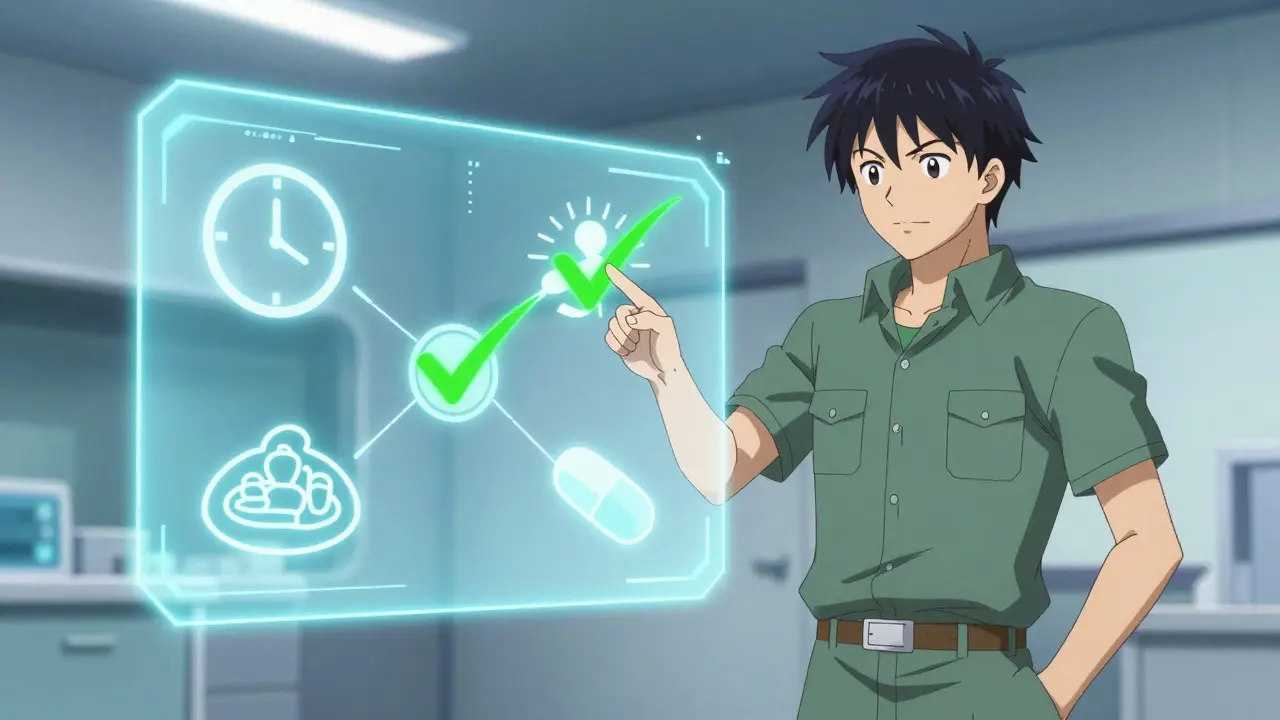
If you manage multiple medications with different requirements, create a simple chart. List each drug, its timing, and its food rule. Post this chart where you take your meds, such as on the refrigerator or bathroom mirror.
When Guidelines Contradict Each Other
Sometimes, you’ll find conflicting advice online. For instance, while most guidelines say to take NSAIDs with food to protect your stomach, some research suggests that for rapid pain relief, taking them on an empty stomach might work faster because there’s no food slowing down absorption. However, the risk of gastric irritation usually outweighs the benefit of slightly faster onset for most people.
Always prioritize the instructions on your specific prescription label over general internet advice. Drug formulations can vary. An extended-release version of a drug might have different food requirements than the immediate-release version. If you are unsure, call your pharmacist. They are the experts in drug interactions and can give you personalized advice based on your full medication list.
The Future of Personalized Medication Timing
Science is moving toward more personalized approaches. Researchers at the University of California, San Francisco, recently developed a machine learning model that predicts how an individual’s gut microbiome will respond to food-drug interactions. While this technology is still emerging, it highlights that our bodies are unique. What works for one person might not work for another.
In the meantime, the FDA is pushing for clearer labeling. New guidelines aim to move beyond vague phrases like "with or without food" to specify meal composition and timing. As electronic health records improve, doctors and pharmacists are better equipped to alert patients to these interactions before they happen. In hospital settings, these alerts have already reduced administration errors by nearly 30%.
Taking your medication correctly is a partnership between you and your healthcare provider. By paying attention to the food instructions on your label, you ensure that the medicine does exactly what it was designed to do-help you get better, safely and effectively.
What does "take on an empty stomach" mean?
Medically, "empty stomach" means taking the medication at least one hour before eating or two hours after finishing a meal. This ensures that your stomach is clear of food that could interfere with the drug's absorption or chemical stability.
Can I take my pills with a snack instead of a full meal?
It depends on the medication. For drugs that cause stomach upset, like NSAIDs, a small snack might be sufficient to buffer the acid. However, for drugs that require fat for absorption, like some HIV medications, a high-fat meal is necessary. Always check with your pharmacist if a light snack is acceptable for your specific prescription.
Does grapefruit juice affect all medications?
No, but it affects many common ones. Grapefruit juice inhibits the CYP3A4 enzyme, impacting statins, certain blood pressure meds, and anti-anxiety drugs. It does not affect most antibiotics or painkillers. Always ask your doctor or pharmacist if your specific medication interacts with grapefruit.
Why should I take Levothyroxine before breakfast?
Food can reduce the absorption of Levothyroxine by up to 55%. To get the full therapeutic dose, it must be taken on an empty stomach with water, followed by a wait time of 30 to 60 minutes before eating or drinking anything else (including coffee).
What should I do if I forget to take my medication with food?
If you realize immediately, you can eat a small amount of food. If you've already taken the pill and feel nauseous, lie down and rest. Do not double up on doses. If you experience severe stomach pain or vomiting, contact your healthcare provider. For future doses, consider setting reminders or keeping snacks near your medication storage area.