
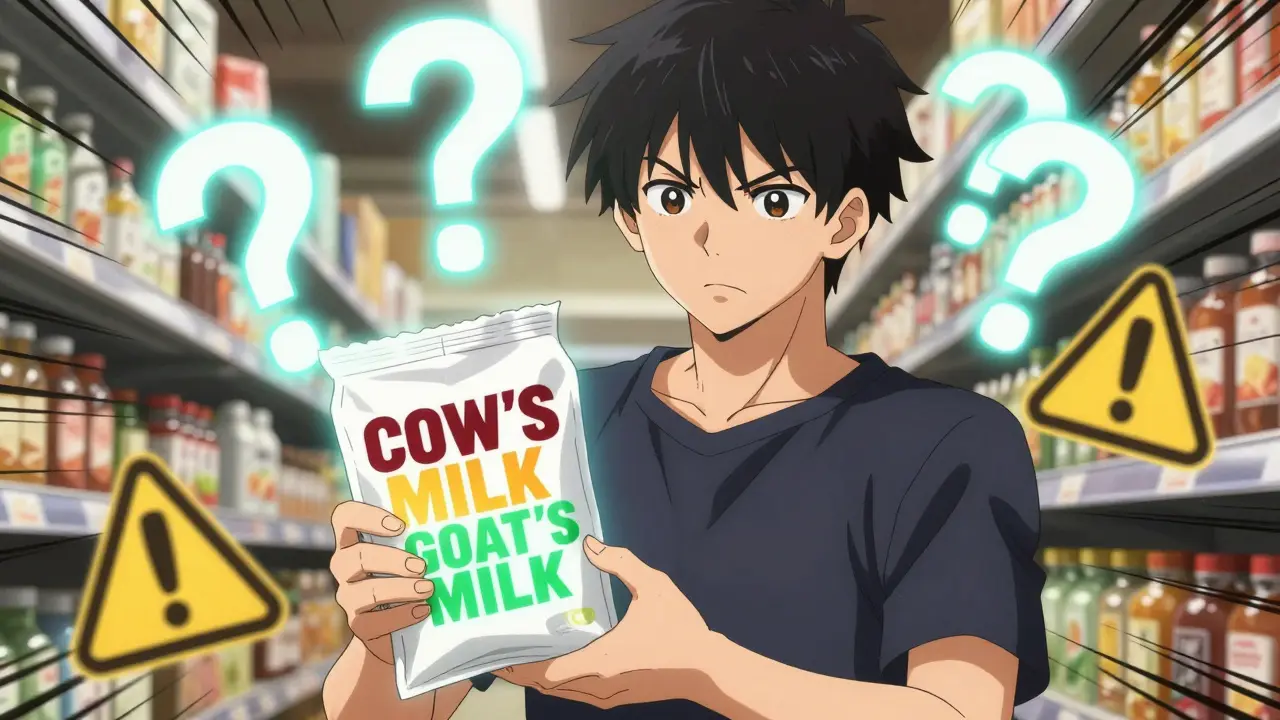
Reading food labels used to be simple: check the ingredients, avoid the ones you’re allergic to. But today, it’s more like solving a puzzle with missing pieces. If you or someone you care about lives with food allergies, you’ve probably felt the frustration - staring at a label wondering if "milk" means cow’s milk, goat’s milk, or something else entirely. Or if "shellfish" includes oysters. Or if "may contain" means "probably safe" or "don’t risk it." The truth is, food labels have changed - and not just a little. In January 2025, the U.S. Food and Drug Administration (FDA) released its latest guidance on allergen labeling, and it’s the biggest shift in over a decade. These aren’t suggestions. They’re clear rules designed to stop confusion, prevent reactions, and save lives.
What Changed on Food Labels in 2025?
The big update? Food allergen labeling is now far more specific. Gone are the vague terms that left people guessing. If a product contains milk, the label must now say whether it’s cow’s milk, goat’s milk, or sheep’s milk. Same with eggs: "duck egg" or "quail egg" must be named, not just "egg." This matters because allergies aren’t always to all animal milks or eggs. Someone might react to cow’s milk but safely drink goat’s milk. Without clear labeling, they’re forced to call manufacturers or guess - and guessing can be deadly.
For fish, the rules got tighter too. "Fish" is no longer enough. Labels must now say if it’s bony fish like trout, cartilaginous fish like shark, or jawless fish like lamprey. Why? Because an allergy to tuna doesn’t mean you’re allergic to shark. This level of detail helps people avoid only what they need to.
One major change? Coconut is no longer considered a tree nut under federal labeling rules. That’s right - coconut is now treated like a fruit. If you have a tree nut allergy but can eat coconut, this removes unnecessary fear. But if you’re allergic to coconut itself, you’ll now see it listed separately - not buried under "tree nuts." This was a win for millions.
Shellfish got a major redefinition. Only crustacean shellfish - like crab, lobster, and shrimp - must be labeled as allergens. Mollusks - oysters, clams, mussels, scallops - are no longer covered. That’s a problem. Around 1.5 million Americans are allergic to mollusks. If you’re one of them, you’re now on your own. A label might say "may contain shellfish" and mean shrimp - but never mention that oysters were nearby. This gap is real. Advocacy groups are pushing for change, but for now, if you’re allergic to clams or oysters, you need to dig deeper than the label.
"Free From" vs. "May Contain" - The New Conflict
Here’s where things get tricky. You’ve probably seen labels like:
- "Gluten-free"
- "Milk-free"
- "May contain traces of milk"
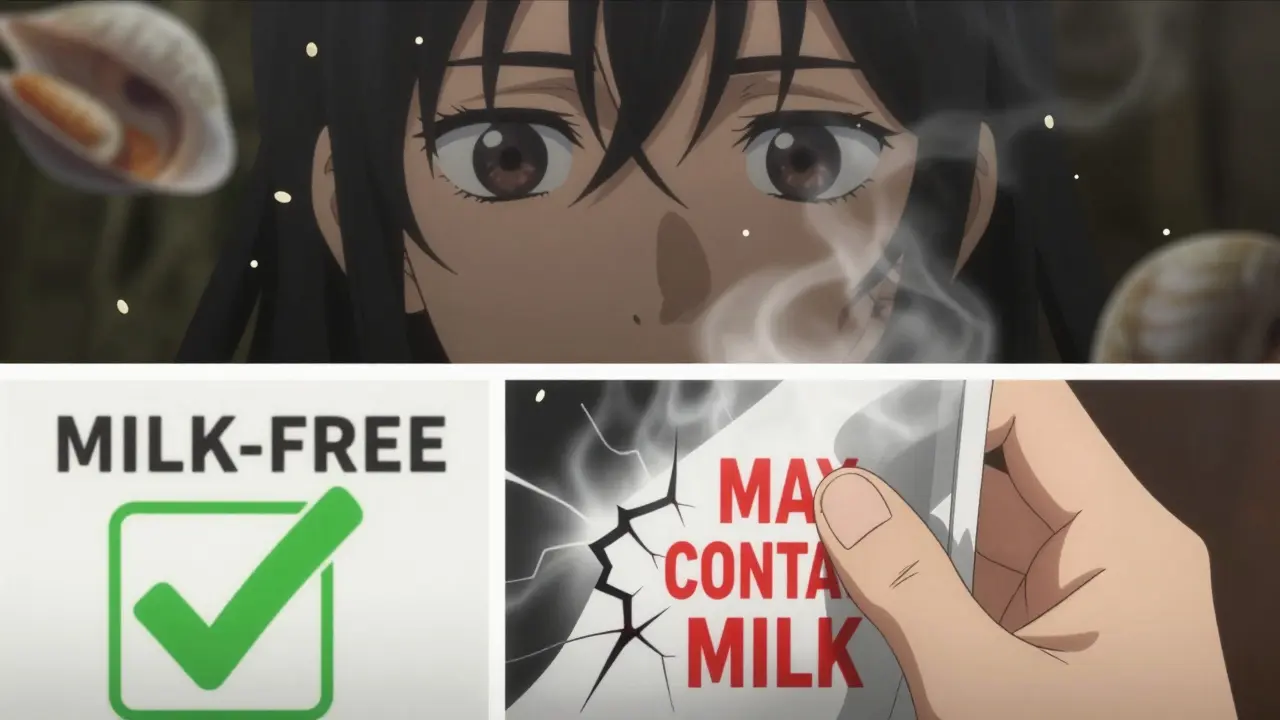
Before 2025, companies could do this. It confused everyone. If a product says "milk-free," but also says "may contain milk," what’s the truth? The FDA’s 2025 guidance says: you can’t do both. If a product claims to be free of an allergen, it must be free - no "may contain" exceptions. That means manufacturers can’t use "may contain" as a legal loophole. If they say "no milk," they’ve got to prove it. No cross-contact allowed. This is huge. It turns "free from" claims from marketing buzzwords into real safety promises.
But here’s the catch: this rule only applies if the manufacturer chooses to make a "free from" claim. If they don’t, they can still use "may contain" - and it’s still voluntary. So if a product doesn’t say "free from" anything, you can’t assume it’s safe. You still need to check for advisory statements. And if you’re unsure? Call the company. Ask: "Did you test for cross-contact?"
Hidden Allergens Are Still Out There
Even with these changes, allergens hide in plain sight. Soy sauce? Often made with wheat. Natural flavors? Could be dairy-derived. Chocolate? Sometimes processed on equipment shared with peanuts. The FDA’s guidance doesn’t cover every possible cross-contact scenario. It only requires labeling of the nine major allergens - milk, egg, fish, crustacean shellfish, tree nuts, wheat, peanuts, soybeans, and sesame - when they’re intentionally added.
That’s why cross-contact remains the silent threat. It happens when a machine that made peanut butter is used for cereal. Or when a bakery uses the same spatula for gluten-free and regular bread. The FDA says these accidental traces don’t have to be labeled - unless the manufacturer chooses to warn. And many don’t. That’s why people with severe allergies still carry epinephrine. That’s why they avoid restaurants, buffets, and bulk bins. The labels help - but they don’t eliminate risk.
And then there’s sesame. Added to the major allergen list in 2023 under the FASTER Act, it’s now required on labels. But many people still don’t realize how common it is. It’s in hummus, tahini, bagels, salad dressings, and even some vitamins. If you’re allergic to sesame, you’ve likely had reactions from labels that didn’t list it - until now. But even with sesame labeled, it’s often hidden under "spices" or "natural flavors." So you still need to know your ingredients.
Who’s Affected - And Who’s Still at Risk?
These changes impact nearly 32 million Americans with food allergies - including 5.6 million children. For those allergic to cow’s milk, the new "goat milk" labeling is a game-changer. For those allergic to peanuts, the clearer "peanuts" vs. "tree nuts" distinction reduces confusion. But not everyone benefits equally.
People with mollusk allergies - oysters, clams, scallops - are now in a dangerous gray zone. Their allergens aren’t covered. No warning. No labeling. And they’re not rare. About 1 in 100 people in the U.S. have this allergy. Many don’t even know they’re allergic until they get sick after eating sushi or seafood stew. The FDA didn’t include them because they’re not as common as shrimp - but that doesn’t make them any less dangerous.
Small food makers are struggling too. Updating labels costs between $5,000 and $15,000 per product line. Many can’t afford it. So you might see inconsistent labeling - even within the same brand. A big company might update their labels. A small local producer might not. That’s why buying from trusted brands matters - and why reading every label, every time, is still essential.
What You Should Do Now
Here’s how to stay safe with the new rules:
- Read every label - every time. Even if you’ve bought the same product for years. Ingredients change.
- Look for specifics. Is it "milk" or "cow’s milk"? Is it "shellfish" or "shrimp"? If it’s vague, call the company.
- Trust "free from" only if there’s no "may contain". If both appear, the "free from" claim is invalid. Avoid it.
- Don’t assume coconut is safe. If you’re allergic to tree nuts, coconut is now labeled separately. If you’re allergic to coconut, check the ingredient list - it’s now called out.
- Be extra careful with mollusks. If you’re allergic to oysters or clams, never rely on a "shellfish" warning. Ask about preparation methods.
- Check for sesame. It’s now required - but hidden in sauces, snacks, and spice blends. Know what it looks like on a label.
And if you’re a parent, teach your kids to ask: "What kind of milk is in this?" or "Is this made on the same line as peanuts?" Knowledge is their best defense.
What’s Next?
The FDA isn’t done. In January 2025, they also released a new framework to evaluate other potential allergens - like mustard, celery, and lupin. These aren’t required yet. But they’re being studied. The global food allergy testing market is growing fast - projected to hit $1.4 billion by 2029. That means more companies will invest in testing, and more labels will improve.
For now, the U.S. leads the world in allergen labeling clarity. The EU still uses broad terms like "milk" or "eggs." The UK follows similar standards. But here, we’re moving toward precision. It’s not perfect. It’s not mandatory for every manufacturer. But it’s progress. And for people who live with food allergies every day, that progress means they can finally shop with a little more confidence.
Stay alert. Stay informed. And never stop asking questions - because your safety depends on it.
Is coconut still considered a tree nut on food labels in 2026?
No. As of January 2025, the FDA removed coconut from the list of major tree nut allergens. It is now treated as a fruit and must be labeled separately. If you have a tree nut allergy, you can now safely consume coconut - unless you’re specifically allergic to coconut itself. In that case, you’ll see "coconut" clearly listed on the ingredient label.
Can a product say "milk-free" and also "may contain milk"?
No. Under the FDA’s 2025 guidance, a product cannot make a "free from" claim (like "milk-free") and also include an advisory statement like "may contain milk." If a manufacturer claims the product is free of an allergen, it must be genuinely free - with no cross-contact. The presence of a "may contain" statement invalidates the "free from" claim. If you see both, avoid the product.
Are oysters and clams covered under shellfish allergen labeling?
No. As of 2025, "shellfish" on food labels refers only to crustacean shellfish: crab, lobster, and shrimp. Mollusks - including oysters, clams, mussels, and scallops - are not covered by federal allergen labeling rules. If you’re allergic to mollusks, you cannot rely on any "shellfish" warning on a label. You must contact the manufacturer directly to ask about cross-contact and ingredients.
Why does the FDA require "cow’s milk" instead of just "milk"?
Because not everyone allergic to milk reacts to all types. Many people are allergic to cow’s milk but can safely consume goat’s milk, sheep’s milk, or even camel’s milk. Before 2025, labels just said "milk," forcing consumers to guess or call manufacturers. Now, manufacturers must specify the animal source - so you know exactly what you’re avoiding.
Are all food manufacturers required to follow the new 2025 labeling rules?
No. The FDA’s 2025 guidance is non-binding. It’s a recommendation, not a law. While most major manufacturers are adopting the changes, small producers may not. The FDA does not require compliance - and only inspects about 10% of food facilities each year. That means labeling can vary widely. Always read labels carefully, and when in doubt, contact the manufacturer.
Dylan Patrick
March 14 2026Finally. I’ve been calling this out for years. My kid’s allergic to cow’s milk but loves goat cheese. Every label just said "milk" - so we avoided everything. Now? We can actually shop without panic. This isn’t just paperwork - it’s life-changing.
Serena Petrie
March 16 2026Coconut’s not a nut? Cool.
Kathy Leslie
March 16 2026I’m so glad someone finally broke this down. I used to stress every time I bought snacks. Now I just look for "cow’s milk" vs "goat’s milk" - it’s like a whole new world.
Aaron Leib
March 18 2026The "free from" vs "may contain" rule is huge. I’ve seen products that say both and it’s a trap. Now if it says "milk-free" and no "may contain," I trust it. That’s progress.
Elsa Rodriguez
March 19 2026OMG I CAN’T BELIEVE THEY LEFT OUT MOLLUSKS. My cousin had anaphylaxis on a clam chowder and the label said "shellfish-free" - but it had oysters. This is a MASSIVE oversight. People are DYING here. Why is this still happening? Someone needs to sue the FDA. I’m crying. 😭
Stephanie Paluch
March 20 2026Thank you for explaining sesame! I didn’t even know it was a major allergen until last year. Now I check every jar of hummus. 🙌 I’ve had 3 reactions before 2023 - all from "spices" or "natural flavors." So glad it’s labeled now. Still sneaky though 😅
mir yasir
March 20 2026While the FDA's recent elucidation of allergen nomenclature represents a paradigmatic advancement in consumer safety infrastructure, it remains fundamentally inadequate in its ontological exclusion of molluscan allergens from regulatory purview. The epistemological lacuna in the delineation of crustacean versus mollusk taxonomy betrays a systemic failure to account for immunological heterogeneity within the broader phylogenetic continuum of aquatic allergens.
rakesh sabharwal
March 21 2026Let’s be real - this is all performative. The FDA doesn’t enforce this. Most small producers ignore it. I’ve seen "milk-free" labels with "may contain" underneath. It’s a joke. They’re just checking boxes while people still get rushed to the ER. This isn’t safety - it’s PR.
And don’t get me started on "natural flavors." That’s a legal loophole bigger than the Mississippi. If you’re allergic, you’re still playing Russian roulette. They call this progress? It’s a carnival.
Also, coconut as a fruit? Cute. But what about lupin? Or mustard? They’re next. And they’ll be buried under "spices" until someone dies again. This isn’t reform - it’s reactive triage.
Meanwhile, companies are still using the same lines for peanut butter and cereal. Cross-contact? Not regulated. Not labeled. Not even mentioned. So we’re supposed to trust the label? Please. We’re still the ones carrying epinephrine. Not them.
And yes, I’ve called three manufacturers this week. Two didn’t answer. One said, "We don’t test for traces." So now what? I guess I’ll keep avoiding everything.
tynece roberts
March 23 2026i just read this whole thing and honestly i’m exhausted. i have a kid with 5 allergies and we’ve been doing this for 8 years. the new rules help a LITTLE. like, now we know coconut’s safe for her (she’s nut allergic but loves it). but then you get a bag of chips that says "made in a facility with shellfish" and you have to call the company and wait 3 days for an answer. and sometimes they just say "we don’t know." like bro. we’re trying to live here. can we just have a simple app or something? like a scanner? i’d pay for that. i’m so tired of reading tiny print on cereal boxes at 11pm while my kid cries because she’s hungry and we can’t find anything safe. 😩
Hugh Breen
March 24 2026YESSSSS the coconut change! My wife has a tree nut allergy and we used to avoid EVERYTHING. Now she can have coconut water, coconut oil, even coconut flour. 🥥 I cried the first time we bought a bag of coconut chips and it didn’t say "tree nuts." This is why we need science-backed labeling - not guesswork. Also - sesame on everything now? YES. I thought it was just in hummus. Turns out it’s in my kid’s granola bars. 😱 Thank you for this guide - shared it with my whole family.
Buddy Nataatmadja
March 24 2026As someone who grew up in Indonesia where coconut is everywhere, it’s wild that it was ever lumped in with tree nuts. We’ve been eating it raw since childhood. The FDA’s update makes sense - it’s botanically a drupe. But I’m still worried about small brands. If they can’t afford label updates, people will still get hurt. Education > regulation, sometimes.
Amisha Patel
March 25 2026I’m allergic to oysters and clams. I didn’t even know I was until I got sick at a seafood restaurant last year. I’ve been reading labels since then. No one ever warns you. I just hope this changes. Maybe next year?
Byron Boror
March 27 2026Why are we letting the FDA dictate what we can eat? This is socialism disguised as safety. If you’re allergic, that’s your problem. Stop making the rest of us pay for your fear. I don’t need to know if it’s goat milk or cow milk. Just label it "milk" and move on. This is why America’s falling apart - overthinking food.