
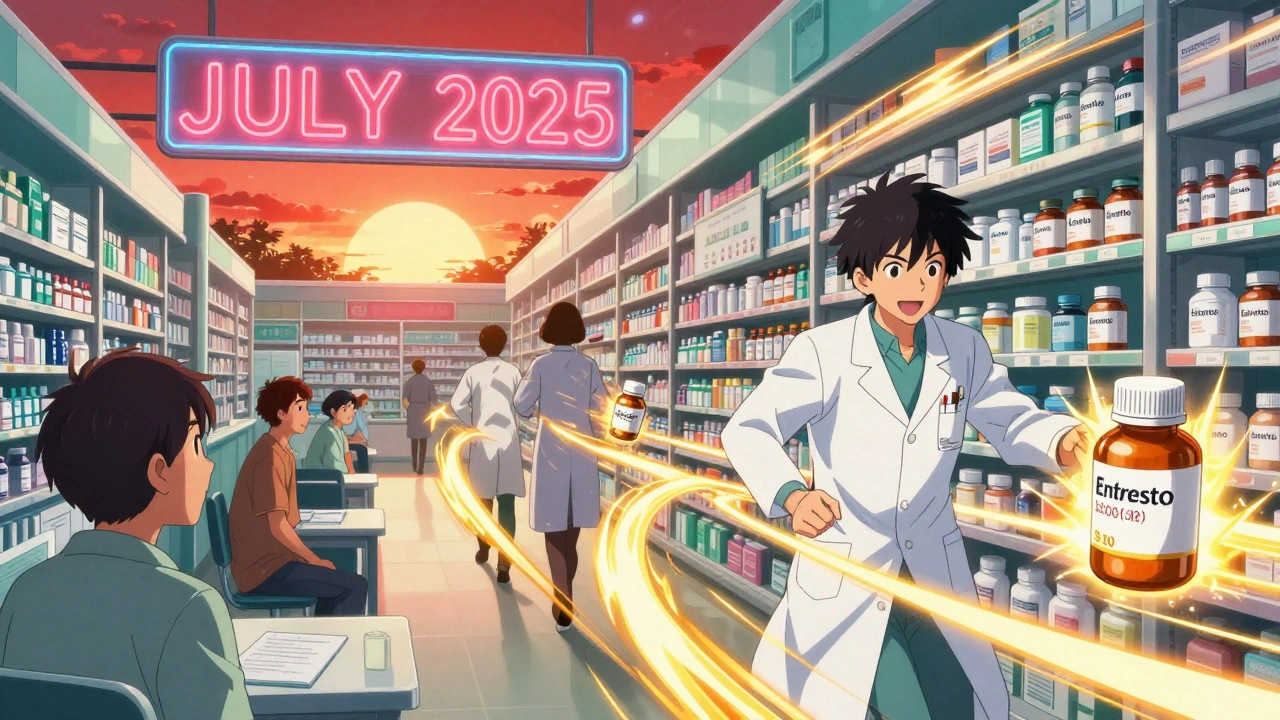
By mid-2025, the pharmaceutical world will face its biggest shift in decades. Dozens of top-selling drugs, each bringing in billions annually, will lose patent protection. This isn’t just a legal technicality-it’s going to change how patients pay for medicine, how pharmacies stock shelves, and how hospitals manage treatment plans. The blockbuster patent expirations starting in 2025 aren’t a distant forecast-they’re already here, with generics ready to hit the market the moment the patents expire.
What’s Expiring in 2025? Entresto Leads the Way
The first major hit comes in July 2025, when Novartis’ Entresto (sacubitril/valsartan) loses its core patent protection in the U.S. Entresto, a heart failure drug, brought in $7.8 billion globally in 2024. For patients, that means monthly costs could drop from $150-$300 to as low as $20-$40 once generics arrive. Hospitals and pharmacies have been preparing for months. By October 2024, 87% of hospital pharmacy directors surveyed by ASHP had already started formulary changes and staff training to switch patients over.
The FDA approved the first generic version of sacubitril-Entresto’s key component-back in October 2024, signaling that manufacturers were ready to roll out full generics the moment the patent expired. This isn’t unusual for small-molecule drugs. Once a patent expires, generic versions typically capture 90% of the market within a year. But Entresto’s case is special because it’s a combination drug, which makes manufacturing slightly more complex than a single-ingredient pill. Still, with over 120 ANDA applications filed targeting Entresto, competition will be fierce.
2026: Eliquis Goes Generic-The Anticoagulant Giant Falls
Just over a year later, in November 2026, Bristol Myers Squibb and Pfizer’s Eliquis (apixaban) loses its key crystalline form patent. Eliquis generated $13.2 billion in global sales in 2024, making it one of the most profitable drugs ever. Unlike Entresto, Eliquis competes in a crowded space. Already, other blood thinners like Xarelto and Pradaxa have generics available. That means when Eliquis generics hit, prices will crash even faster.
Patients on Eliquis are mostly older adults managing atrial fibrillation or recovering from surgery. Many pay hundreds per month out of pocket. With generics, that could drop by 85% within six months. Pharmacy technicians are already seeing a spike in inquiries. One user on the Pharmacy Technicians United Facebook group noted, “We’re getting calls every day from patients asking if the generic will be cheaper.”
But there’s a catch: Eliquis has multiple patents beyond the core composition. Some secondary patents may still block certain generic versions for a few more months. Still, the main revenue stream ends in late 2026. By early 2027, generic apixaban will likely be the default choice in most U.S. pharmacies.
2028: The $30 Billion Giant-Keytruda’s Turn
Nothing compares to what’s coming in 2028. Merck’s Keytruda (pembrolizumab), a cancer immunotherapy drug, will lose its core composition patent. In 2024, Keytruda brought in over $29 billion-more than any other drug on the planet. It’s used to treat melanoma, lung cancer, and several other deadly cancers. For many patients, it’s the only thing keeping them alive.
Unlike heart or blood pressure drugs, there’s no simple generic version of Keytruda. It’s a biologic-a complex protein made in living cells. That means the competition won’t be “generics” but “biosimilars.” Biosimilars are similar, but not identical, to the original. They take longer to develop, cost more to produce, and face more regulatory hurdles. The FDA has approved only a handful so far, and none target Keytruda yet.
Analysts predict Merck could lose up to $15 billion in annual revenue within 18 months of biosimilar entry. That’s the biggest single-year revenue drop in pharmaceutical history. But here’s the twist: even with biosimilars, Keytruda won’t disappear. Doctors are cautious. Many patients have been on Keytruda for years. Switching isn’t automatic. Biosimilars may only capture 50-60% of the market over three to five years. And Merck isn’t sitting still. In November 2024, they announced a $12 billion investment in next-generation cancer therapies to replace Keytruda’s revenue.
Why Biologics Are Different-The Patent Thicket Problem
Not all blockbuster drugs are created equal. Small-molecule drugs like Eliquis and Entresto have straightforward chemical structures. Generics can copy them exactly. Biologics like Keytruda, Humira, and Enbrel are made from living organisms. Their complexity makes exact copying impossible. That’s why biosimilars take 18-24 months longer to reach the market after patent expiry.
On top of that, biologics are protected by dozens of patents-not just one. Dr. Gary Pisano from Harvard noted that biologics average 132 patents per product, compared to just 14 for small molecules. These aren’t just about the active ingredient. They cover delivery systems, manufacturing methods, even packaging. Companies use these to extend exclusivity, a practice called “patent thickets.”
These patent thickets often lead to lawsuits. Generic manufacturers must fight through legal delays before they can sell. The RAND Corporation found that patent litigation delays biosimilar entry by an average of 2.3 years. That’s why Humira, despite its core patent expiring in 2023, still had limited competition until late 2024.
Who Wins? Who Loses?
The winners are clear: patients, insurers, and government programs like Medicare. The Congressional Budget Office estimates the 2025-2030 patent expirations will save the U.S. healthcare system $312 billion over the decade. That’s $198 billion in savings just from 2025 to 2027.
For patients on Entresto or Eliquis, monthly costs could drop from hundreds to tens of dollars. A 2024 American Heart Association survey found 68% of heart failure patients would switch to generic Entresto immediately if available. That’s not just about money-it’s about access.
Pharmaceutical companies, on the other hand, face massive revenue loss. Merck stands to lose $31.2 billion in potential revenue from expiring patents by 2030. Amgen could lose 52% of its 2024 revenue. That’s why companies are scrambling: Bristol Myers Squibb bought Karuna Therapeutics for $4.1 billion to build a new pipeline. Teva, Mylan, and Sandoz are racing to develop the most generic and biosimilar products. Teva alone has 37 drugs in development targeting the 2025-2030 cliff.
How Are Providers Getting Ready?
Hospitals and pharmacies aren’t waiting for the patents to expire. They’re acting now. ASHP’s 2024 survey showed 76% of hospital pharmacists are taking extra training on the upcoming expirations. Formulary committees are rewriting drug lists. Pharmacists are preparing patient education materials.
One hospital system in Ohio already negotiated a 60% price reduction with its pharmacy benefit manager (PBM) for Entresto, anticipating the generic launch. That’s not uncommon. PBMs, which manage drug coverage for insurers, are pushing hard for lower prices. The Generic Pharmaceutical Association’s “Patent Cliff Navigator” tool is now used by 82% of PBMs to track expiration dates month by month.
But challenges remain. Only 28% of U.S. states have laws allowing pharmacists to automatically substitute complex generics like Entresto. That means doctors may need to write new prescriptions, and patients may face delays. Pharmacists are also worried about supply chain issues. After Humira biosimilars launched, there were shortages. Will the same happen with Entresto or Eliquis generics? No one knows for sure.
What’s Next After 2030?
The patent cliff doesn’t end in 2030. It just slows down. Another wave is already building. Drugs like Trulicity (diabetes), Dupixent (eczema), and Stelara (psoriasis) have patents expiring in the early 2030s. The industry is shifting. Companies are investing less in me-too drugs and more in gene therapies, RNA treatments, and personalized cancer vaccines. The days of billion-dollar blockbusters built on a single chemical are fading.
But for now, the focus is on 2025-2028. These three drugs-Entresto, Eliquis, Keytruda-represent over $50 billion in annual sales. Their transition to generics and biosimilars will reshape how medicine is priced, prescribed, and paid for. Patients will pay less. Pharmacies will stock more generics. Hospitals will save millions. And the pharmaceutical industry will have to adapt-or lose its biggest profits.
What drugs are losing patents in 2025?
The most significant drug losing its patent in 2025 is Entresto (sacubitril/valsartan), a heart failure medication from Novartis. Its core combination patent expires in July 2025. Other drugs with 2025 expirations include certain diabetes medications and older antivirals, but Entresto is by far the highest-value, with $7.8 billion in global sales in 2024.
Will generic Entresto be as effective as the brand?
Yes. Generic versions of Entresto must meet strict FDA standards proving they deliver the same amount of active ingredients and work the same way in the body. Clinical studies show no meaningful difference in effectiveness or safety between brand-name Entresto and its generics. The main difference is cost-generics are typically 80-90% cheaper.
Why is Keytruda’s patent expiration such a big deal?
Keytruda is the world’s top-selling drug, with $29 billion in 2024 revenue. Unlike pills, it’s a biologic-made from living cells-so it can’t be copied exactly. Instead, biosimilars will enter the market, but they take longer to develop and approve. Merck could lose up to $15 billion in annual revenue after biosimilars launch in 2028. This is the largest single-drug revenue loss in pharmaceutical history.
When will Eliquis generics be available?
Eliquis (apixaban) will lose its key patent in November 2026. Generic versions should be available shortly after, likely by early 2027. With multiple manufacturers already preparing ANDA submissions, Eliquis generics will likely hit the market faster than most drugs due to its simple chemical structure and high demand.
How will this affect my prescription costs?
If you’re taking Entresto, Eliquis, or similar drugs, expect your out-of-pocket costs to drop dramatically. For Entresto, monthly costs could fall from $300 to under $50. Eliquis could drop from $400 to $60-$80. Most insurers will automatically switch you to the generic unless your doctor specifies otherwise. Check with your pharmacy or insurer to confirm your coverage.
nikki yamashita
December 11 2025Generics are gonna save so many people money-this is huge. I’ve seen friends choose between meds and rent, and this changes everything. 🙌
Robert Webb
December 13 2025It’s fascinating how the market responds to these shifts. The real story isn’t just the price drop-it’s the systemic reorganization of care delivery. Hospitals are already restructuring formularies, pharmacists are retraining, and insurers are renegotiating contracts. This isn’t a ripple-it’s a tidal wave reshaping the entire infrastructure of medicine. We’re witnessing the quiet collapse of a profit-driven model, and honestly? It’s about time.
Laura Weemering
December 13 2025...but who’s really paying for this? Big Pharma didn’t just wake up one day and say ‘let’s give away $50B’-they’re already building the next monopolies. Biosimilars? More like ‘bioslaves’-regulated into oblivion while Merck quietly patents the next 17 gene therapies under 300 different names. You think this is about patients? Nah. It’s about control. And they’re already locking the door behind the gate they just opened.
Lawrence Armstrong
December 15 2025Entresto generics are coming? Yeah, right. I’ve seen what happens when these things launch-shortages, mislabeled batches, inactive ingredients that make people dizzy. The FDA approves them, sure, but who’s testing them on real people with real comorbidities? Not you. Not me. Some lab in China with a 30% failure rate. And you’re just gonna trust it? 😏
Audrey Crothers
December 16 2025OMG I’m so excited!! My dad’s on Eliquis and he’s been crying over the cost for years. If he saves $300/month?? That’s a whole vacation!! 😭💖
sandeep sanigarapu
December 16 2025This development is indeed significant. The transition from branded to generic pharmaceuticals represents a critical juncture in healthcare accessibility. It is imperative that regulatory frameworks remain robust to ensure safety and efficacy.
Nathan Fatal
December 18 2025People act like generics are magic, but the real issue is the erosion of innovation incentives. If companies can’t recoup R&D costs on drugs like Keytruda, who’s going to fund the next breakthrough? Biosimilars are not the same as generics. They’re expensive to make, hard to approve, and still face legal roadblocks. The system is breaking, and we’re celebrating the wrong thing.
Donna Anderson
December 20 2025so like… if i switch to generic entresto, will my heart still not explode?? 😅 i just need to know if i can trust it. no cap.
Ashley Skipp
December 20 2025Why are we even talking about this like it’s a win? Big Pharma knew this was coming. They’ve been buying up generic makers for years. This isn’t lowering prices-it’s just consolidating power under fewer names. You think Teva’s gonna give you a discount? Nah. They’ll just charge $45 and call it ‘value’
Adam Everitt
December 21 2025the patent thicket thing is wild honestly… like they patent the colour of the pill and the shape of the packaging. its not innovation its legal jenga. and we’re just supposed to be grateful when they finally let go?
Rob Purvis
December 21 2025I’ve been tracking this for two years. The real story isn’t the expiration dates-it’s the fact that 82% of PBMs are using the Patent Cliff Navigator. That means the system is adapting faster than most realize. Insurers are already locking in bulk deals with generic manufacturers. By Q1 2026, most prescriptions will auto-switch unless flagged. This isn’t chaos-it’s a quiet, efficient transition. We just don’t notice it until our co-pay drops.
Stacy Foster
December 22 2025Wait-so you think the FDA actually approves these generics? Please. The same agency that let opioids through? The same one that approved a COVID vaccine in 11 months? They’re underfunded, understaffed, and bribed by pharma lobbyists. You think a $20 pill made in a factory with no OSHA inspections is safer than $300 Entresto? Wake up.
wendy b
December 24 2025It's interesting to observe the socio-economic implications of patent expirations, particularly when juxtaposed against the historical precedent of pharmaceutical innovation. One must consider the long-term ramifications on R&D investment paradigms. The short-term savings are statistically significant, yet the structural degradation of incentive mechanisms may yield catastrophic outcomes in therapeutic advancement over the next decade. One cannot simply equate cost reduction with public health improvement.