Imagine ordering a month’s supply of blood pressure medication from a website that looks professional, offers deep discounts, and promises fast shipping. You click "buy," wait two weeks, and finally receive a plain brown package. Inside are pills that look slightly off-color. You take them anyway because you need the medicine. Weeks later, you’re in the emergency room with symptoms that shouldn’t be there. This isn’t a hypothetical horror story; it is the reality for thousands of people who fall victim to rogue online pharmacies, which are illegal websites that sell prescription drugs without proper licensing, quality control, or medical oversight.
The internet has made healthcare more accessible, but it has also opened the door to dangerous scams. With the global online pharmacy market valued at over $68 billion in 2022, the stakes have never been higher. The problem? Most consumers cannot tell the difference between a safe, regulated vendor and a criminal operation selling counterfeit or contaminated drugs. Knowing exactly what to look for can save your health-and potentially your life.
The Stark Reality: How Many Pharmacies Are Actually Safe?
You might assume that if a pharmacy shows up on Google, it must be legitimate. That assumption is dangerous. A 2023 study published in the Journal of Medical Internet Research (JMIR) analyzed 116 online pharmacy websites and found that nearly half-47%-were confirmed as rogue operations. Another 12% were verified by bodies other than the General Pharmaceutical Council (GPhC), leaving only 41% fully verified as legitimate in the UK context.
In the United States, the numbers are even starker. The National Association of Boards of Pharmacy (NABP) reported that as of late 2021, only 68 US-based online pharmacies held VIPPS accreditation. Considering there are estimated to be tens of thousands of online pharmacy domains globally, the vast majority operate outside the law. LegitScript, a leading verification service, noted that approximately 96% of online pharmacy websites operate illegally. When you browse for medications online, you are statistically far more likely to encounter a scammer than a safe provider.
Red Flag #1: No Prescription Required
This is the single biggest warning sign. If a website sells prescription-only medicines (POMs) like antibiotics, ADHD medications, or erectile dysfunction drugs without asking for a valid prescription from a licensed doctor, it is a rogue pharmacy. Period.
A study published in PMC (NIH) in 2023 found that 98.2% of rogue operations did not require prescriptions for POMs. In contrast, zero percent of legitimate pharmacies skip this step. Why do scammers offer this "convenience"? Because they don’t care about your medical history. They don’t check for drug interactions, allergies, or underlying conditions. They just want your credit card number. Legitimate pharmacists act as a safety net; rogue operators remove that net entirely.
Red Flag #2: Prices That Seem Too Good to Be True
We all love a discount, but pharmaceutical manufacturing is expensive. High-quality ingredients, sterile environments, rigorous testing, and regulatory compliance cost money. If an online pharmacy offers brand-name drugs at 50% or 70% below standard retail prices, something is wrong.
Data from Reginfo.gov indicates that 76.4% of rogue sites use deep discounts as a primary lure. These low prices often reflect the true cost of the product: cheap, substandard, or completely fake ingredients. Counterfeit medications may contain incorrect dosages, harmful contaminants like arsenic or lead, or no active ingredient at all. Saving $20 on a box of pills is not worth risking kidney failure or treatment resistance.
Red Flag #3: Lack of Verifiable Contact Information
A legitimate business wants to be reached. A rogue pharmacy wants to hide. Check the website’s "Contact Us" page. Does it list a physical street address? Is there a working phone number? Can you find a licensed pharmacist listed to answer questions?
The FDA and NABP state that a verifiable physical address within a regulated jurisdiction is non-negotiable. However, research shows that 67.7% of rogue pharmacies declare a physical location that does not match their actual server location. Often, these addresses are fake PO boxes or residential homes unrelated to the business. Furthermore, 89% of rogue sites lack verifiable contact information entirely. If you cannot call a real human being to ask about a medication, do not buy from that site.
Red Flag #4: Fake Accreditation Seals
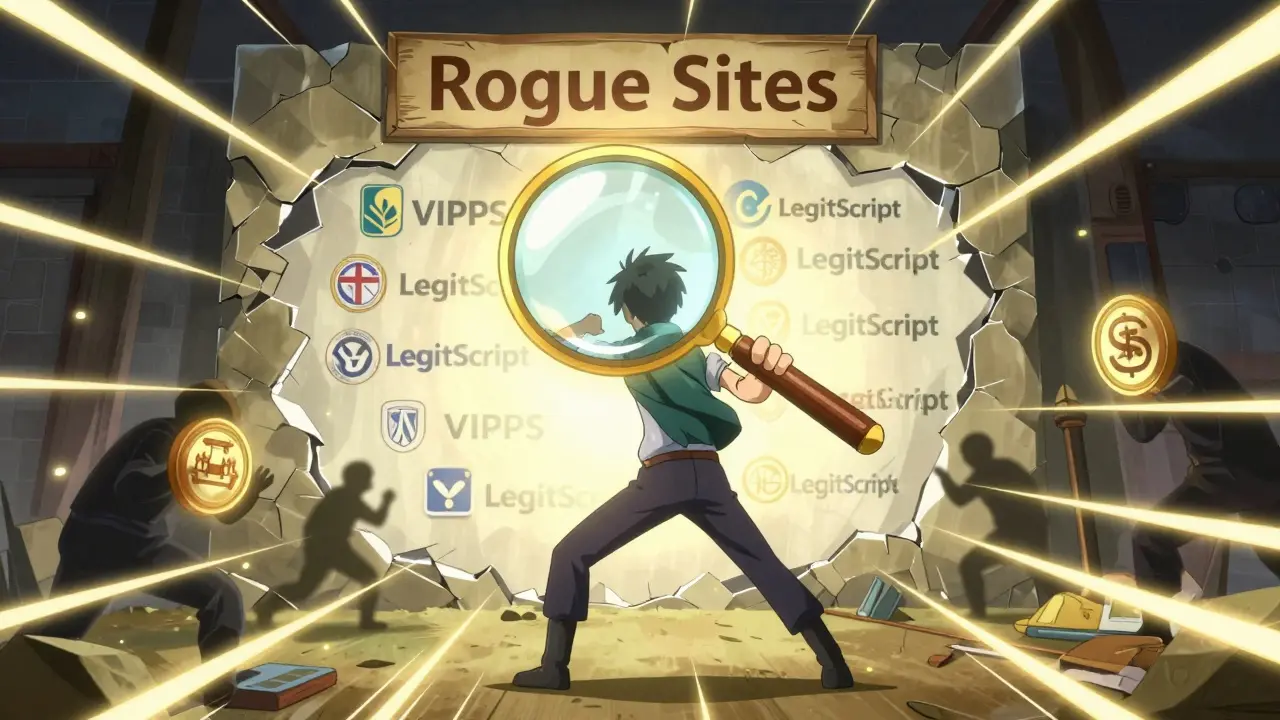
Rogue operators know that trust is currency. To mimic legitimacy, many fake pharmacies display logos from reputable organizations like VIPPS, LegitScript, or the GPhC. But here is the catch: these seals are often just images. They are not clickable links to the official verification database.
In the JMIR study, 41.8% of rogue sites displayed counterfeit accreditation logos. Never trust a logo alone. Always click the seal. It should take you directly to the accrediting body’s website (e.g., vipps.nabp.pharmacy) where you can independently verify the pharmacy’s status. If the link breaks, goes to a generic page, or doesn’t exist, it is a fake.
How to Verify a Pharmacy: Step-by-Step Guide
Don’t guess. Verify. Here is how to ensure your online pharmacy is safe, depending on your location:
- In the United States: Look for the VIPPS seal. Visit vipps.nabp.pharmacy and search the pharmacy’s name. Only VIPPS-accredited pharmacies meet strict federal and state standards. As of 2021, only 68 pharmacies held this status nationwide.
- In the United Kingdom: Check the General Pharmaceutical Council (GPhC) register. You can search by registration number, trading name, or postcode. If the pharmacy is not on this list, it is illegal to practice in the UK.
- In the European Union: Look for the mandatory EU common logo. Clicking this logo must redirect you to a government verification page showing the pharmacy’s authorization status. If the logo is missing or doesn’t work, avoid the site.
- Global Check: Use LegitScript’s verification tool. While not a government body, LegitScript is widely respected in the industry for identifying compliant vs. non-compliant sites.
The Hidden Dangers of Counterfeit Medications
Why do rogue pharmacies persist? Because they exploit vulnerability. During the 2022 infant formula shortage, 62% of investigated rogue sites sold unauthorized or counterfeit products. They prey on desperation.
The consequences are severe. The FDA has documented cases where medications from rogue sources contained:
- Wrong Ingredients: Substituting cheaper chemicals that cause adverse reactions.
- Incorrect Dosages: Too little means the disease progresses; too much causes toxicity.
- Harmful Contaminants: Mold, heavy metals, or bacteria introduced due to poor manufacturing hygiene.
Dr. Sarah Almomani, lead author of the 2023 NIH study, warned that rogue pharmacies create "substantial patient safety risks" by bypassing essential consultations. Gareth Jones of the UK’s National Pharmacy Association added that while the commercial impact might seem small, the impact on patients is "much more worrying."
Comparison: Legitimate vs. Rogue Online Pharmacies
| Feature | Legitimate Online Pharmacy | Rogue Online Pharmacy |
|---|---|---|
| Prescription Requirement | Required for all POMs | Not required (98.2% of cases) |
| Physical Address | Verifiable, matches server location | Missing, fake, or mismatched (67.7%) |
| Pharmacist Access | Licensed pharmacist available for consultation | No pharmacist available (93.1%) |
| Pricing | Competitive but realistic | Extremely low/too good to be true (76.4%) |
| Accreditation | Valid VIPPS/GPhC/EU Logo with clickable verification | Fake seals or none (41.8% fake seals) |
| Shipping | Often restricted to local jurisdiction | Ships worldwide (84.6%) |
Why Search Engines Fail You
You might wonder why these dangerous sites appear so high in Google searches. Unfortunately, search engine algorithms sometimes prioritize rogue pharmacies over legitimate ones. A 2022 report noted that algorithm updates negatively impacted many reputable sites, allowing illegitimate pharmacies to outrank established businesses. Additionally, rogue operators spend heavily on social media advertising and spam emails (sent by 68.9% of rogue sites) to drive traffic.
Do not rely on ad placement or search ranking as proof of legitimacy. Always perform manual verification using the methods above.
What To Do If You’ve Already Bought From a Rogue Site
If you suspect you have purchased medication from an unverified source, stop taking it immediately. Do not flush it down the toilet. Instead:
- Save the Packaging: Keep the pills, bottle, and any documentation. These are evidence.
- Contact Your Doctor: Explain what you bought and any symptoms you are experiencing. They may order blood tests or scans to check for toxicity.
- Report It: In the US, report to the FDA MedWatch program. In the UK, report to the GPhC or NHS. Reporting helps authorities shut down these operations.
Your vigilance protects not just you, but others who might fall into the same trap. The line between convenience and danger is thin when buying medicine online. Stay informed, verify every detail, and never compromise on safety for a lower price.
What is the safest way to buy prescription drugs online?
The safest way is to use a pharmacy accredited by a recognized regulatory body. In the US, look for VIPPS accreditation via the NABP. In the UK, check the GPhC register. In the EU, ensure the site displays the clickable common logo. Always require a valid prescription from your doctor and verify the pharmacy’s physical address and pharmacist availability.
Are online pharmacies legal?
Yes, legitimate online pharmacies are legal and regulated. However, many rogue online pharmacies operate illegally by bypassing prescription requirements and safety regulations. It is crucial to distinguish between the two by verifying accreditation and checking for red flags like missing contact info or unrealistically low prices.
Can I trust an online pharmacy that doesn't ask for a prescription?
No. Any online pharmacy that sells prescription-only medications (POMs) without requiring a valid prescription from a licensed doctor is operating illegally and is considered a rogue pharmacy. Studies show that 98.2% of such sites are rogue operations posing significant health risks.
What are the signs of a counterfeit medication?
Signs include pills that differ in color, shape, size, or taste from previous doses. Other indicators are broken seals, misspellings on packaging, or unusual odors. Counterfeit drugs may also contain harmful contaminants or incorrect dosages, leading to unexpected side effects or lack of efficacy.
How do I report a rogue online pharmacy?
In the US, you can report suspicious pharmacies to the FDA MedWatch program or the National Association of Boards of Pharmacy (NABP). In the UK, report to the General Pharmaceutical Council (GPhC). Providing details like the website URL, screenshots, and product information helps authorities investigate and shut down illegal operations.
Is it safe to buy generic medications from online pharmacies?
Generic medications are safe and effective when purchased from legitimate, accredited online pharmacies. They must meet the same rigorous standards as brand-name drugs. However, buying generics from rogue pharmacies is risky, as these sites may sell counterfeit versions with incorrect ingredients or dosages.
Why are rogue online pharmacies so common?
Rogue pharmacies thrive due to high demand for affordable medications, weak cross-border enforcement, and sophisticated deception tactics. They often use fake accreditation seals and aggressive marketing to appear legitimate. Additionally, search engine algorithms sometimes inadvertently promote these sites over regulated ones.