
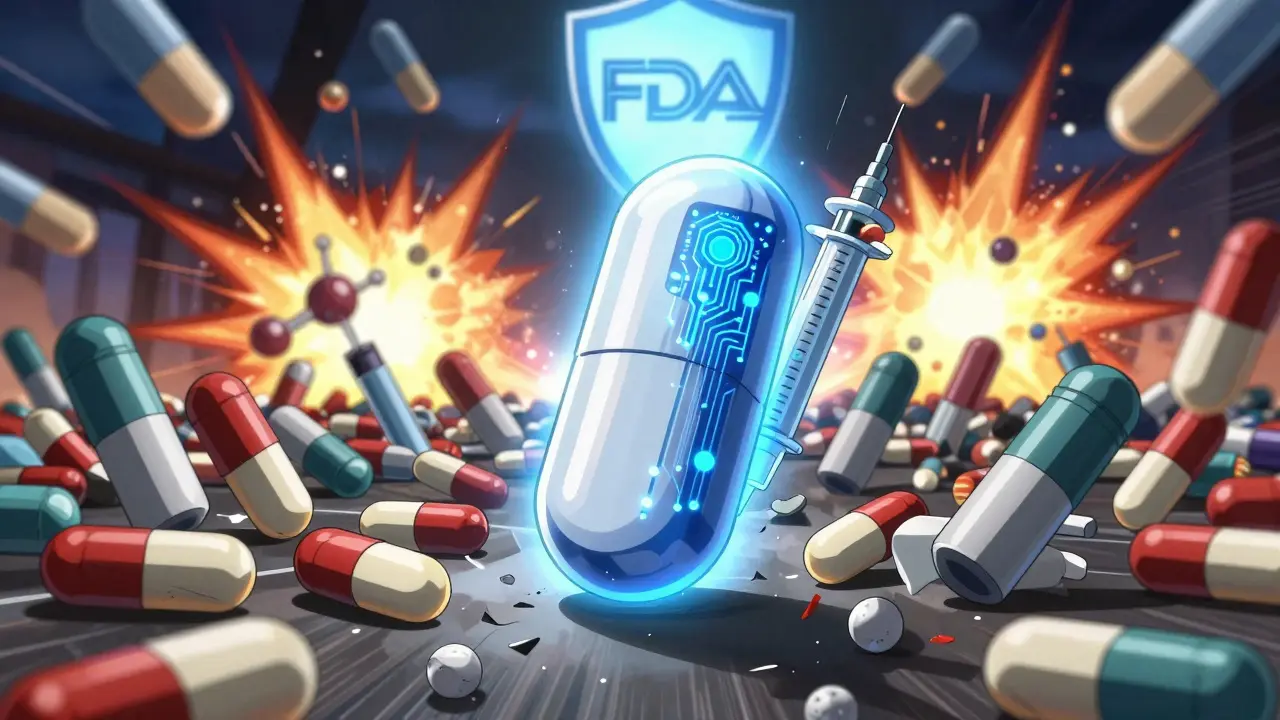
Generic drugs used to be simple: copy the brand, cut the price, sell more. But that’s not enough anymore. The future of generics isn’t in making more of the same-it’s in making better versions. These aren’t just copies. They’re generic combinations: smarter, more complex products that combine drugs, devices, or delivery systems to improve how patients take medicine and how well it works. This shift isn’t optional anymore. It’s the only way generic manufacturers can survive in a market where price cuts are eating away at profits and patients demand more from their treatments.
What Exactly Are Generic Combinations?
Generic combinations aren’t your grandfather’s generics. They’re fixed-dose combinations (FDCs), drug-device systems like auto-injectors or inhalers, or modified-release pills that control how a drug enters your body. Think of them as upgrades. Instead of taking three separate pills for high blood pressure, a single pill combines three drugs in the right doses. Or instead of using a separate inhaler and spacer, you get one device that does both. These aren’t new drugs-they’re smarter ways to deliver existing ones.The FDA defines these as combination products when they mix a drug with a device or change how the drug behaves in the body. That’s where things get complicated. A simple FDC like a pill with two blood pressure drugs is easier to approve. But a device that delivers a precise dose of insulin through a needle you activate with one click? That’s a whole different ballgame. The FDA’s Office of Combination Products has to decide whether the drug or the device is the main part of the product-and that affects the entire approval process.
Why the Market Is Moving Fast
Between 2025 and 2030, over $220 billion in annual sales from branded drugs will lose patent protection. That’s a massive opportunity. But here’s the catch: if generic companies just copy the original pills, they’ll get crushed by price wars. We’ve seen it before. A brand-name statin might sell for $100 a month. Within two years, 20 generic versions flood the market, and the price drops to $3. Margins vanish.Generic combinations change the game. Take the example of bupropion, an antidepressant. The original branded version, Wellbutrin XL, sold for $187 million a year before generics came in. When simple generics arrived, total sales dropped to $42 million. But when Teva launched Budeprion XL-an extended-release version with a different release profile-it kept strong sales because it wasn’t just a copy. It was an improvement. That’s the power of a super generic.
Now, look at Trelegy Ellipta, a respiratory combo with three drugs in one inhaler. It made $2.8 billion in 2024. Generic versions of this aren’t just possible-they’re inevitable. But making them? That requires advanced manufacturing, precise testing, and years of development. The reward? Companies can hold onto 40-60% of the original price for five years or more. Compare that to traditional generics, which lose 80-90% of their price in two years.
Regulatory Hurdles Are Getting Real
The FDA doesn’t treat these like regular generics. A standard ANDA (Abbreviated New Drug Application) for a simple pill might take 18 months. A complex combination? That’s 3-4 years. Why? Because regulators need to prove the product works the same way as the brand, even if it’s delivered differently. For an inhaler, they don’t just check if the drug is there-they test how well it reaches the lungs. For a modified-release pill, they need to match the exact timing of drug release across different patients.According to FDA data from 2024, 78% of combination product rejections come from problems with delivery systems, not the active ingredients. That means a company can get the chemistry perfect, but if the device doesn’t release the drug correctly, it gets rejected. The European Medicines Agency (EMA) is even stricter. Through early 2025, the U.S. approved 37 complex combination products. The EU approved only 12. That gap isn’t accidental. It’s policy. U.S. regulators are trying to keep pace with innovation. Europe is moving slower, prioritizing caution.
In October 2025, the FDA launched a pilot program to fast-track reviews for combination products made entirely in the U.S. That’s a big deal. It could cut approval time by 3-6 months. Why? Because U.S. manufacturing is seen as more reliable, with better quality control. This isn’t just about speed-it’s about trust.

Who’s Winning and How
The players in this space aren’t small generics anymore. They’re big, focused companies with deep pockets and technical expertise. Viatris, formed from the merger of Mylan and Pfizer’s generics division, now has a dedicated team for complex products. Sandoz, after spinning off from Novartis, restructured to focus almost entirely on high-value generics. In Q2 2025, Viatris and Credence merged for $2.3 billion-just to get better at making these products.Manufacturers are also teaming up with device companies. Catalent, a leader in drug delivery tech, is working with Hikma to build auto-injectors for diabetes drugs. Aspen Pharmacare is developing generic versions of semaglutide combinations-targeting the $100 billion GLP-1 market. These aren’t random bets. They’re strategic plays. The companies that win will be the ones who can handle the science, the manufacturing, and the regulatory maze.
Therapeutic Areas Leading the Charge
Not all drug classes are equal in this race. Some are perfect for combinations. Oncology is growing fastest, at 11.3% CAGR. Why? Because cancer treatments often need multiple drugs working together. A single pill combining two kinase inhibitors could reduce side effects and improve adherence. Respiratory comes second, at 9.9% CAGR. Inhalers are ideal for combinations-imagine a single device that delivers both a bronchodilator and an anti-inflammatory. CNS disorders like Parkinson’s and bipolar disorder are also big targets. Drugs like Austedo (deutetrabenazine) for movement disorders are complex, expensive, and perfect for generic upgrades.Meanwhile, simple oral FDCs-like two blood pressure pills in one-still make up 62% of the market. But they’re growing slowly, at just 5.2% per year. The real growth is in the complex stuff: drug-device combos (9.8% CAGR) and super-complex systems like nanoparticle delivery (12.7% CAGR). These are the future. They’re harder to make, but they pay better.

The Global Picture
The U.S. leads in both innovation and market size, with 42% of global sales. Why? Reimbursement policies favor higher-value products. Medicare and private insurers will pay more for a combo that reduces hospital visits or improves compliance. India, meanwhile, is the manufacturing engine. It produces 35% of the world’s complex generics, thanks to low costs and skilled chemists. But India’s regulatory system still lags behind the U.S. and EU in complexity. So while Indian companies make the products, they often export them to the U.S. or Europe for approval.China and Southeast Asia are catching up fast, but regulatory uncertainty and quality concerns still hold them back. The global market for super generics is expected to hit $474.6 billion by 2035. That’s more than double today’s value. But it won’t happen unless companies keep investing in better science, better manufacturing, and better regulation.
What’s Next?
Three trends will define the next decade:- The complexity premium-products with multiple innovations (drug + device + modified release) will command 2-3 times the price of a basic generic.
- Regional divergence-the U.S. will keep moving faster than Europe and Asia. Companies will need separate strategies for each market.
- Partnerships over competition-pharma companies will team up with device makers, contract manufacturers, and even tech firms to build the next generation of products.
But there’s a risk. If too many companies rush into this space without the science to back it up, we could see safety issues. Dr. Aaron Kesselheim from Harvard warned in 2025 that the definition of "therapeutic equivalence" for complex generics is still unclear. If a generic version doesn’t work the same way in real patients-even if it passes lab tests-patients could suffer.
That’s why the FDA’s pilot program and ICH Q14 guidelines (finalized in June 2025) matter so much. They’re trying to create clear, science-based standards so companies know exactly what’s needed. This isn’t just about profit. It’s about patient safety.
For patients, the future looks better. Fewer pills. Fewer injections. Better control of chronic conditions. For manufacturers, it’s a race to build the smartest, most reliable versions of old drugs. The ones who get it right won’t just survive-they’ll lead.
What’s the difference between a regular generic and a generic combination?
A regular generic copies the exact drug and dosage form of the brand-name product. A generic combination improves on it-by combining two or more drugs in one pill, adding a delivery device like an inhaler or auto-injector, or changing how the drug is released in the body. These changes aim to improve effectiveness, safety, or patient adherence.
Why are generic combinations more expensive to develop?
Developing a generic combination can cost $15-$50 million and take 4-7 years, compared to $1-$5 million and 2-3 years for a simple generic. That’s because they require advanced formulation tech, specialized manufacturing equipment, and more clinical data to prove they work the same as the brand-especially when a device or delivery system is involved.
Are generic combinations safe?
Yes, if they’re approved properly. The FDA and EMA require rigorous testing to prove they’re therapeutically equivalent to the brand. But there’s concern that the standards for complex products aren’t fully defined yet. Some experts warn that without clear guidelines, a product might pass lab tests but still behave differently in real patients.
Which countries are leading in generic combinations?
The U.S. leads in market size and regulatory innovation, approving 37 complex combination products by early 2025. India is the top manufacturing hub, producing 35% of the world’s complex generics. The EU is more cautious, approving only 12 in the same period. China and Southeast Asia are growing but still face regulatory and quality challenges.
Will generic combinations replace all traditional generics?
No. Simple generics will still dominate high-volume, low-cost drugs like statins or antibiotics. But for chronic conditions where adherence and precision matter-like diabetes, COPD, or mental health-generic combinations will take over. By 2030, they’re expected to make up 35-40% of the total generics market value, even if they’re only 15-20% of the number of pills sold.
Nancy Kou
December 20 2025Finally someone gets it. Generics aren’t about cutting corners anymore-they’re about building better tools for patients. I’ve seen elderly relatives struggle with five pills a day. One combo inhaler? Game changer. No more forgotten doses, no more confusion. This is healthcare evolution, not just cost-cutting.
Hussien SLeiman
December 22 2025Let’s be honest-this whole ‘super generic’ narrative is corporate fluff dressed up as innovation. The real story is Big Pharma’s attempt to extend monopolies under a new label. If a drug’s active ingredients are identical, calling it a ‘combination product’ doesn’t magically make it superior. The FDA’s pilot program? Just a backdoor subsidy for U.S. manufacturers to keep prices high while pretending they’re helping patients. Don’t be fooled.
William Storrs
December 22 2025This is exactly the kind of shift we need. Too many people think generics = cheap and lazy. But look at what’s happening with insulin auto-injectors or CNS combos-these aren’t just copies, they’re life improvements. Patients take fewer pills, have fewer side effects, and stick with treatment longer. That’s not just smart business-it’s human-centered care. Kudos to the teams building this stuff.
James Stearns
December 24 2025It is imperative to underscore the profound regulatory incongruities that currently persist within the global pharmaceutical landscape. The FDA's expedited pathway for domestically manufactured combination products constitutes a form of protectionist policy that undermines the principles of equitable international trade. Furthermore, the implicit assumption that U.S. manufacturing is inherently superior lacks empirical substantiation and risks fostering complacency in quality assurance standards abroad.
Nina Stacey
December 25 2025im reading this on my phone at 2am after my dad took his combo pill for diabetes and i just cried a little. he used to forget half his meds and now he just clicks one device and its done. no more pill organizers, no more arguing. this isnt just science its real life. the companies doing this deserve more than just profits they deserve hugs
Frank Drewery
December 25 2025That point about India being the manufacturing engine but lagging in regulation is spot on. I’ve worked with labs there-they’ve got the chemists, the precision, the cost advantage. But when it comes to validating delivery systems, the documentation is often thin. The U.S. doesn’t just approve faster because it’s better-it’s because it demands more data. That’s why the $15M+ development cost makes sense. You’re not just making a pill-you’re engineering a system.
Danielle Stewart
December 27 2025Can we talk about how wild it is that a single inhaler like Trelegy makes $2.8B and the generic version will still charge 40% of that? That’s not a ‘super generic’-that’s a monopoly by another name. The real win here isn’t patient adherence-it’s shareholder returns. We’re just swapping one brand loyalty for another, wrapped in fancy tech.
mary lizardo
December 29 2025The notion that complex generics are ‘better’ is dangerously misleading. Therapeutic equivalence cannot be reliably demonstrated for drug-device combinations without decades of real-world outcomes data. The FDA’s pilot program is a regulatory gamble-prioritizing speed over safety. When a patient suffers because a modified-release tablet failed to dissolve consistently, no one will blame the FDA. They’ll blame the ‘generic.’ And that’s unacceptable.
jessica .
December 29 2025U.S. manufacturing is more reliable? LOL. All these ‘combination products’ are made in China and shipped here. The FDA’s pilot program is just a PR stunt to make Americans feel safe. Meanwhile, our insulin prices are still sky-high because Big Pharma owns the patents on the devices. This isn’t innovation-it’s a scam.